

Bitcoin erases 2025 gains as investors fret over the macro environment
As at Nov 20, cryptocurrency’s value is 2.4% lower than that at the start of the year

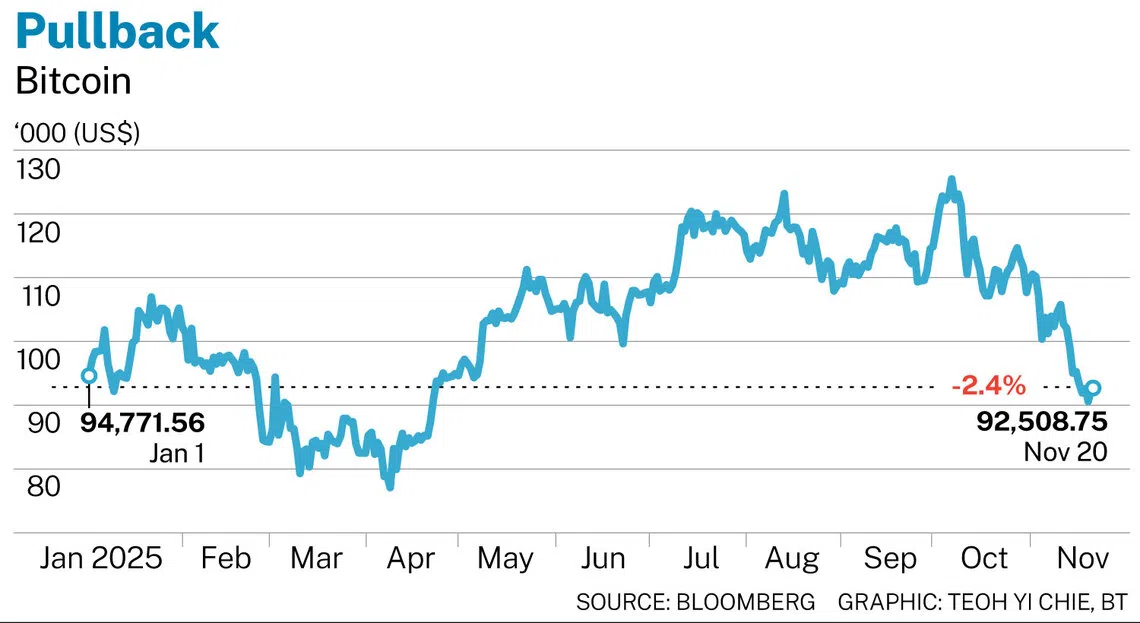
[SINGAPORE] Bitcoin’s correction has erased the gains it made in 2025, just over a month after it hit a new record. Analysts attributed the decline to investor concerns over the US economy and the wider macro environment.
Bitcoin surged this year after President Donald Trump passed pro-crypto legislation. On Oct 6, the cryptocurrency hit an all-time high of US$126,251.
On Tuesday (Nov 18), it fell below US$90,000, technically entering a bear market, according to market observers.
As at Thursday, Bitcoin – the largest cryptocurrency by market capitalisation – was at US$92,508.75, 2.4 per cent lower than the US$94,771.56 at the start of 2025.
On Wednesday, Bloomberg reported that Bitcoin’s slide has spurred record-high withdrawal from Bitcoin exchange-traded fund (ETF) iShares Bitcoin Trust (IBIT). Bloomberg data suggested that there were US$523 million in outflows from the ETF the day before, making it the highest outflow on record.
Prices of IBIT were 8.4 per cent lower in the year to date as at Wednesday.
Deribit’s chief commercial officer Jean-David Pequignot pointed out that the correction in Bitcoin prices has not only erased the 2025 gains, but also removed “critical long-term support”.
He added that the next downside levels to watch would be at US$83,000 to US$85,000 as a potential confirmation zone.
Rachael Lucas, crypto analyst at BTC Markets, said: “Technically, this puts us in a bear market.”
Macro uncertainty
Pequignot noted that macro uncertainty is fuelling the decline in Bitcoin prices, pointing out that the odds of a cut in US interest rates in December have dropped to approximately 50 per cent, from nearly 70 per cent earlier in November.
This fall in the odds reflects sticky inflation, mixed labour signals and a data backlog after the government shutdown, he added.
Edward Carroll, head of MHC markets at digital assets platform MHC Digital Group, said: “With markets now expecting fewer (US Federal Reserve) cuts, some of the short-term ‘cheaper money’ thesis around Bitcoin has unwound.”
He believes that the Bitcoin sell-off is not a “crypto-specific story”, but is a trend that reflects the global funding system.
Most market observers agreed that because of the cryptocurrency’s reactive nature, it has adjusted to the liquidity stress sooner than traditional markets.
What next?
Despite the paper losses, on-chain data suggests that “whales” – owners of large amounts of Bitcoin – are taking the opportunity to snap up more of the cryptocurrency.
Pequignot from Deribit noted that the increase in whale accumulation hints that there is “smart-money accumulation at undervalued levels”.
Data from cryptocurrency exchange Independent Reserve suggested that one such large transaction was done by Bitcoin accumulator Strategy, which purchased 8,178 Bitcoin for US$835.6 million at approximately US$102,171 per coin.
The pullback in price does not mean that there is a break in cryptocurrency fundamentals. Instead, it reflects tight funding conditions and shifting rate expectations, observed Carroll.
He added that institutions will likely see more opportunities with the low prices of Bitcoin.
“ETF flows, rising stablecoin market caps and increased derivatives hedging all point to crypto’s growing maturity,” he said, noting that dips in prices that are driven by liquidity and positioning are often entry points.
“Once the liquidity cycle turns, we expect digital assets to rebound first, just as they have after every major intervention over the past decade.”
TRENDING NOW

Philippine power giant First Gen rebuffs foreign offers, plans up to US$2.6 billion in expansion

Cliff Tan has 7 million followers and a 4-month waitlist. Why won’t he expand his business?

Could stablecoins be the future of money?

From finance aspirant to Asean CEO: TUV SUD’s Jonas Strahberger on finding people who believe in you

