‘Bringing Asean together as a single market’: PM Wong
He also notes at DBS forum with the bank’s CEO Tan Su Shan how firms can manage AI’s impact on jobs and operations
[SINGAPORE] For South-east Asia to continue attracting investments, the challenge lies in bringing Asean together as a single market, while encouraging entrepreneurship and innovation, said Prime Minister Lawrence Wong.
“We really have to harness the benefits of a single market, which we don’t have today,” he said.
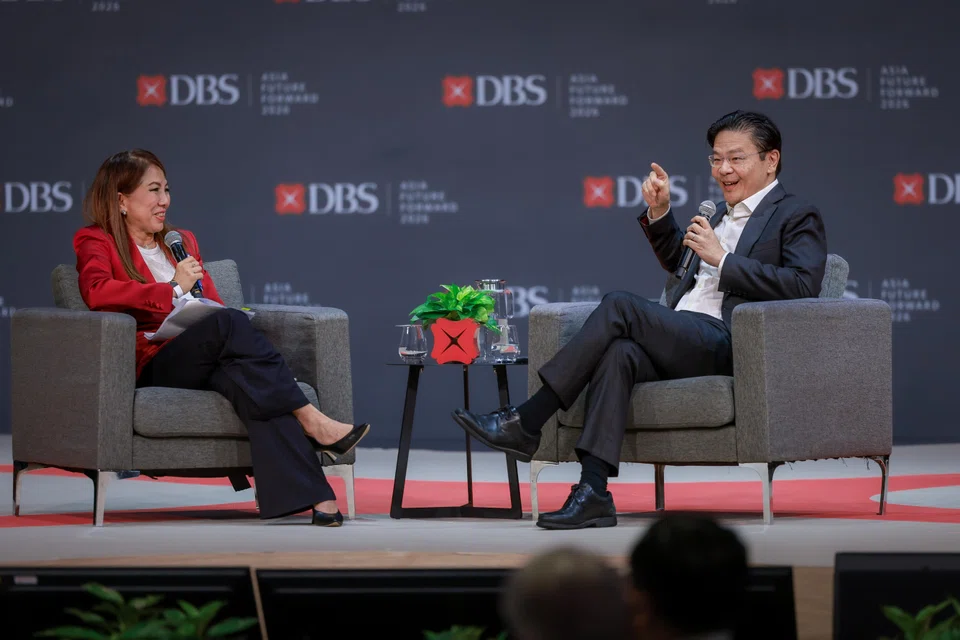
PM Wong was speaking at a dialogue with DBS CEO Tan Su Shan at the DBS Asia Future Forward Conference held at the Suntec Singapore Convention & Exhibition Centre on Monday (Oct 12).
They discussed a range of topics, from how to responsibly manage the impact of artificial intelligence on jobs, to encouraging liquidity, confidence and interconnectedness in Asia’s capital markets.
In response to a question on Asean’s separate markets, PM Wong said: “We are like Europe, but in fact, even further behind because the complexity of operating in South-east Asia is far greater than in Europe.”
However, he noted that every challenge presents an opportunity for Asean to integrate its economies more closely.
“With all these ingredients, with innovation, entrepreneurship, with a single market, hopefully we can see more successes and a larger and more successful capital market in South-east Asia too.”
PM Wong and DBS’ Tan also discussed how a key driver of this integration will be the digital economy.
He noted that as Asean strengthens its regional digital frameworks, it must remain globally connected.

The approach, he said, is “not to develop a closed system, not to just have an exclusive digital system with one country, but to keep an open system that allows us to connect with many different layers”.
He noted that the Asean Digital Economy Framework Agreement (Defa), which is set to be signed in November at the 49th Asean Summit, is an attempt to make the region’s digital economy “work better”.
“I think many businesses operating in the region know that it is fragmented now; that you have different rules, systems (and) different requirements across Asean countries... and so it can be very frustrating.”
While PM Wong recognised the potential for Defa to facilitate more data flows and cross-border digital trade, he said that it is “not a magic switch”.
“It’s a first but important step, and there’s still a lot of work to be done to translate the agreement into practical benefits for companies,” he said. He cited the example of enabling companies to engage customers and scale across the region more seamlessly as well as facilitating cross-border payments with less friction and lower costs.
“That’s our ultimate goal; and next year, when Singapore takes on the chair of Asean, we will look at how we can give some priority to some of these initiatives.”
Managing AI’s impact on jobs
PM Wong noted that the rate of adoption of AI differs among Asian economies.
“Some are moving more decisively, and they are harnessing AI well, and they are benefiting from the changes. Others are moving more slowly and not benefiting as much,” he said. “And over time, I think these differences will matter.”
In terms of how Singapore is managing the impact of AI on jobs, PM Wong said that while the Republic’s focus on reskilling and upskilling workers might be “the harder road... it’s also the more sustainable road”.
He added: “We are not saying zero retrenchments, not at all. We are recognising that from time to time, if a company has to automate and embrace technology, some retrenchments may happen.”
He urged companies to manage the transition responsibly. “Do it properly, be fair to the workers, give the workers advance notification, so that then the unions can come in, and they can help the workers retrain and get new jobs,” he said.
He added that the government is expanding support programmes to aid the transition.
Beyond the impact of AI on jobs, PM Wong also highlighted a shift in how companies manage their operations and supply chains. The era of hyper-efficiency, he suggested, is giving way to a need for buffers.
“You cannot operate on the basis of just in time and efficiency all the time,” he said. “You have to have resilience, and that costs something, and you have to factor that into the cost of doing business these days.”
Decoding Asia newsletter: your guide to navigating Asia in a new global order. Sign up here to get Decoding Asia newsletter. Delivered to your inbox. Free.
Copyright SPH Media. All rights reserved.