Malaysian glove makers poised for US growth but broader tariffs may upend optimism
They may also face stiffer competition as Chinese rivals pivot from the US to markets in Europe and Asia, add analysts

MALAYSIAN glove makers were poised to capture the United States market, after Chinese gloves were slapped with higher tariffs, but the return of a Donald Trump presidency could pose a stumbling block in 2025.
This is as Trump signalled that he aims to raise global tariffs once he is inaugurated as US president on Jan 20, regardless of the origin of the goods.
In addition, Chinese brands which have pivoted away from the US are now zeroing in on other markets in Europe and Asia, adding another hurdle for Malaysian glove manufacturers, analysts noted.
The glove companies’ financial results have generally improved since the start of 2024, as customers looked to replenish their inventories after depleting their stockpiles from the Covid-19 pandemic.
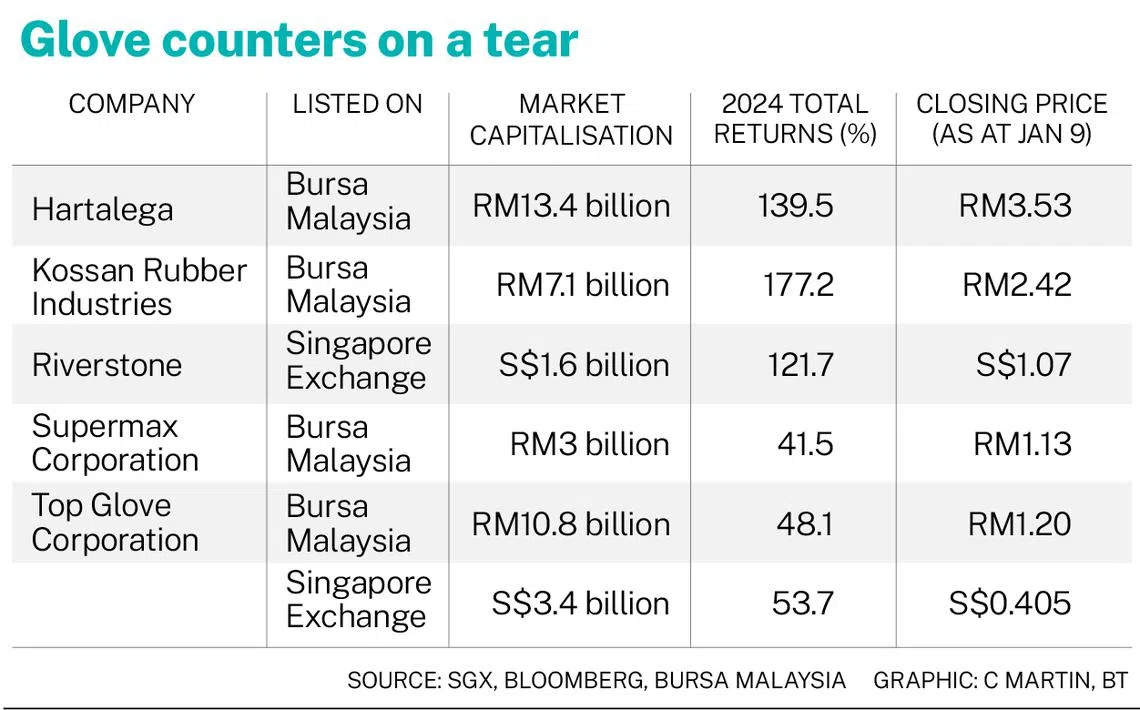
Top Glove Corporation , listed in both Singapore and Malaysia, narrowed its audited losses for the full year ended Aug 31, 2024, to RM64.9 million (S$19.7 million), from RM925.2 million a year ago.
In the first quarter of its 2025 fiscal year, the company swung back into the black with a profit of RM5.5 million, reversing from a loss of RM57.7 million in the corresponding year-ago period.
Riverstone , which specialises in cleanroom and healthcare gloves, posted a profit of RM216.9 million for the nine months ended Sep 30, 2024, 41.9 per cent higher than RM152.9 million in the same period a year ago.
Bursa Malaysia-listed peers, such as nitrile glove maker Hartalega and rubber glove manufacturer Kossan Rubber Industries, also announced increases in earnings.
In tandem with earnings gains, share prices have increased as well. UOB Kay Hian (UOBKH) analyst Jack Goh told The Business Times: “In 2024, domestic glove makers’ share prices surged around 46 to 53 per cent after respective quarterly results signalled meaningful business recoveries.
“The steep share price action reflects optimistic sentiment on the sector’s turnaround narrative.”
Diverting orders
Following a decent 2024, a new catalyst in 2025 could bolster the sector further, said analysts.
In September last year, the Office of the United States Trade Representative announced that Chinese-made medical and surgical gloves will receive a steep hike of 50 per cent in 2025 and 100 per cent in 2026, from 7.5 per cent in 2024.
OCBC Investment Research analyst Donavan Tan said that Malaysia has historically been a dominant player in the global gloves market, exporting more than one-third of its production to the US, but has lost market share to Thai and Chinese competitors.
“The new US tariffs on Chinese gloves are expected to further weaken China’s position in the global market, thereby enhancing Malaysia’s competitive advantage,” he noted.
In a December report, AmInvestment Bank (AmBank) analyst Liew Jin Sheng said: “We see US customers diverting their orders from China to non-Chinese manufacturers, benefiting Malaysian glove players.”
He pointed out that both Top Glove and Hartalega “have started to see some signs of orders diversion, (leading) to huge volume growth ahead of the imposition of the import tariff”.
Lim Jin Feng, Top Glove’s head of marketing, said in an earnings briefing that US inquiries are “coming back” since the tariff announcement. “Many of these are past customers that, in the past one or two years, may have moved many of their orders to China suppliers.”
Citi analyst Megat Fais said that Hartalega similarly recorded a pickup in volume in November last year.
At the group’s Q2 earnings briefing, its management guided for its Q3 volume to be at seven billion to 7.5 billion, implying another quarter-on-quarter pickup at midpoint, he added.
Maybank analyst Wong Wei Sum said that higher tariffs on Chinese gloves are a “major industry game changer”.
“Average selling prices are expected to improve to US$21 to US$23 per thousand pieces in Q4 FY2024 to FY2025, based on our estimate,” he said, adding that this price would still make Malaysian-made gloves cheaper than their Chinese peers for customers in the US. This would result in improved margins for Malaysian glove makers, as well as higher US market share, he noted.
Conversely, a January note by RHB analysts said that Malaysian glove makers appear to be “facing challenges in reaping the full advantage” of the tariffs on Chinese products, citing stiff pushback from US customers.
Most analysts also believe that the ongoing earnings recovery has been priced into the valuation of the companies’ counters on Bursa Malaysia after a recent stock rally.
Both AmBank’s Liew and Maybank’s Wong downgraded the Malaysian glove sector to underweight and neutral, respectively. RHB’s rubber products call was also lowered to neutral.
The Trump effect
Despite an optimistic view going into 2025, analysts highlighted some potential risks that could pull the rug from under the Malaysian gloves sector. The impending return of Trump to the White House is a concern, as the president-elect has pledged to slap a blanket tariff of 10 to 20 per cent on all imports.
AmBank’s Liew said that there is “uncertainty” surrounding US trade tariffs on all imported goods, which may be put in place to address “perceived unfair trade practices by foreign manufacturers and protect US workers and businesses”.
Maybank’s Wong explained: “Potentially higher tariffs under the Trump administration on Malaysia gloves could pose risks, as any import restrictions by the US or additional tariffs could undermine the growth trajectory of Malaysia’s glove sector and erode its competitiveness in the US market.”
However, UOBKH’s Goh added that the bottom line impact to Malaysian glove makers from the global tariffs will be limited. “Factoring in the 50 to 100 per cent tariffs imposed on China medical gloves in 2025 and 2026, the pricing gap between Malaysia and China producers for US exports is still wide,” he said.
Hong Leong Investment Bank analyst Chee Kok Siang said: “In any case, should (Trump) impose a baseline tariff of 10 to 20 per cent, we reckon Malaysia glove manufacturers are still able to pass (this on) to US glove distributors.”
In response to questions on Trump tariffs, Top Glove’s executive chair Lim Wee Chai indicated that this is an external factor that “is out of our control”.
He nonetheless believes that tariffs on goods of Chinese origin will still be higher than tariffs on imports from other countries, even if such duties increase across the board.
Exacerbating oversupply
Another possible challenge for Malaysian glove makers could stem from the response from their Chinese peers to the higher US tariffs.
Maybank’s Wong noted these China-based brands have moved to divert US sales to non-US markets, starting in January 2025. This could be an issue for Top Glove, he said.
“Our concerns remain with Top Glove’s significant exposure to the non-US markets, which accounted for 82 per cent of its Q1 FY2025 sales volume,” he added.
In addition, Chinese glove makers have established production facilities outside of China, which could come online as soon as H2 FY2026, noted Wong. “In our view, glove makers should build up their war chest over the next two years before their China counterparts’ overseas expansion starts production.”
AmBank’s Liew said that China’s glove makers’ focus on markets outside the US to bypass the tariff “will further exacerbate the glove oversupply situation”.
However, Citi’s Megat believes that while Chinese players are producing goods outside China, “the pace of expansion could be gradual given the risk of tariffs being expanded to include offshore facilities”.
Hong Leong Investment Bank’s Chee said that it is still too early to price in “potential oversupply risks” that could arise from China diversifying to Indonesia, as there is “uncertainty surrounding Indonesia’s overall operating cost advantages compared to Malaysian competitors, along with the execution risks involved”.
Nonetheless, UOBKH’s Goh expects that 2025 will be a “year of delivery” for Malaysian glove makers. “Executions are very crucial for local glove makers this year, to ride on this earnings recovery pathway.”