Keppel eyes better market valuation as it sheds ‘conglomerate discount’
Ongoing transformation has improved earnings quality, says its chief executive

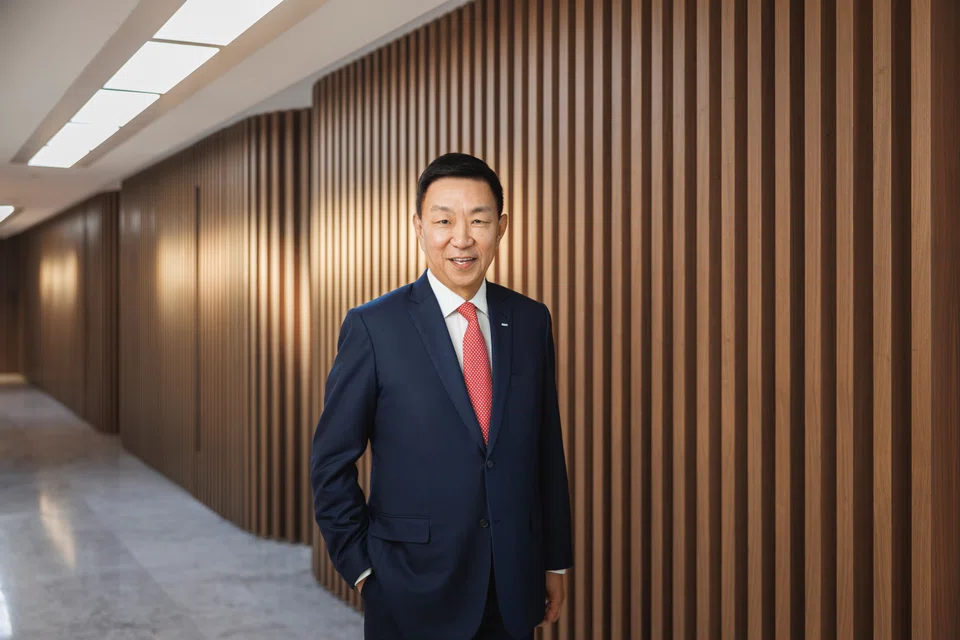
[SINGAPORE] Global asset manager Keppel is eyeing a better valuation from the market, as the company sheds the “conglomerate discount” with its ongoing transformation, said chief executive Loh Chin Hua.
“Keppel is no longer ascribed a conglomerate discount by most analysts covering us. As we strive to achieve our goals... we hope the market will ascribe an appropriate growth multiple to the new Keppel,” he said in the company’s annual report, released on Friday (Mar 28).
Keppel used to be known mainly as an offshore rig builder, property developer and infrastructure contractor with independent verticals, Loh noted. But it has since reshaped itself as an asset manager under the Vision 2030 strategy, launched five years ago.
Trading at 15.1 times earnings as at Thursday, the company now focuses on investment strategies including energy, environmental infrastructure, data centres and private credit.
“Importantly, we have demonstrated our ability to do more with less,” said Loh, noting that Keppel’s total assets fell by 14 per cent over the past four years to S$27.7 billion as at end-2024.
Since October 2020, the company has announced the monetisation of almost S$7 billion in assets, of which S$1.5 billion was announced in 2024. The divestment of Keppel Offshore & Marine would have added another S$4.7 billion, bringing Keppel’s total monetisation to S$11.7 billion to date.
Earnings quality
Loh believes that earnings quality has also “improved significantly”. Out of last year’s net profit from continuing operations, S$766 million, or 72 per cent, was recurring income. This is up from 21 per cent in FY2021.
“We have also shifted from being largely an engineering, procurement and construction player with lumpy earnings to providing technology, and operating and maintenance services,” he said.
Keppel’s largest profit contributor is now the infrastructure segment, where earnings rose by almost five times from S$137 million in FY2021 to S$673 million in FY2024.
Meanwhile, the company’s funds under management (FUM) has grown 2.4 times, from S$37 billion in 2020 to S$88 billion in 2024. In the same period, asset management fees rose at a compounded annual growth rate of 25 per cent to S$436 million.
The company’s connectivity segment has grown from a “subscale data centre and logistics player to a premier digital infrastructure provider”, said Loh. Earnings in the segment rose 2.5 times from S$74 million in FY2018 – before the privatisation of Keppel Telecommunications & Transportation and telco M1 – to S$184 million in FY2024.
“We have also expanded our data centre portfolio significantly, and ventured into new growth areas such as subsea cable systems,” said the chief executive, adding that M1 has evolved from a traditional telco into a “digital-first network operator”.
Future plans
Keppel aims to hit S$100 billion in FUM before the end of 2026, and S$200 billion by 2030. It is also focused on achieving more asset monetisation, with an interim target of S$10 billion to S$12 billion in 2026.
“We will also work hard at pivoting our real estate segment to be more asset-light, and driving the monetisation of our legacy offshore and marine assets,” said Loh.
He noted that the entity Asset Co owns “one of the most advanced” rig fleets, with about half of the rigs contracted and generating cash flows.
“Having full control of Asset Co and its S$1.1 billion cash helps us better manage and accelerate the monetisation of the legacy rigs,” said Loh.
Keppel will be placing the rigs and its stake in offshore vessel company Floatel – with a total carrying value of S$3.6 billion – into a private fund. This provides “flexibility to respond to opportunities, whether through sale or securitisation”, said Loh.
“A number of the rigs are already on bareboat charters. Our immediate task would be to put more of the rigs to work to generate cash flow, as we position ourselves for the further recovery of the offshore sector,” he added.