

Newly minted DBS CEO Tan Su Shan keeps eye on 15-17% ROE target
Piyush Gupta steps down after 15 years at the helm

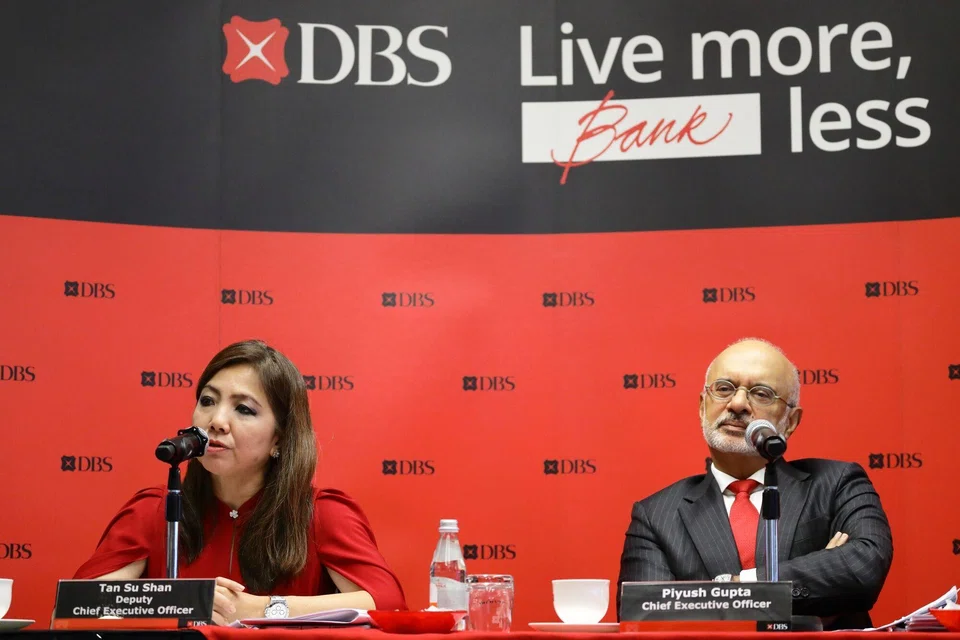
[SINGAPORE] DBS should be able to hit its return on equity (ROE) target of 15 to 17 per cent through its growth strategy in the years ahead, said the bank’s new chief executive, Tan Su Shan.
The target accounts for the four interest-rate cuts in 2024, as well as the lender’s expectations for another four reductions this year and next, said Tan at DBS’ annual general meeting (AGM) on Friday (Mar 28).
The AGM, which more than 1,500 shareholders attended, also marked the leadership transition of South-east Asia’s largest lender.
Piyush Gupta stepped down from the role of CEO at the end of the AGM, ending a 15-year tenure during which the bank reaped cumulative shareholder returns of almost 600 per cent.
Commenting on the ROE outlook, Gupta said that if interest rates stay closer to the 4 per cent range, DBS may be able to achieve returns of around 17 to 18 per cent.
The ROE may also get a boost if the bank succeeds in returning its excess capital to shareholders, he added.
Tan said that under her leadership, the focus will be on structural growth.
This means honing in on areas such as wealth management, the coverage of financial institutions, transaction banking, and treasury sales.
She also noted structural growth from intra-Asian trade, which should allow DBS to tap connectivity and trade flows in the region.
“We want to continue to be that transformative organisation,” she said. “We want to be nimble, we want to be agile, we want to adopt new technologies, but still balance the risk and resiliency agenda.”
Additionally, Tan – who previously ran DBS’ consumer banking and wealth management businesses, as well as its institutional banking division – noted opportunities for more connectivity within the bank across countries, segments, businesses and clients.
Regional growth strategy
The new CEO noted that DBS’ strong presence in Asia’s key financial hubs – Singapore and Hong Kong – allows it to attract regional clients, as well as family offices.
The bank also has a presence in India, China and Indonesia, granting it diversified access to some of the highest-growth and biggest markets in Asia, she added.
Gupta said DBS’ view is to have stronger on-the-ground efforts focused on the largest markets in the region, such as India, China, Taiwan, Indonesia and South Korea.
This would give the bank the best return on its endeavours, given that the effort and compliance work required to enter a smaller market match those needed when venturing into a big market, he said.
Nevertheless, the lender is still present in other markets in South-east Asia, he said.
Separately, Tan noted that the lender has completed around 3 per cent of its S$3 billion share buyback programme, which it announced alongside its third-quarter results in November 2024.
The bank will carry this plan out over three years to reduce its excess capital, with the repurchased shares cancelled.
In good hands
In a letter to DBS, its board and shareholders, as well as Gupta, Temasek CEO and executive director Dilhan Pillay noted the “highly effective partnership” between the outgoing chief executive and Peter Seah, chairman of the lender’s board.
They created “very significant value” not just for the bank and its franchise, shareholders and employees, but the financial services sector as well, Pillay said.
He also pointed out that during Gupta’s 15 years at the helm, DBS’ market capitalisation quadrupled to S$120 billion and its cumulative total shareholder return was nearly 600 per cent, or 12 per cent per annum.
Temasek is DBS’ largest shareholder, with 28.2 per cent of the shares, based on the bank’s 2024 annual report.
“It is commonly thought that a listed company should either be a dividend-yield company or a growth company, but during this period, DBS has proven that you can be both,” Pillay said in the letter, which was read out at the AGM.
He expects DBS to continue being in good hands – Seah’s and Tan’s – as he noted that Gupta had fostered a culture of innovation and diversity with meritocracy and purpose, leaving behind strong foundations for his successor.
TRENDING NOW

Could stablecoins be the future of money?

Once staunchly pro-China, Malaysian Chinese businesses are now distancing themselves from Beijing

Vietnam’s data-centre investment rush faces reality check on power and site constraints
‘My grandfather’s legacy’: Sherman Kwek lays out three-year plan for CDL to drive returns

