

Oilfield equipment specialist MTQ zeroes in on Middle East for ‘steady growth’
It will continue to press on in the traditional energy sector, while looking out for opportunities in renewables

Elysia Tan
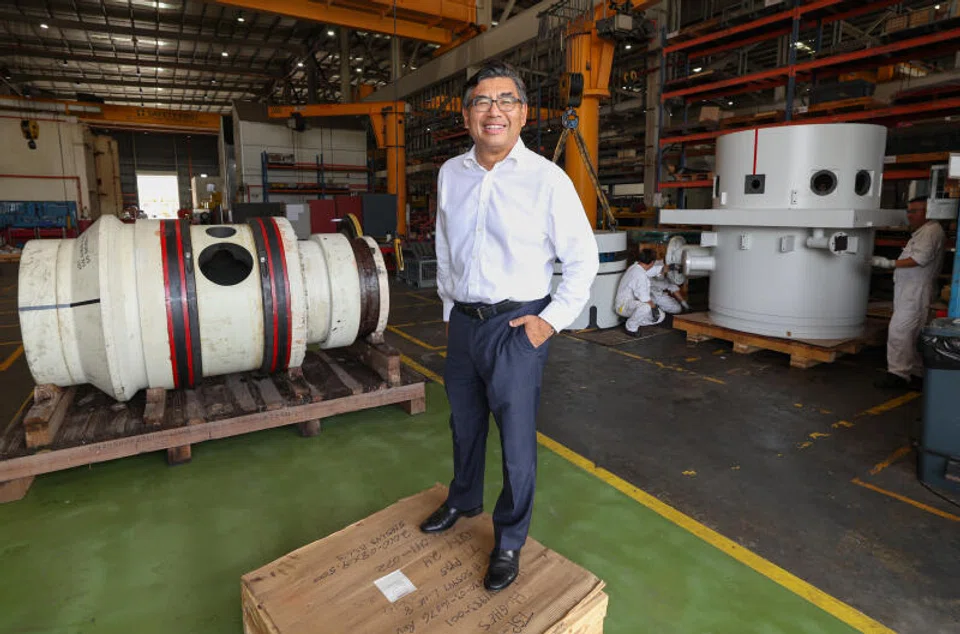
EVEN as renewable has emerged as the energy sector’s hottest buzzword, fossil fuels are still far from being relics of a bygone age – and remains MTQ Corporation’s best bet for growth.
“The glory days when everyone reported huge orders are probably over,” admitted Kuah Boon Wee, the engineering, repair and maintenance services group’s chief executive officer.
But MTQ capped off its 2023 financial year with the highest annual revenues recorded from its Bahrain segment since it moved into the Middle East over a decade ago.
The oilfield equipment services company is still focused on supporting players in the oil and gas sector. Specifically, it is training its sights on the Middle East.
Revenues were up to S$83.8 million for FY2023 ended March. This marked a 61.2 per cent jump from S$52 million in the preceding financial year, mostly driven by the continued pickup in Bahrain.
“Of course, you must embrace all the new activities in (the renewables) space, and we will do our part,” said Kuah. “But the conventional space needs to remain stable and steady, so that we can eventually all transition to a low carbon future… it’s not going to disappear overnight.”
In FY2023, the group reported a net profit of S$3.7 million, nearly trebling its S$1.3 million net profit in FY2022.
The headline-grabbing growth numbers posted in the last financial year are unlikely to be repeated, said Kuah, as they were boosted by pent-up demand in the pandemic years. Still, with the Middle Eastern boom, he said: “I do expect that there will be steady growth for us.”
Eyes on the price
In addition to increasing existing capacity, MTQ is considering a geographical expansion beyond Bahrain in the Middle East, potentially setting up plants in other countries. “There’s enough critical mass”, said the group CEO, considering the number of assets deployed.
Recently, the region has been a hub for oil activity, with national oil companies – that do not need to contend with the dearth of funding from banks in the “dirty” industry – leading the growth.
Middle Eastern national oil companies are “probably the biggest revenue contributors to their countries”, he noted.
In the 2022 fiscal year, Saudi Arabia, for example, recorded its first budget surplus in nearly 10 years, owing to the uplift provided by earnings from oil. The Saudi government’s oil giant, Aramco, reportedly earned a historic US$161.1 billion net income in FY2022.
“When the price of oil is reasonably high or reasonably attractive, then some form of investment and development will happen,” Kuah said, referencing the oil price surge following Russia’s invasion of Ukraine and the subsequent Western sanctions on Russian oil.
“Every time you sell a barrel of oil… you have to find a new barrel of oil to maintain (a supply of energy),” he added.
When these Middle Eastern nations reinvest in assets and double down on drilling activity, that is where MTQ comes in – to provide the components and repair and maintenance works for their equipment.
“I suspect, over time, any new infrastructure that is going to be built will be built in the Middle East,” he said.
Moving away from home
The Middle East now contributes more to MTQ’s revenues than Singapore. In FY2023, external sales in both regions grew on the year, but the Bahrain segment came up to S$40.3 million, against S$38.7 million in Singapore. And Kuah expects the gap to widen.
The Singapore business was supported by spillover effects from the Middle East last year – but these will likely taper off, he explained.
In 2012 and 2013, towards the tail end of the last industry boom, companies in South-east Asia such as Keppel built many oil rigs, some on speculation, Kuah said. Then, the market corrected itself in 2014 and 2015, and they were left with undelivered assets.
“In the last couple of years, some of these rigs had found homes, most of them in the Middle East,” he continued. MTQ, with its experience and familiarity with the specs of equipment in the Middle Eastern market, was able to pick up a “fair chunk of work”, modifying and repurposing these oil rigs for overseas use.
But the next financial year will be unlikely to see the same boost. “All the excess – we’re talking about 2012, 2013, 2014 commitments – pretty much, they’ve all been absorbed into the market,” said Kuah. “So there are no leftover rigs waiting to be deployed.”
Maintenance and servicing works for these equipment in Singapore are also out of the equation: “Once (the equipment) goes there, it won’t come back.”
Furthermore, the market for MTQ’s services is smaller in Singapore, labour costs are up, and workers are harder to hire.
Similar to other labour-intensive industries in the Republic, Kuah struggles with manpower, with older workers approaching retirement and young people uninterested in manufacturing jobs. The company has had to lean on foreign workers, primarily from Malaysia and China.
These factors have prompted consolidation in the industry. MTQ began moving out of its Pandan Loop facility into its new, larger premises at Tuas South last year, buying over the property from equipment manufacturer and Schlumberger company Cameron International.
MTQ expects to finalise the move by end-June. Temporarily working out of two facilities has caused an increase in operating costs, due to the additional overheads. Costs related to the Pandan property came in at S$1.1 million in FY2023; relocation cost MTQ S$0.8 million.
But on top of a longer JTC lease at the new location, the group has taken over the revenue streams of Cameron’s existing business at the facility, as well as the manpower there. The resulting business has a bigger footprint and more economies of scale, Kuah said.
“(Locally), our challenge is to maintain what we have, look for replacements – but not really trying to grow,” said Kuah. “If there are other opportunities to consolidate, I wouldn’t be averse to that.”
Transition from tradition
While MTQ remains focused on its bottom line, the heat is on to reduce the reliance on the carbon-intensive oil and gas industry. To make its business more sustainable, the group has already installed solar panels on the roofs of its Singapore facilities: “We’ve got to a point where 30 per cent to 40 per cent of our energy comes from that.”
But diversifying to service the renewable energy sector will not be easy. While MTQ knows the drill when it comes to traditional energy, renewable sources of energy are not its area of expertise.
“When you think about wind turbines or solar farms, they have very different driving components compared to drilling… it’s a very, very different configuration,” said the CEO. MTQ has also considered a shift to batteries, or “electronics-driven things”.
“But again, running a plant to do that is quite different, and I don’t even know where the technology is heading,” Kuah confessed.
A few years ago, MTQ made an attempt to get into the marine services space, but exited after struggling to survive in the industry, which was experiencing consolidation.
“I guess we’ll keep looking,” Kuah said. “The way I look at it is: no matter what we all do in the renewables space, the fossil fuel space is going to have to remain – reducing, but still a significant piece of the pie – for 20, 30 years.”
As at Mar 31, 2023, MTQ’s cash and cash equivalents stood at S$13.6 million. It proposed a final cash dividend of S$0.005, representing a payout ratio of about 29.1 per cent of its profit attributable to shareholders.
On Jun 16, its shares closed at S$0.38, up S$0.21 or 123.5 per cent from its record-low share price of S$0.17 in October 2020. Based on Bloomberg data, its market capitalisation stood at S$85.5 million with a price-to-book ratio of 1.32.
“We’re not going to grow like the old days; we’re going to focus on utilisation. A lot of what we do is really on maintenance, keeping things in use,” Kuah concluded. “I don’t see what’s wrong with that.”
TRENDING NOW

Once staunchly pro-China, Malaysian Chinese businesses are now distancing themselves from Beijing

Singapore’s wealth management success should extend to everyday families
Stocks to watch: Jardine Matheson, Frasers Property, Advanced Systems Automation, Southern Alliance Mining

‘Wasting money, spending tokens’: Companies still in search of AI use cases with worthwhile ROI, says Broadcom’s Hock Tan

