

Sats’ next lap will lean on AI, F1-style telemetry – and hot wings
Its strategy includes a central, data-enabled platform and expanding its aviation and food businesses

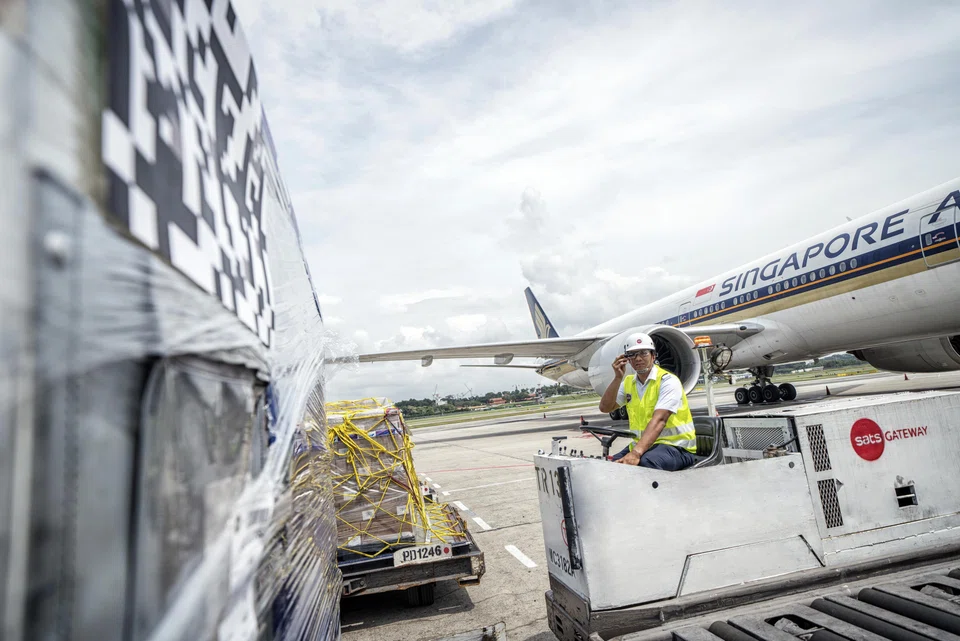
[SINGAPORE] Sats wants to borrow a page from Formula 1 to boost its own performance all over the globe, using real-time data and artificial intelligence to help run its expanding aviation and food logistics network.
Kerry Mok, its president and CEO, said: “In an F1 race, teams are getting a continuous data feed from car telemetry. You have a strategy team that takes the data, analyses it, and that helps the team make decisions. I look at that and say, ‘This is perfect for us’.”
Sats is in the midst of building a group-level, AI and data platform to boost overall performance and decision-making. At the same time, the Singapore Exchange mainboard-listed company is continuing the expansion of its key businesses of gateway services and food solutions.
Gateway services include ground handling, which is the management of passengers, cargo, baggage and refuelling for aircraft and cruise ships, among other things. It also includes cargo handling, which is moving air freight from aircraft to the next step in the logistics chain, such as freight forwarders.
The group’s food solutions arm is involved in catering to companies in both the aviation sector and other industries, as well as food production, distribution and supply.
In the quarter ended March 2026, its revenue was up 9.8 per cent at S$1.6 billion year on year, while net profit rose 31 per cent to S$50.7 million. That brought its FY2026 revenue to a record S$6.35 billion and earnings to S$285.2 million.
The right formula
“We are building a unified technology and data platform across our operations to drive planning, forecasting and execution improvements at scale,” said Sats on Jul 10, in response to investor queries ahead of its annual general meeting.
Speaking to The Business Times, Mok – a motorsports fan – sees a clear parallel between motorsports and aviation and envisions an F1-style control centre that will monitor and coordinate efforts across the company.
“We already have a lot of telemetry and data out there. We are not optimising in milliseconds like F1, but by minutes so that the airport can be efficient,” he said.

With such a system comes the ability to make dynamic decisions and deploy resources in the most optimal way, since it can use multiple data points and plan efficiency on the fly.
Indeed, Sats has already started this at a smaller scale.
In February, it showed off its first AI command centre for Country Foods, one of its food solutions subsidiaries which sources, processes and distributes meat and frozen foods to other businesses.
Country Foods’ global supply chain spans more than 20 countries and 200 facilities that are supplied by 4,000 farms. The centre, which debuted after 18 months of testing, uses global media, digital networks and real-time operational data to monitor the system in almost real time.
According to Sats, this has already helped to deal with the effects of extreme weather and disease outbreaks in Brazil and port congestion in Thailand by re-routing shipments and keeping the business on track.
In future, this type of data-driven control will be applied to other Sats units, including air-cargo operations, at locations around the world.

As an aviation-focused company, such flexibility will be a great advantage, added Mok, as the sector is constantly dealing with disruptions from weather, geopolitics and more.
It could also help address the continued labour shortage in the aviation industry. Sats, noted the CEO, lost 50 per cent of its staff during Covid-19 and manpower is a continual challenge.
A smart platform directing people and equipment more efficiently could help address that problem. It could boost not just Sats’ capacity, but also that of the entire aviation ecosystem as the company can integrate partners’ efforts as well, including airlines and airports.
More business as usual
In recent years, Sats has expanded far beyond Singapore, diversifying its business on a wide scale and becoming one of the largest air-cargo handlers in the world. Gateway services contribute around 77 per cent of the company’s revenue.
It acquired air-cargo logistics company Worldwide Flight Services in 2023, boosting its network in the Americas and Europe.
“We already have a lot of telemetry and data out there. We are not optimising in milliseconds like F1, but by minutes so that the airport can be efficient.”
Kerry Mok, president and CEO, Sats
This wide network, Mok explained, strengthens Sats’ appeal to both existing and new customers as it has not only increased reach, but also flexibility and resilience.
For example, this helped the company to not just cope with, but also even benefit from recent airspace and hub shutdowns in the Middle East.
Intensifying Middle East tensions, peaking as the quarter closed, exerted downward pressure on top-line growth and the bottom line, including contributions from associates and joint ventures.
But from March, Sats began managing air-cargo shipments for Kuwait-based low-cost carrier Jazeera Airways.
When the Kuwait International Airport shut down due to the conflict, the airline flew instead to Dammam, Saudi Arabia, utilising Sats’ 60,000 square metre (sq m) cargo facility there. The supplies were then transported overland into Kuwait.
“This means that we are able to help our customers continuously operate, despite them being in a war zone… and I’m quite optimistic that we will still find ways to grow,” said Mok on the effects of the Iran conflict.
He sees continued potential in key aviation growth markets globally: Asia-Pacific – in particular, South-east Asia where Sats has much experience – and Latin America, where it intends to leverage its current presence in Brazil to grow.
“We have organised ourselves very differently from before, especially in cargo. We’re a global network… That’s the best strategy to grow your network: by going to where the customers are going.”
Notably, Sats has a number of joint ventures in place across the region, including China, Indonesia, India and Malaysia, which position it well to ride this wave of growth.
One example is Tan Son Nhat Cargo Services, a joint venture between Vietnam Airlines and Sats, that acts as the airline’s cargo arm in one of Asia’s fastest-growing economies.
The model goes beyond the Asia-Pacific and into Europe, Africa and the Middle East, too. Oman Sats LLC, a joint venture between Oman Airports and Sats, for instance, has also seen an uptick in business as an alternate route for cargo through that region.
But Mok added that a drawn-out Iran conflict could put a damper on performance.
“When it starts to affect energy supply and energy costs, then it’s a different story. Then you’re talking about global economic impact, and we have to be very cautious about how we manage our costs going forward.”
Food for thought
Sats is also cooking up scale and automation in its food business, which contributes around 23 per cent of its revenue.
Besides supplying meals to aircraft and cruise ships, Sats is also involved in retail distribution and food technology.
The company recently acquired an additional 40 per cent of Nanjing Weizhou Airline Food Corp (NWA), of which it has owned 50 per cent since 2019.
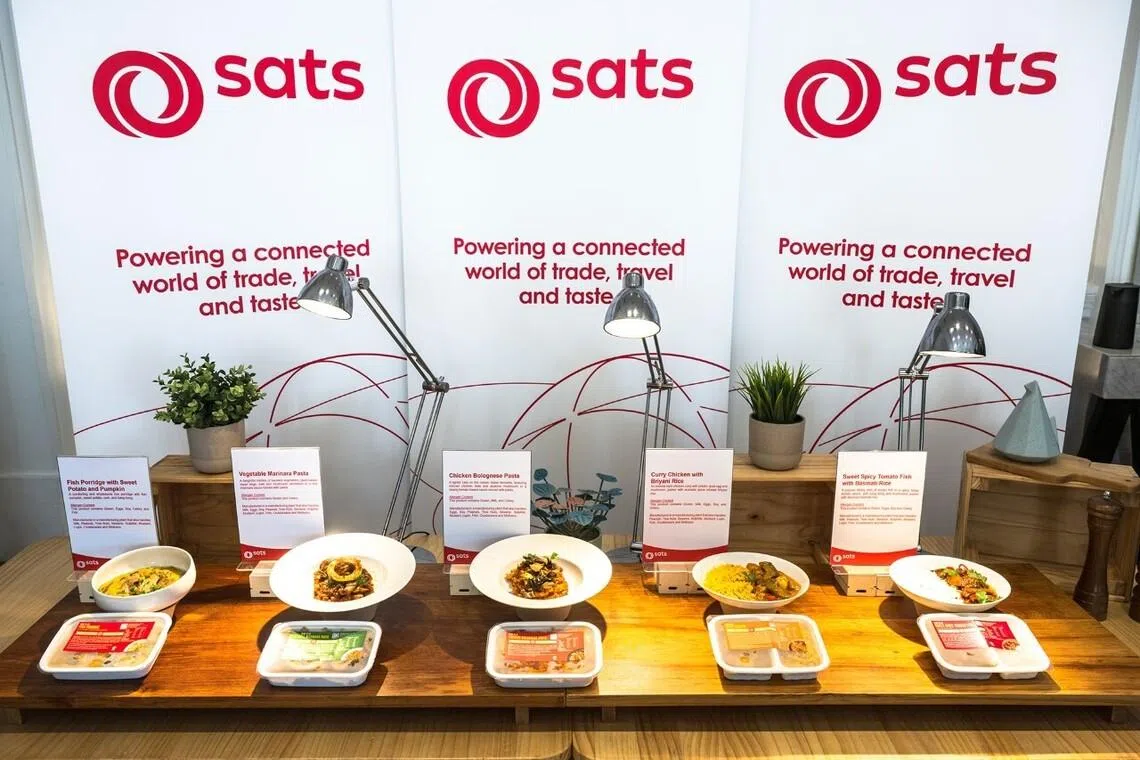
NWA is a leading producer of frozen food meals for aviation in China, but for Mok, the importance of the company lies in its ability to drive innovation. It has been quick to adopt and develop new methods and techniques, including using automation and robotics.
“The speed of innovation I’ve seen with this company is very quick. There are big lessons we’ve learnt from them since 2019,” he noted.
Sats will take those new approaches in food to drive efficiency and cost savings – timely, as it is going big in food production.
Its first “food factory”, a 35,000 sq m facility, will begin operations in Thailand this year and boost production capacity by five times to around 120,000 meals per day.
Rather than serving every market, increasing production in Thailand gives a “scalable route to growth”.
Leveraging its food know-how, including shelf-stable meals ready to eat, Sats is eyeing market expansion in China, India and untapped markets in South-east Asia.
But Mok stressed that food is all about taste too, saying that Sats has long specialised in authentic Asian food, which has enabled its market success so far.
In fact, it has long experience in all kinds of cuisine, such as through the long-established Farmpride brand, under Country Foods.
“The Farmpride brand is over 30 years old now, and I believe we’ve got the best buffalo wings in the market,” he quipped.
TRENDING NOW

DBS, OCBC, UOB rout lops billions off STI as inflation, rate concerns spook investors

Grab CEO’s wife Chloe Tong on life with Anthony Tan and finding her purpose

OCBC sheds S$8 billion in value as shares close nearly 6% down; analysts cautious on banks

Deal between tycoon friends sparks scrutiny of Philippine power sector

