

SGX posts 30.1% rise in H1 profit to S$284.6 million
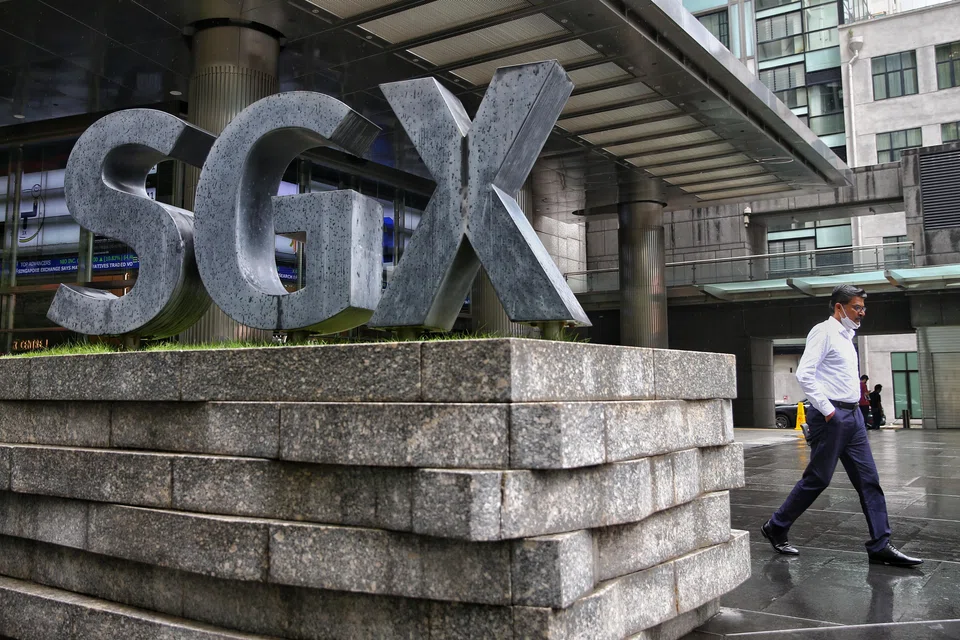
SINGAPORE Exchange (SGX) reported a 30.1 per cent increase in net profit to S$284.6 million for the first half of FY2023, from S$218.7 million a year earlier.
On Thursday (Feb 9), the bourse operator said the year-on-year increase in net profit came on the back of a 9.6 per cent growth in revenue to S$571.4 million, driven mainly by an increase in derivatives trading and clearing revenue, and treasury income.
Earnings before interest, taxes, depreciation and amortisation (Ebitda) for the half year grew 9.2 per cent to S$334.1 million from S$306 million.
Earnings per share (EPS) increased to S$0.266 in H1 FY2023 from S$0.204 in H1 FY2022.
An interim quarterly dividend of S$0.08 per share, payable on Feb 24, was declared. This takes the total dividend for H1 FY23 to S$0.16 per share, unchanged from a year ago.
SGX chief financial officer Ng Yao Loong said during a briefing that they will assess the dividend levels towards the end of the financial year, where there will be the full-year performance, and better visibility over the next financial year.
Meanwhile, chief executive officer Loh Boon Chye added that SGX wants to reward shareholders, which the company also balances with investing for growth. “Total shareholder returns are important,” he said. “The markets will do what it does with the share price, but we want to make sure that we create value and then we pay our shareholders.”
Excluding non-cash and non-recurring items, the bourse operator reported an adjusted net profit of S$236.8 million, up 7 per cent from the previous year. The adjustments were for items such as S$27 million in fair value gain from an investment in a private equity fund, as well as the write back of an earnout for FX trading platform MaxxTrader amounting to S$15 million.
SGX said these adjusted figures better reflect the group’s underlying performance, as the non-cash and non-recurring items have less bearing on its operating performance.
The group’s derivatives business – which includes listed equities, currencies and commodities futures and options and associated treasury income – was a key contributor to the H1 FY2023 performance.
Revenue from derivatives across all asset classes grew 28 per cent on year, or S$54.2 million, and derivatives contributed 44 per cent to group revenues.
Ng noted that the growth was broad-based across all asset classes, and came from higher volumes and average fee increases. “The outperformance of this segment reflects the value that global investors place on SGX as a platform for Asian access and portfolio risk management,” he said.
Average clearing fee per contract rose to S$1.58 in H1 FY2023 from S$1.50 in the corresponding period a year earlier.
Fixed income, currencies and commodities revenue, which accounted for 27 per cent of group revenue, increased 35 per cent to S$154.3 million from S$114 million.
Equities revenue from both cash and derivatives rose at a slower pace, climbing 3 per cent to S$344.7 million. While derivatives revenue increased, revenue from cash equities fell 10 per cent to S$171.2 million, dragged by lower listing revenue and trading and clearing revenue.
During the first half of FY2023, SGX saw four new equity listings raising S$9.7 million compared with six listings and S$1.3 billion raised a year earlier.
Loh noted that near-term uncertainties for cash equities may continue to persist as inflation and interest rate risk concerns may impact growth and corporate earnings. “We remain very focused on extending our mutual market connectivity initiatives,” he said.
Pol de Win, head of global sales and origination, noted that the global initial public offering (IPO) market has been at very low activity levels, but markets do not remain shut forever. “If I look at where we were a year ago, I would actually say I’m more optimistic today,” he said. “The consensus is for Q2 to see a stabilising rates environment… so I do expect on the back of that, the markets to come back, I would say towards the second half of this year.”
Meanwhile, the commodities business recorded its highest six-month volumes in its flagship iron ore contract.
Loh noted that they have accelerated the “financialisation of iron ore”, and there has been an increasing proportion of “screen trading” and growing interest in trading iron ore outside of Asia. “We are at the start of our journey to grow and entrench our key commodities, not only iron ore, but also freight, as macroeconomic proxies,” Loh said.
Operating expenses rose 10.1 per cent to S$237.4 million from S$215.6 million. This was mainly due to higher total staff costs and increased technology expenses arising from SGX’s recent acquisition of Maxxtrader. Excluding Maxxtrader, total expenses would have increased by 6 per cent instead.
Despite maintaining its guidance for FY2023 expenses and capital expenditure, SGX said that it expects full-year expense growth and capital expenditure to be at the lower end of its earlier guidance, where it projected an increase of 7-9 per cent and S$70-75 million, respectively.
Net asset value per share fell to S$1.40 as at Dec 31, 2022 from S$1.45 at Jun 30, 2022. SGX total borrowings also fell in H1 FY2023, with gross debt to Ebitda ratio declining to 1.1 times, from 1.4 times a year ago.
SGX shares were trading at S$9.16 as at 1.49 pm on Thursday, up 0.1 per cent or S$0.01 from the previous close.
TRENDING NOW

Malaysian king buys stake in Singapore-listed mining firm expanding into rare earths

Grab CEO’s wife Chloe Tong on life with Anthony Tan and finding her purpose

Once staunchly pro-China, Malaysian Chinese businesses are now distancing themselves from Beijing

Longer wait times expected as S’pore healthcare institutions report system disruptions

