Singapore digital banks want more than just your deposits; credit cards are the next battleground
Credit cards give these banks insights into their customers’ spending patterns

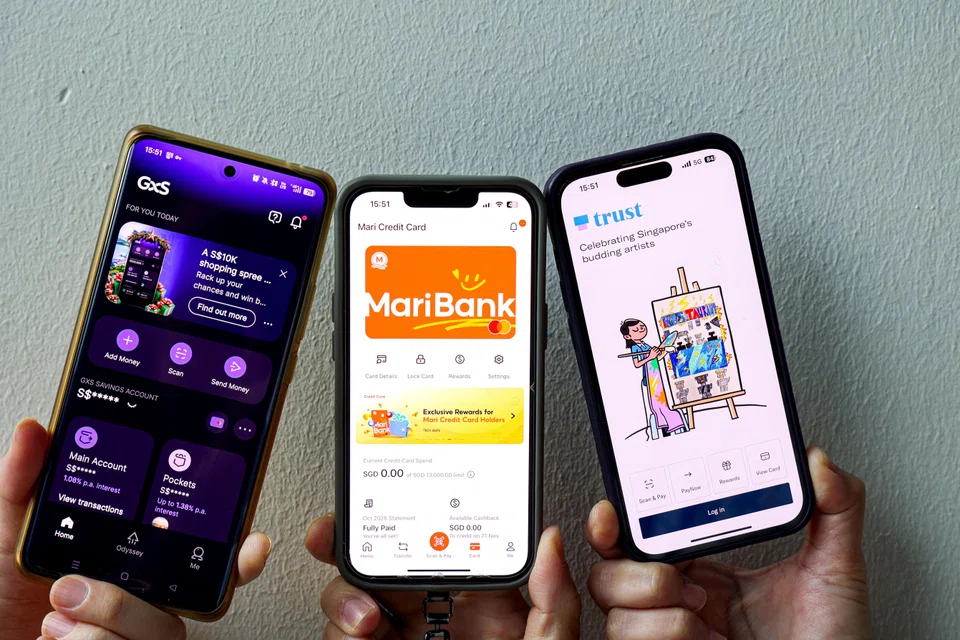
[SINGAPORE] With all three of Singapore’s digital banks now offering credit cards, the battle is shifting from simply acquiring customers to capturing more of their everyday spending – and the valuable data that comes with it.
GXS Bank became the latest to join the fray on Aug 17 with its cashback card, which has similar offerings to those from MariBank and Trust Bank.
MariBank has a cashback credit card, and Trust Bank's cards offer cashback, stock rewards and benefits linked to NTUC’s loyalty programme.
Wong Wanyi, fintech leader at PwC Singapore, said: “Banks often use credit cards as a tool to attract new customers and keep them engaged with the bank.”
Credit cards enable these banks to have more regular interactions with customers, gleaning data from their spending and repayment behaviours, other analysts said.
These insights can enhance credit profiling, risk management and cross-selling of other products to these customers, said Seah Li Yun, EY Asean banking and capital markets leader.
High-frequency engagement
Early usage figures suggest that customers of these digital banks are engaging regularly with the cards.
GXS ran a beta programme for its cashback card, roping in more than 1,000 customers a month before the launch of the card. More than 90 per cent of those customers used it for their Grab and Singtel payments, noted Jenn Ong, group head of retail at the bank.
Grab and Singtel are parent companies of GXS.
On average, beta testers of the GXS card received S$18 in cashback and in GrabCoins, Grab’s loyalty programme points.
“This is important because it tells us that customers are using the card in the way we designed it, both for the services they already use within Grab and Singtel, as well as for their broader everyday spending,” said Ong.
Before the credit card debuted, GXS’ only card product was the FlexiCard, which has a spending cap of S$500; it was featuring in regular everyday usage, with customers making an average of 10 transactions a month, using about two-thirds of the credit limit.
Huo Haiyan, head of consumer business at MariBank, said that 90 per cent of its new credit card customers in 2026 were still active six months after signing up, and one in four customers are actively using its card products. About six in 10 active cardholders have used the card abroad.
“Comparing H1 2026 to H1 2025, overseas spend volume on the Mari Credit Card jumped 650 per cent, and there was a 5.2-time increase in active foreign currency users,” she added.
Trust Bank’s rebranded Freedom credit card attracted significant customer interest and sign ups. Dwaipayan Sadhu, the bank’s CEO, said there has been a more than 100 per cent jump in overall credit card sign ups since the rebrand on Aug 13.
“The early response reinforces our belief that customers are looking for rewards on their everyday spending that can grow in value over time, and that making investing effortless can help more people take their first steps towards investing,” he said.
Trust’s credit cards have activation rates of above 85 per cent, and cardholders make an average of 25 credit card transactions a month. This reflects “strong day-to-day usage”, he said.
Trust customers have made more than 60 million overseas transactions in over 175 countries as well.
Engaging cashback
Market observers said credit cards have evolved into a tool for strategic customer engagement and data. This is the same for both digital and traditional banks.
“For digital banks in particular, credit cards are one of the few tools that help represent them physically to customers,” said Mohit Mehrotra, financial services industry leader, Deloitte Southeast Asia.
The choice by the digital banks to start with a cashback credit card is no coincidence, as because consumers prefer cashback over rewards, noted market observers.
Rewards often have varying eligibility criteria, and terms and conditions that make them less straightforward for customers to understand.
Antony Ruddenklau, head of financial services at KPMG in Singapore, said: “I think in Singapore we like cashback because of the instant dopamine hit, the feel-good factor of seeing some immediate return.”
This instant gratification from earning cashback might make customers prefer it over rewards, even though rewards may offer a better deal, said Deloitte’s Mehrotra.
Cashback is also a simpler, more transparent value proposition for retail customers, and often easier to run, noted EY’s Seah.
But the days might well be numbered for cashback deals, which may become less profitable to run through credit cards down the road, said KPMG’s Ruddenklau.
The reason: Interchange fees, the fee that a card-issuing bank receives for every transaction, might be reduced. Regulators around the world are pushing to reduce this fee – in the process thinning the margins that banks reap from their credit card products.
Singapore’s interchange fees are now on par with most international markets, at between 1.5 and 3.5 per cent of the transaction.
Ruddenklau believes that interchange fees are going to be lowered, hitting the cashback credit cards banks run.
“It would be unprofitable to do cashback going forward, because cashback effectively comes out of that interchange fee, I think its days are numbered,” he added.
Differentiation the next battle
Now that all the digital banks have a credit card product, differentiation will be key in attracting more customers. The digital banks will have to build on their existing differentiation from traditional banks in the convenience, speed and low cost front, said PwC’s Wong.
“Building on this, digital banks can further differentiate themselves through offering a credit card which provides higher value to consumers and to have a smooth and swift credit card-application process,” she added.
GXS has tapped onto its partner ecosystem as a differentiation factor; its customers are allowed to link their new credit cards to their Grab accounts without having to manually key in the details.
The digital bank’s focus will be on ensuring its proposition remains relevant and useful to customers, said Ong.
“This means understanding where customers are using it, the benefits they prefer and how we can stretch the spending dollar for our customers, who are part of the ecosystem,” she added.
MariBank is seeking to double down on delivering value to customers, gearing up to launch a major campaign in the fourth quarter of 2026. This campaign will reward spending locally and overseas, said Huo.
“Our strategy over the next 12 months will focus on expanding our ecosystem partnerships to give cardholders even more real-time savings, exclusive travel vouchers and high-value experiences,” she added.
At Trust, the rebranded Freedom card is just the beginning, with a focus on offering choice and value to customers, said Sadhu. The digital bank plans to introduce the ability to earn air miles along with its current cashback and stock back rewards in the future.
“We will continue to innovate around how our customers use our credit cards with the goal of helping them get more out of every dollar they spend,” he said.