Singapore plays premium data centre game as Johor, Batam take on scale
With land and power at a premium, the Republic homes in on workloads with stronger reasons to be hosted on its shores

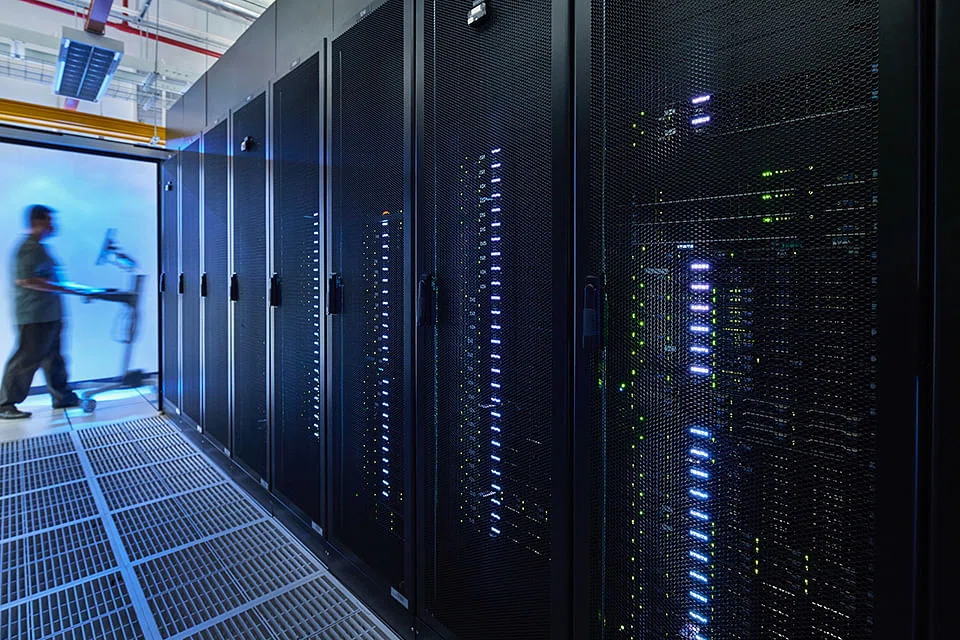
[SINGAPORE] Singapore is carving out a premium role in the region’s data centre boom, prioritising higher-value and resource-efficient workloads rather than competing with neighbouring Johor and Batam on capacity, analysts said.
With land and power at a premium, the Republic is focusing on workloads that have stronger reasons to be hosted on its shores, including those driven by data sovereignty needs or latency-sensitive applications.
But this positioning comes at a price.
Vivian Wong, lead analyst for the Asia-Pacific at data centre research house DC Byte, estimated that space-only co-location rates in Singapore to be between US$300 and US$400 per kilowatt each month.
This is three times the rate in Johor and Batam, which are also popular regional data centre locations.
Wong told The Business Times: “The pricing premium reflects Singapore’s higher development and operating costs as a Tier-1 market, including construction and labour costs.”
The scarcity of capacity can be seen in the outcome for Singapore’s second Data Centre Call For Application (DC-CFA 2), which attracted more than 20 local and global applicants for just four provisional allocations of 50 megawatts (MW) each.
The four operators each awarded 50 MW of provisional data centre capacity were Digital Realty, Keppel, ST Telemedia Global Data Centres and Equinix.
While 50 MW of capacity might seem modest against the backdrop of hyperscale artificial intelligent data centres, industry observers said they remain significant for other types of demand.
Dedi Iskandar, Asia-Pacific regional director at data centre research house datacenterHawk, said the capacity remains a “meaningful amount” for enterprises, retail co-location and artificial intelligence inference workloads.
However, he noted that the timeline for operators to fully utilise the capacity will depend significantly on the target customer segment.
For a facility anchored by a major AI training or hyperscale customer, pre-leasing can happen very quickly, even within months.
On the other hand, a dedicated facility for inference, enterprise or retail customers might have a more gradual ramp-up, and could take two to three years following completion for the facility to reach full utilisation.
“Singapore’s data centre strategy is fundamentally about balancing continued digital and AI growth with the country’s constraints on land, energy and other resources,” he said.
Wong noted that much of capacity awarded in the pilot DC-CFA in July 2023 is under development and has yet to enter the market.
Differentiated approach
Rather than putting Singapore in direct competition with neighbouring markets, analysts see an increasingly differentiated data centre landscape, where workloads are located according to specific requirements.
Jeremy Deutsch, chair of the Asia-Pacific Data Centre Association, told BT that Singapore, Indonesia and Malaysia each have their own strengths and are playing important roles in supporting the region’s “rapidly growing digital economy”.
Wong noted the additional 200 MW allows Singapore to continue anchoring on workloads that benefit from its financial, digital and connectivity ecosystem.
Johor, on the other hand, will continue to have a significant impact in terms of scale and cost – making it better positioned for large hyperscale, AI and less latency-sensitive regional workloads, she added.
“Rather than viewing the two markets as directly competing, we increasingly see them playing complementary roles within the regional ecosystem,” she noted.
“The key question for operators and customers will increasingly be which location best fits the specific workload and business requirement,” said Dedi.
This likely means that unsuccessful bidders for Singapore’s latest capacity allocations will not necessarily look elsewhere to Johor, Batam or other regional markets as a substitute, noted analysts.
“We would not interpret all of the applications as being tied to immediate demand or committed offtake, nor assume that unsuccessful applicants would necessarily redirect their requirements to another market,” Wong said.
Dedi pointed out that a majority of data centre operators already have facilities in regional markets such as Japan, India, Korea and Malaysia.
“For short-term and immediate capacity requirements, operators may therefore use their existing facilities elsewhere in the region to meet customer demand,” he said.
What’s powering the boom?
For the four successful operators, the challenge extends beyond securing the tender – they must now meet stringent energy requirements.
One of them states that the operators need to power at least half their new capacity from green-energy sources.
Dedi offered several pathways for the operators to meet such requirements:
One of the “more straightforward” options is through renewable-energy certificates, which allows operators to match a portion of their electricity consumption with renewable energy generation.
Another pathway is for the operators to enter into virtual power purchasing agreements with renewable-energy producers. This will allow a longer-term commitment to energy generation.
Arrangements with independent energy suppliers to bring in alternative energy sources, such as solar, geothermal and hydrogen, might also be possible, he said.
“The more likely approach is a combination of renewable energy procurement, longer-term power agreements and, where feasible, direct access to alternative energy sources,” he said.
The four selected operators did not disclose the specific green pathway they intend to use to power their data centres.
Nonetheless, analysts remain optimistic that the green-energy pathway regulations will lead to positive outcomes to the energy industry as a whole.
“The data centre industry is uniquely positioned to act as a powerful catalyst for the next generation of clean energy,” said Neil Bear-Hetherington, director for Asia-Pacific data centre capital markets at CBRE.
He noted that many data centre operators and hyperscalers are actively investing in pioneering technologies such as small modular reactors as well as solar and advanced geothermal power.
“By creating additional demand for green energy, the sector can support continued investment and innovation in the energy ecosystem, while working closely with the government and the energy sector to advance Singapore’s broader decarbonisation objectives,” said Deutsch.