

StarHub on the cusp of reaping season
Telco will be decommissioning costly legacy systems, starting in the middle of this year, and is also working on wrapping up its cloud transformation

Wong Pei Ting
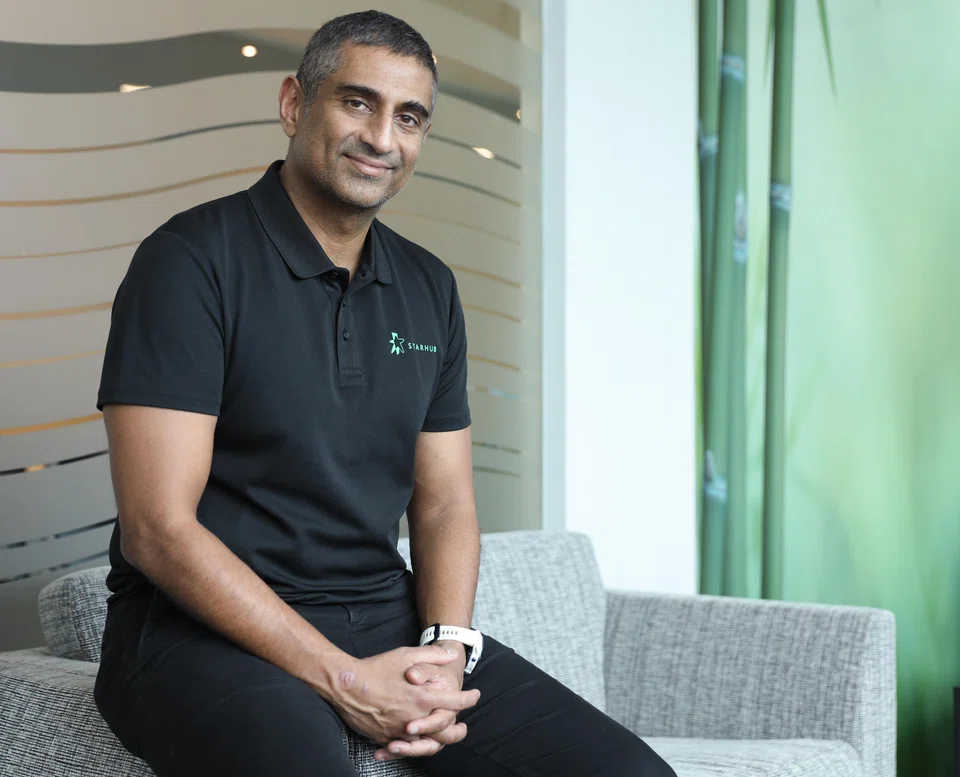
BEFORE the end of his first year at the helm of StarHub, Nikhil Eapen did the unthinkable.
Eapen became the chief executive of StarHub on Jan 1, 2021. And Singapore’s second-biggest telco looked on track to wrap the year with decent revenue growth, good earnings before interest, taxes, depreciation and amortisation (Ebitda) expansion, and strong free cash flow.
But, in November 2021, he went to the market to announce an audacious multi-year plan that was going to cost S$270 million and diminish its service Ebitda margin from 30 per cent to around 20 per cent in the coming years.
Much of the jargon used then – such as cloud, infinity play, and transformation enablement – flew right over the heads of many observers. And frankly, they still do.
But executives now see some light at the end of the tunnel, and Eapen says that he is proud of the baby with a plucky name: Dare+.
Despite its toll on capital expenditure and operating expenses (opex) over the past two years, Dare+ has brought StarHub out of a situation where it runs its network in a “very monolithic” way.
Eapen explained that monolithism, which many of StarHub’s competitors are still subjected to, comes when a telco is required to “use a lot of energy – probably more than is needed, because not everyone needs all that bandwidth all the time across your entire network”.
With Dare+, StarHub is close to shifting its network from legacy platforms towards one that operates off a combination of hybrid and public multi-cloud systems, he said.
When this process completes – targeted for mid-2024 for its consumer business and end-2024 for its enterprise businesses – StarHub will become the first “brownfield” telco in the world to cloudify an existing network, he noted.
Brownfield challenges
Running it off the cloud means that “you can pinpoint the delivery of that bandwidth to where it’s needed, how much it’s needed, to the specific requirements of the customer at that point in time”, Eapen said.
This includes when enterprises need the network to support more data-intensive operations requiring multi-access edge computing. It is about managing transmission in a dynamic way, for it to go where it is needed, rather than providing it uniformly at maximum capacity with a buffer across the entire network, he added.
Telco operators playing in this arena are Japan’s Rakuten Mobile, United States’ Dish Network, and India’s Reliance Jio. These are “greenfield telcos”, however. For brownfield telcos like StarHub, a company founded more than 25 years ago, the added challenge is in reskilling engineers who have not worked with the cloud from day one, Eapen noted.
The transition is also opex-heavy, with StarHub having to keep both the old and the new systems running. Opex are up almost 18 per cent, with S$1.57 billion spent in the first nine months of 2023, versus S$1.33 billion over the same period in 2021.
Net profit initially suffered, falling 18.4 per cent from S$108.2 million for the nine months in 2021 to S$88.3 million in 2022. Earnings have since rebounded 29.1 per cent to S$114 million in the first nine months of 2023 though – a result that Eapen attributes to the beginnings of Dare+ taking effect.
The market, however, has not taken to StarHub’s new direction. Its share price has shed a fifth of its value since late-2021 when Dare+ was announced. The counter last closed at S$1.09 on Jan 5.
Profit goals
StarHub will soon scrap its legacy platforms though, heralding a season of reaping. Being infrastructure-heavy, these platforms come with substantial running costs that will soon be a thing of the past.
Eapen said that the decommissioning will start in the middle of 2024 and stretch into 2025, sparking three things: sustained revenue growth, a tailing-off of transformation spend, and harnessing of efficiencies.
The efficiencies, through automation and cost reduction, are expected to kick in from the second half of 2024 onwards. “With all three things in combination, our goal is strong profitability growth,” he said.
Will StarHub subscribers feel a change? This is where Eapen perks up. “Imagine a world where you’re not stuck within these rigid legacy telco bundles, and you can self-serve and build your own package.”
He continued: “Imagine that world where a platform has embedded within it data and artificial intelligence capabilities, so we can suggest products that are suitable for you based on our very deep understanding of you.
“Also imagine this world where we make all of these things available to you at a price point and a value, which frankly pales in comparison to the delight and lifestyle enrichment and the safeguards that you get.”
Consumers will start experiencing such changes by the middle of the year, he added.
Eapen offered a piece of trivia: “For cloud gaming, do you know that more than half of our customers are not StarHub’s connectivity customers? A lot of them don’t even sit in Singapore. They are in Asean.” They sign on as their countries only have “legacy” telco providers that cannot provide the same level of services, he shared.
The benefits also permeate StarHub’s enterprise business, which Eapen views as a 50-50 contributor to revenue. Cloudification allowed it to deploy a secure autonomous cloud network for smart city projects, including JTC’s Punggol Digital District.
Such a network can overcome existing pain points, such as the lack of computing power for analytics, an absence of true multi-cloud options to not be overly reliant on one cloud system, and a dearth of options to avoid overspending on cloud security, he said. “This is a very different world from this sort of clunky telco, systems-integrator use cases.”
The dividend picture
The way Eapen sees it, StarHub is poised for strong profitability growth from this year onwards.
While the company can maintain strong dividends due to its strong free cash flow and low debt – its net debt to Ebitda is about 1.4 times versus the regional telco average of 2.5 times – Eapen wants it to be seen as more than a dividend play.
Although telcos are seen as very stable businesses, and investors do buy it for the dividend yield, Eapen said: “We view ourselves as a total shareholder return company. We’re not just a dividend company.”
Eapen even believes that StarHub is under-leveraged, and said that he is contemplating moving its net debt to Ebitda closer to the telco average of 2.5 times over the long term. The current low leverage “gives us a lot of firepower for acquisitions, which we’re focused on”, he added.
On this note, there has been talk that StarHub could buy over one of the telcos for some years now.
The proposition was met with a tight-lipped Eapen, who would only say: “We have a high degree of credibility and confidence. I think we’ve executed quite well. Our mobile revenue market share has expanded… We have low leverage and funding firepower.
“So while I can’t comment on the specifics of any consolidation, I would say we are well-positioned.”
TRENDING NOW

Once staunchly pro-China, Malaysian Chinese businesses are now distancing themselves from Beijing

Philippine power giant First Gen rebuffs foreign offers, plans up to US$2.6 billion in expansion

Grab CEO’s wife Chloe Tong on life with Anthony Tan and finding her purpose

The line between public servants and private property

