

Struggling companies lifted by tie-ups with new economy players
But return on investment for such collaborations often weak; tie-ups also subject to risks
Singapore
SEVERAL locally listed companies that have seen better days are teaming up with startups and "new economy" players to launch initiatives providing entry point to untapped market opportunities. In some cases, their announcements have triggered big jumps in their deflated share prices.
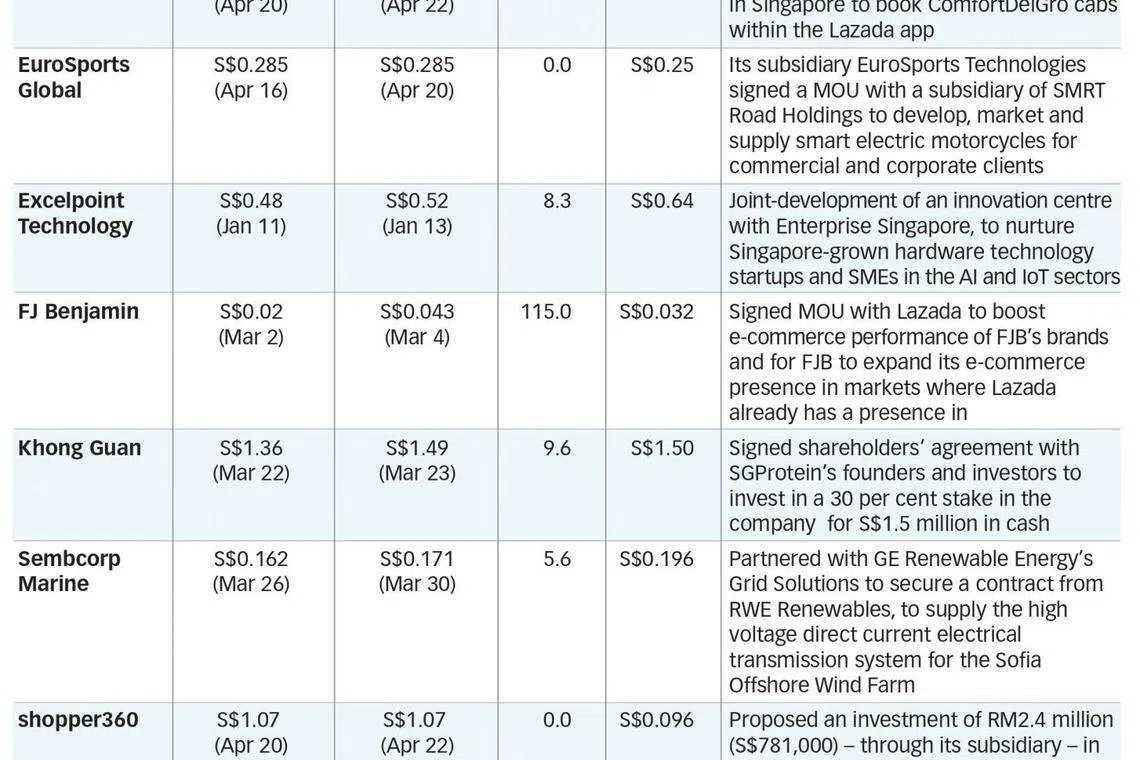
Two months ago, fashion retailer FJ Benjamin (FJB) said it would form a partnership with Lazada that would boost the e-commerce performance of FJB's stable of brands in Singapore, Malaysia, and Indonesia, as well as to expand and incubate new FJB brands to eventually integrate brick-and-mortar and virtual stores. On the day of the announcement, shares of FJB closed 130 per cent higher. The last time the counter traded near such price levels had been in 2018.
That same month, beverage maker Yeo Hiap Seng said it had struck a deal with Sweden's Oatly to jointly invest S$30 million in equipment and facilities to produce its popular oat drink in Singapore. Yeo's group chief executive Samuel Koh said that the partnership will be value-accretive to Yeo's business, by providing it with another growth driver in the fast-growing plant-based milk alternative segment.
Yeo Hiap Seng's share price jumped 15 per cent the day the deal was reported by this newspaper.
Then, there was biscuit maker Khong Guan's purchase of a 30 per cent stake in SGProtein - a Singapore-based startup which manufactures plant-based meat - for S$1.5 million in cash. Khong Guan said the investment "represents a new and exciting opportunity for growth for the company in Singapore and the region". Shares in Khong Guan also closed nearly 10 per cent higher on the day after the announcement was made.
Among the larger companies, Sembcorp Marine raised hopes in March that it is successfully pivoting to renewable energy when it announced a £600 million (S$1.12 billion) UK wind farm contract together with GE Renewable Energy's Grid Solutions. A day after the announcement, on March 30, shares in SembMarine jumped 6.2 per cent to close at S$0.171.
More recently, ComfortDelGro and Lazada said last month that they had formed a partnership that will allow shoppers in Singapore to book ComfortDelGro taxis within the e-commerce platform's app, so as to allow the transport company to "expand its reach by tapping into Lazada's wide customer base, particularly the younger demographic of shoppers who frequent the platform".
The response from the market was more muted in this instance, perhaps reflecting ComfortDelGro's relatively robust core business. Shares in ComfortDelGro dipped 1.69 per cent on the day of the announcement, though they gained more than 2 per cent the day after.
Other recent announcements made by locally-listed companies on similar partnerships include EuroSports Global, Excelpoint Technology, and shopper360.
Should investors be excited about these tie-ups with startups and new economy players? Do the locally listed companies have what it takes to carve a niche for themselves in these new fields?
Guillaume Sachet, partner, advisory at KPMG in Singapore, noted that the "new world is now driven by ecosystems rather than strong and leading stand-alone incumbents". Thus, having collaborations with a technology or distribution partner may better help companies "create greater scale".
Meanwhile, Lim Ee Ling, regional director for Asia-Pacific at venture capital firm 500 Startups, said partnerships with startups could be useful for businesses that have yet to find "the right talent to develop their own innovation", but have "a genuine interest in building new businesses for a future that is further out". She added: "Partnering with startups is definitely a good way to unearth transformative solutions rapidly."
Whether an old-economy company can make the transition, however, could depend on the extent to which it has already been sidelined by disruption in its industry.
Joongshik Wang, EY-Parthenon's Asean leader, said old economy incumbents tend to be under enormous pressure once a disruptor or challenger gains market share of more than 30 per cent. "The question (will not be) about how to transform, but how to quickly work with the new disruptors... or it's almost the last stage."
On the other hand, if a new challenger has garnered market share of only 10 per cent, existing industry players "still have a chance" to transform their business models, he added. Mr Wang cited the media industry as one such example of an industry that is facing high levels of disruption. On the other hand, the manufacturing and oil and gas sectors, despite being old economy industries, face relatively low levels of disruption by new players, he said, the rise of renewable energy notwithstanding.
For investors, the big question is whether tie-ups with startups and new economy players will actually enable old economy companies to earn a good financial return over the long run.
Tamanna Dahiya, venture director at corporate venture builder FutureLabs Ventures, said that the return on investment for collaborations between corporates and startups is often weak, especially if judged in terms of financial and strategic impact. "This is primarily because they face the same constraints as any innovation efforts in a large business," she added, such as having processes and capabilities focused on control as opposed to agile decision-making, which is necessary to experiment with new models and technologies.
Another risk would be if there is "a lack of commitment from one of the sides to execute and there is no implication if they do not execute", said Ms Dahiya. She noted that speed is oftentimes a crucial factor, and startup partnerships will fail if corporates do not move quickly enough.
On a broader level, some established companies have pursued transformation without monitoring closely enough whether their efforts were paying off in terms of profitability and market valuations.
Vikram Chakravarty, EY's Asean strategy and transactions leader, said: "As companies try to break from historical business models - where they've optimised their margins - and move, one of the things they have to keep their eye on is how they can balance (that with) the increase that they should expect on the valuation side. Companies that do it well can benefit greatly."
Telcos, for instance, have fared rather poorly in this aspect, he added. "All the monies they've spent is seen as monies wasted. They're not getting the benefit of a digital business."
Nonetheless, with the Covid-19 pandemic accelerating the rate of digitalisation, Mr Chakravarty noted that an increasing number of companies undergoing transformation may now be "willing to embark and go down the path where they're willing to take some initial upfront balance sheet and margin hits in the move to lock in customers for a long time".
With additional reporting by Claudia Chong
TRENDING NOW

Once staunchly pro-China, Malaysian Chinese businesses are now distancing themselves from Beijing

Philippine power giant First Gen rebuffs foreign offers, plans up to US$2.6 billion in expansion

Grab CEO’s wife Chloe Tong on life with Anthony Tan and finding her purpose

The line between public servants and private property

