

Tariffs spark caution but no financing rush this time round: Citi’s Damien Tan
‘The key difference is that during the Covid-19 pandemic, there were a lot of demands for funding, bolstering of balance sheets, and drawdown of loans,’ Tan says

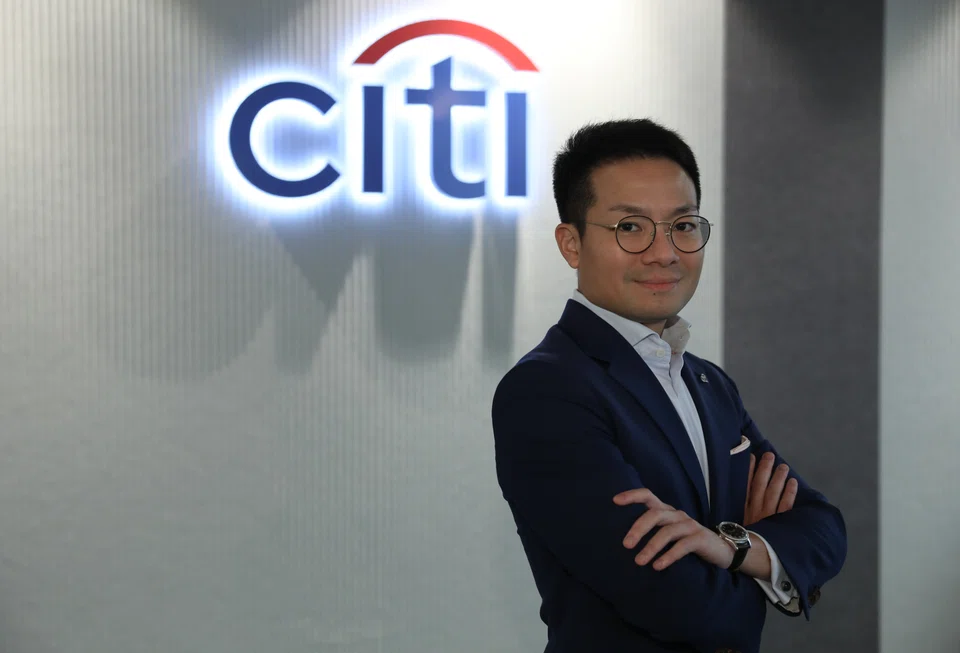
[SINGAPORE] Tariffs have roiled markets and economies but Citi has not seen the “same rush for financing” as it did during the Covid-19 pandemic, said Damien Tan, the bank’s head of corporate bank for Singapore.
While clients are still watching their capital expenditure and investment decisions closely, “things are generally more calm” as they “are already diversified from the past three to four years of pandemic upheavals”.
“The key difference is that during the Covid-19 pandemic, there were a lot of demands for funding, bolstering of balance sheets, and drawdown of loans,” Tan said. “This time round, it’s very different.”
Clients are also yield-driven in the current high interest rate environment, and the advice Tan gave is to have “a good sense of where your money sits, and to maximise it”, through efficient treasury management and tapping real-time payments.
“The more you can consolidate your funds into a certain space, the more you can place it out, and you can earn higher yields,” he said. “Otherwise, you will have trapped cash in little pockets where you have no visibility, and it just sits there, earning less.”
Here are some excerpts from his conversation with The Business Times:
How did you end up in your role?
From young, I have always wanted to be a banker. I read economics in university, and I chose to do it in the London School of Economics, where you get to live within the buzz of a city environment.
I got recruited from London into Singapore by Citi as a management associate – so that is how it started.
The journey has been 22 years now, and I’ve been through more than 10 business units. Within the corporate banking space, I have covered financial institutions, real estate, shipping, aviation, industrials, healthcare, agribusiness, and the public sector.
The bank has actually invested in me, and it also allows mobility of talent across the board. I benefited from good managers – people who take a chance on you, and invest time in you.
Why did I always want to be a banker? One is that you are in the thick of things, to be able to assist your clients. You also have to be nimble; you have to cut across different sectors, and I find that intellectually challenging.
What is a key trend that you see in your area?
What is key is really the political uncertainty as well as economic uncertainty. With respect to the current US tariff situation, our clients are in risk management mode.
They remain cautiously optimistic, and are preparing for the headwinds by bolstering their – already pretty strong – balance sheets, as well as evaluating their capital expenditure plans.
Most of them are concerned about the second order impact from tariffs, because that will impact demand.
Of course, their business still needs to grow. It is just about being more cautious and deliberate about where you put your dollars.
The resultant thing is that Singapore continues to be resilient and attractive as a hub. We continue to see treasury centres and regional headquarters being set up here.
Our North Asia clients are coming to Singapore to set up shop; we see increasing activity from them – treasury, billing, markets, and hedging activities driven out of Singapore to boost diversification.
We also see strong interest from India and South-east Asian companies as they expand domestically and internationally to tap offshore financing requirements.
How do these affect your role?
The key here is that we need to stay present and close to our clients. We need to stay on top of the changing trends and shifting geopolitical landscape, and advise our clients accordingly, to allow them to anticipate and prepare for changes that may affect them.
Many of the large corporations that we deal with are largely resilient. They have been through uncertainty before.
So, our network which allows us to do business in over 180 countries, our ability to connect the dots across the markets and provide real-time insights – and execute at scale – are what would differentiate us from a Citi perspective, and we continue to find ways to help them mitigate risks and seize opportunities when they arise.
One example is that we regularly host client calls to provide them with latest market updates and geopolitical developments as they happen overnight.
The current advice is to ensure sufficient liquidity and keep your capital structure flexible, so that if there is any opportunity that arises, they can capture it.
TRENDING NOW
Companies still in search of AI use cases with worthwhile ROI, says Broadcom’s CEO
Beauty World Plaza up for collective sale for S$165 million
Trouble in paradise: Bali runs low on fuel, sparking long lines at pumps

Philippine power giant First Gen rebuffs foreign offers, plans up to US$2.6 billion in expansion

