Air India investment receives ‘full attention’ from whole board: SIA chairman
CEO Goh Choon Phong adds that any decisions will be supported by a ‘robust business case’ and within the group’s means

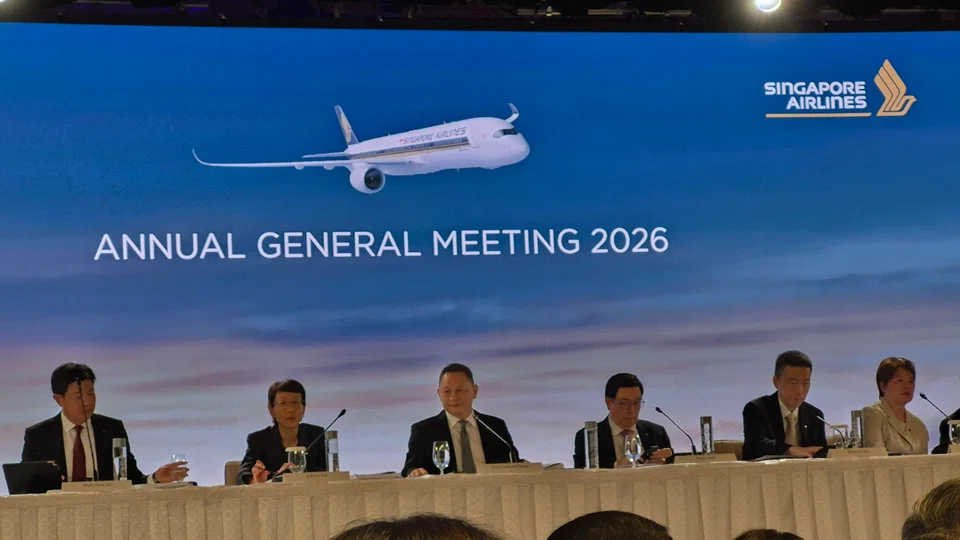
[SINGAPORE] Singapore Airlines (SIA) chairman Peter Seah assured shareholders at the group’s 54th annual general meeting (AGM) that the board of directors is on top of its billion-dollar investment in Air India.
“I can assure you that this subject receives full attention from the whole board, so it’s not delegated to management,” he said in response to several questions raised on the subject on Friday (Jul 24), during the 1.5-hour-long proceedings at Marina Bay Sands Expo and Convention Centre.
Seah pointed out that the investment jointly made with Indian investor Tata Sons gets “discussed in every board meeting”, and the directors will continue to review the joint venture.
As for how much more SIA will invest in Air India, Seah said that “we’ll have to take it as it comes along” even as he and CEO Goh Choon Phong extolled the potential of the Indian aviation market.
The chairman gave this response after Goh declined to reveal the bases for SIA’s decisions on whether there would be further investments in Air India, or its maximum quantum of investment before calling it quits.
However, Goh assured shareholders that any investment decisions are supported by a “robust business case and that it will be within our means”.
SIA holds a 25.1 per cent stake in the enlarged Air India following the merger with its former associate Vistara in November 2024.
Its share of Air India’s losses amounted to S$945.2 million for the 2026 financial year ended March, its first year of integration with Vistara. The Indian carrier posted a loss of S$3.8 billion in total.
SIA reported a 57.4 per cent fall in earnings to S$1.2 billion for FY2026, due largely to the absence of a S$1.1 billion non-cash accounting gain from the merger of Air India and Vistara, coupled with the group’s share of full-year losses from the Indian investment.
In October 2025, Air India reportedly requested a S$1.1 billion capital injection, but SIA said it was not in a position to comment.
The Singapore carrier noted that Air India continues to face well-publicised challenges, such as the depreciation of the Indian rupee, supply chain disruptions, Pakistani airspace closures and a plane crash in June 2025 that killed 260 people.
But SIA also noted that Air India is making tangible progress in its transformation efforts across the customer journey and experience, fleet and network expansion, on-ground and in-flight products and services, as well as operational performance.
At the AGM, shareholders asked about the impact of high-speed rail services in India on Air India. Both Seah and Goh sounded unfazed in their replies, citing examples of domestic carriers in other countries that continue to thrive after high-speed trains were introduced.
Goh said that Air India’s potential also includes its international markets.
Responding to a question on the possibility that SIA would dual-list on Nasdaq, Seah said that there were no plans to do so but “never say never”.
All 11 resolutions raised at the AGM were approved at its conclusion, including a final ordinary dividend of S$0.22 per share and a special dividend of S$0.07 per share.
The counter closed at S$7.55, down 0.3 per cent or S$0.02, on Friday.