

Singapore sells less marine fuel in April amid war-induced tight supply
Number of oil-tanker arrivals down 13.3% on the month

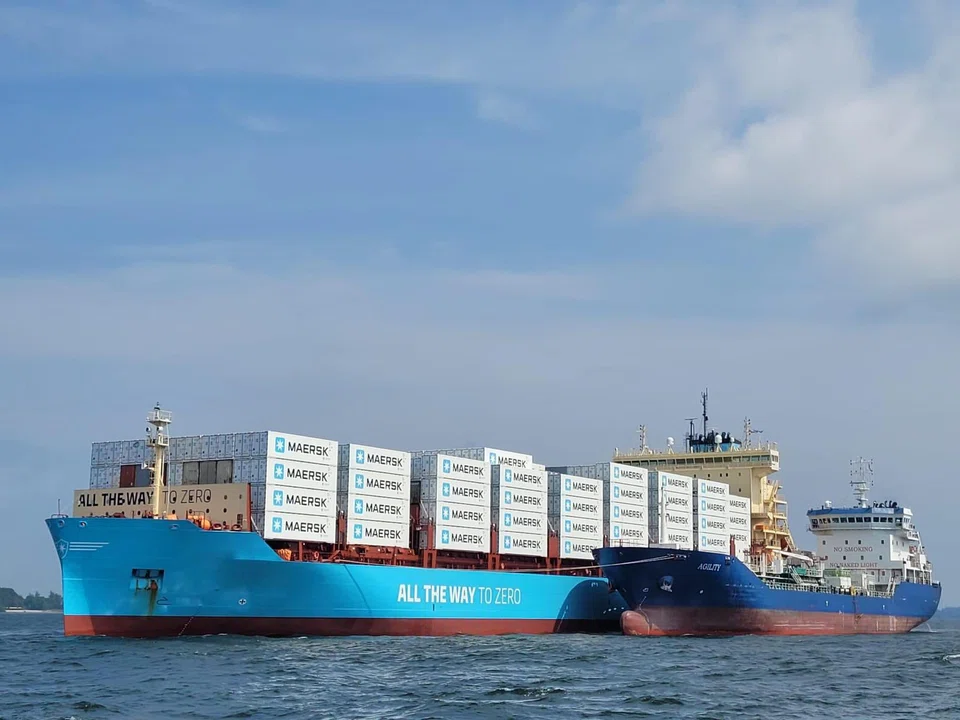
[SINGAPORE] The Republic, the world’s largest refuelling hub for ships, posted 8.7 per cent less bunker sales in April.
This is in tandem with a nearly 20 per cent month-on-month drop in oil tanker gross tonnage arriving in Singapore.
According to statistics from the Maritime and Port Authority of Singapore (MPA) published on Thursday (May 14), bunker sales stood at about 4.4 million tonnes in April, down 8.7 per cent from nearly 4.8 million tonnes in March.
On a year-on-year basis, the marine fuel volume sold was marginally lower by 1.2 per cent.
The number of oil-tanker arrivals, meanwhile, dropped 13.3 per cent month on month to 1,432 with 54.2 million gross tonnage in total in April, versus 1,651 with a total of 67.3 million gross tonnage in March.
In April last year, there were 1,483 oil tanker arrivals with 59.8 million gross tonnage.
Gross tonnage measures the total internal volume of tankers.
Ivan Mathews, head of Asia-Pacific analysis at Vortexa – a data and analytics platform for energy and freight industries – told The Business Times: “We noticed more ballast oil tankers heading to Zhoushan (China) instead of Singapore for bunkering in April. This is most likely due to more competitive bunker prices (there).”
Other vessel types – for example, container ships and cargo ships plying the route from North Asia to South-east Asia – may have also chosen to bunker in China instead of Singapore, Mathews added.
This has resulted in overall lower vessel arrivals in Singapore for bunkering in April and weaker bunker sale volumes.
The drop in bunker sales and fewer oil tanker arrivals for Singapore came as the supply of crude oil flowing through the Strait of Hormuz almost stopped after Iran closed the waterway following the start of attacks by the US and Israel on Feb 28.
Twenty per cent of global crude oil volume would have normally flowed through this passage.
Since the war began, spot prices for bunkers delivered in Singapore have more than doubled for key grades, including high-sulphur fuels, low-sulphur fuels and marine gasoils.
In March, MPA told BT that Singapore’s bunker supply comes from several sources and that there is enough supply to meet demand.
Meanwhile, total container throughput in April slipped 3.5 per cent month on month, but rose 3.6 per cent year on year to about 3.8 million 20-foot equivalent units or TEUs – a measure of capacity.
Total cargo also posted a decline, of 7.8 per cent over the month – but flattish year on year – to 49.2 million tonnes.
Ningbo-Zhoushan port overtook Singapore as the world’s second-busiest container port – for the first time – in the first quarter as the Chinese port’s nearly 11.6 million TEUs beat Singapore’s 11.2 million TEUs.
TRENDING NOW
Prima to move out of historic Keppel Road flour mill building in 2028

Temasek-related Azalea, SeaTown, Seviora Capital to merge in 2027
Family offices see more tailored products, leverage ‘collective firepower’ for direct deal access

Singapore room rates soar, but hotels seeing mixed demand from F1 race and events

