‘Wasting money, spending tokens’: Companies still in search of AI use cases with worthwhile ROI, says Broadcom’s Hock Tan
Both he and Intel CEO Tan Lip-Bu suggest that capital could be AI’s next biggest bottleneck
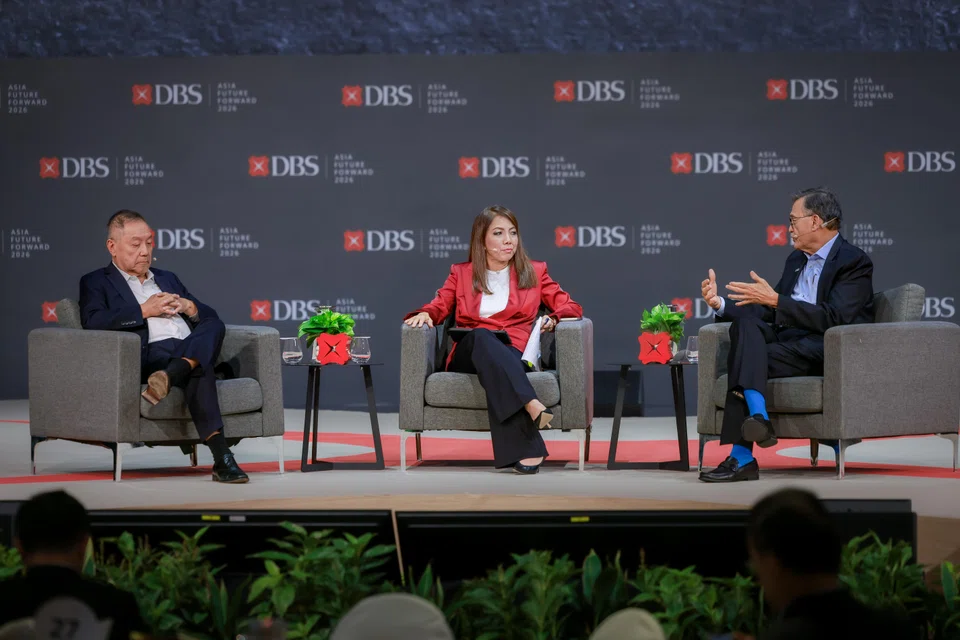
[SINGAPORE] Most companies are still trying to arrive at use cases for artificial intelligence (AI) that generate a return on investment, Broadcom’s CEO Hock Tan said on Monday (Oct 12).
While these companies have adopted AI in some form in their operations, their current use cases of generative AI are still “subtle” and are not necessarily raising productivity, he said in a panel discussion at a conference.
“Most companies out there cannot find any return on investment,” he said, adding that “people are just wasting money, spending tokens, trying to understand (AI)”.
He likened the situation to a child in a game arcade: “Ever thought when you’re a kid, you go to the arcade, your parents give you $10, you finish it in 10 minutes, and you haven’t learned anything? That’s what’s happening in enterprises today.”
He and Intel CEO Tan Lip-Bu were discussing the source of the next trillion dollars of investment in AI at DBS’ Asia Future Forward Conference, in a panel moderated by the bank’s CEO, Tan Su Shan.
Intel’s Tan said that investors are increasingly looking for a “real impact” from AI as they seek better returns on their investment, given the large amounts of capital that is being poured into the space.
Capital crunch
The current AI boom is focused on the hardware providers, otherwise known as providers of the “picks and shovels”, said Broadcom’s Tan.
But the future value of AI is likely upstream, towards the builders of frontier models, who have the capability to disintermediate software players, he added.
“If there’re only picks and shovels, this phenomenon will not sustain,” he said. “What’s really driving this, or will sustain and grow this, is whether (tech companies) can build the frontier models that can create a lot of value.”
Hence, capital is likely the next bottleneck for the industry, with frontier models seeking the same sources of financing as the infrastructure players of today, he said.
Intel’s Tan said he expects AI to have an even bigger impact on the world than the Internet, with agents being able to improve efficiency, enabled by larger amounts of available data.
Despite fears that AI may be a bubble near its bursting point, the two chipmaker leaders do not see any signs of a slowdown in the sector, given the impact that AI can likely bring to humans.
Commenting on investors’ disappointment in OpenAI’s latest revenue forecast, Broadcom’s Tan noted that an annualised revenue of US$50 billion is “by itself, not that bad”, considering its status as a startup.
The disappointment investors feel stems from their not understanding the business model of such AI companies, which he said is viable “for now”.
“A lot of investors have no clue what they’re investing in, but set very extreme expectations,” he said. “It’s almost like they are in a casino, gambling.”
For now, these companies are losing money as they are spending heavily on training, but this might change with greater scale.
DBS’ Tan referred to the “token paradox”, the situation in which companies are burning more tokens than before, yet spending less. For example, DBS has quintupled its AI consumption, while managing to reduce overall token costs.
She said: “The next wave of winners … will be the enterprises that know how to adopt this for their own return on investments and return on equity.”
Speaking in a separate panel discussion on capital flows in the AI era, Franklin Templeton CEO Jenny Johnson said that nobody has really talked about the transformation that needs to happen in every industry because of AI technology.
“In the end, who cares about the picks and shovels of any of this? It’s all about what businesses are enabled for.”
Decoding Asia newsletter: your guide to navigating Asia in a new global order. Sign up here to get Decoding Asia newsletter. Delivered to your inbox. Free.
Copyright SPH Media. All rights reserved.