

When Singapore burns hydrogen, prices go boom
Expect electricity rates 2 to 3 times the current prices with hydrogen in the mix, experts say

Wong Pei Ting
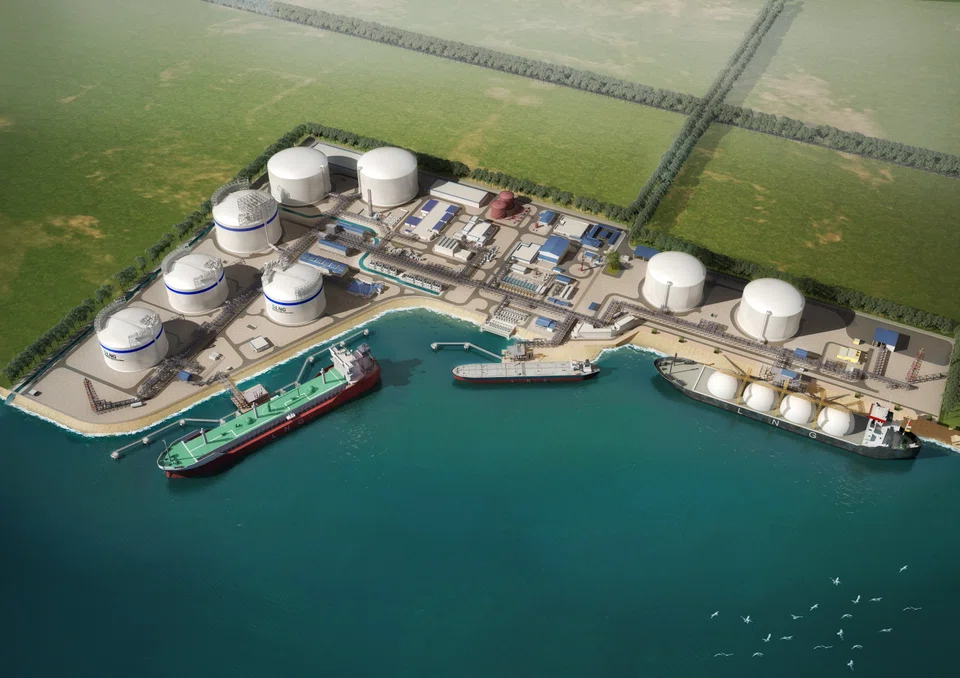
ELECTRICITY prices are likely to climb to two to three times their current rates if Singapore were to switch out natural gas for low-carbon hydrogen, two experts separately told The Business Times.
That estimate assumes a low-carbon hydrogen cost of US$6.60 per kg and accounts for distribution costs provided domestic hydrogen-compatible infrastructure is already built up, said Chan Siew Hwa, co-director of the Energy Research Institute @ NTU.
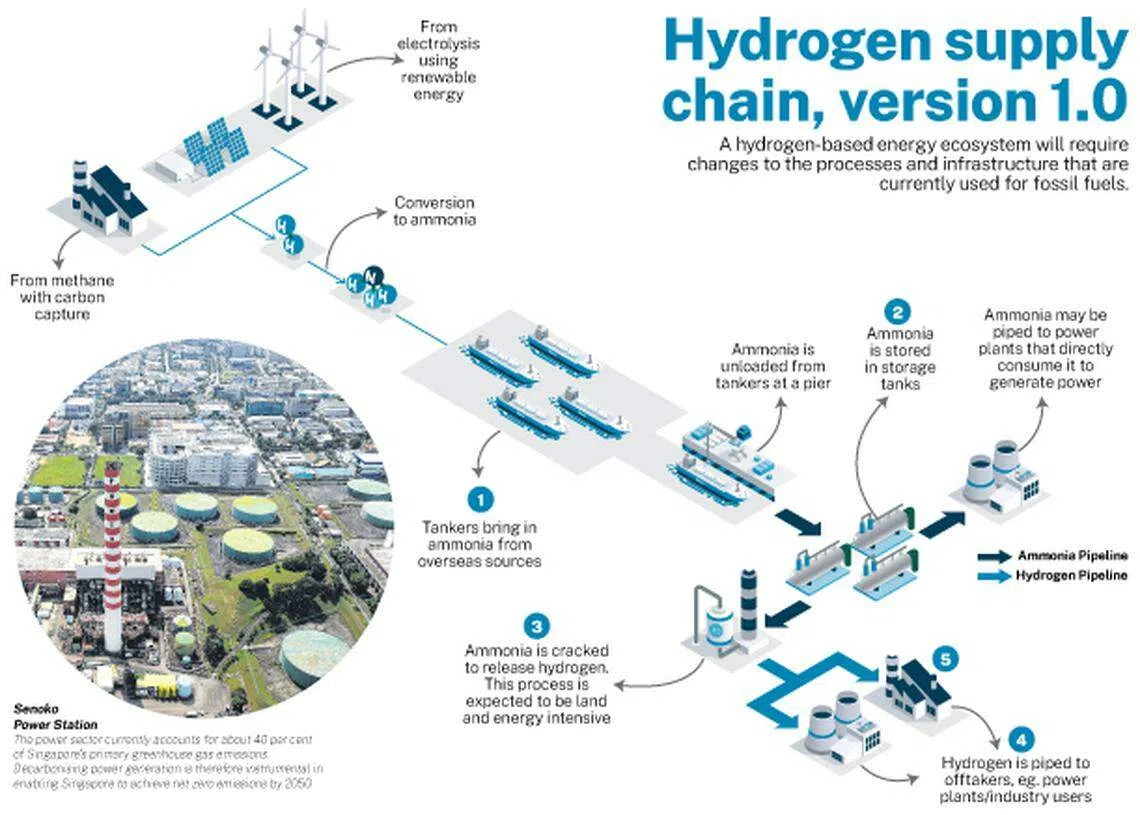
Justin Payne, a partner at sustainability consultancy firm ERM, came to the same conclusion by analysing the energy along a value chain that transports green hydrogen from Australia to Singapore in the form of ammonia – a leading candidate as a carrier chemical via which hydrogen can be transported and stored.
The Singapore Government recently launched an import-reliant hydrogen strategy, with Deputy Prime Minister Lawrence Wong announcing that hydrogen could supply up to half of Singapore’s power needs by 2050 if technology continues to advance.
Payne said Singapore is challenged by simple physics, pointing out that six to eight kilowatt-hours (KWh) of renewables from Australia would need to be imparted for every one KWh of energy ultimately produced by a hydrogen-ready power plant in Singapore. “Super simplistically, if you get access to electricity in Australia for 10 to 15 cents per KWh, it could be six times that (after transportation), which would be two to three times the current rate in Singapore,” he said.
Elaborating, he said there is an “energy penalty” in every step of the hydrogen value chain, beginning from the electrolysis of water at the source country, where hydrogen is produced with the use of renewable energy without releasing any carbon into the atmosphere. The output after compressing the hydrogen gas, converting it to ammonia for easier transport, and cracking the ammonia to get hydrogen again at the destination country is therefore far lower at the receiving end, he noted.
System complexities
Chan, likewise, said it is hard to know the cost of infrastructure buildout due to the complexity of a hydrogen system and its supply chain.
Among other things, special pipelines will have to be installed to domestically distribute hydrogen because current pipelines used to transport natural gas are not suitable for hydrogen, which can embrittle stainless steel. Although current natural-gas fired gas turbines can use a blend of up to 30 to 50 per cent of hydrogen by volume, 100 per cent hydrogen-ready turbines will eventually be needed too.
Chan also specified a need for liquefied hydrogen (LH2) bunkering facilities, which can be co-located within liquefied natural gas (LNG) ones, in the future. LH2 – touted as the ideal feedstock – removes the need for a hydrogen carrier, but it needs to be cooled to an extreme temperature of -253 degrees Celsius to maintain its liquid form for transport.
David Phua, a special counsel with global law firm King & Wood Mallesons, said the level of infrastructure modification and construction required will depend quite heavily on the degree and manner in which hydrogen displaces other energy sources.
Sharad Somani, who heads infrastructure advisory at professional services firm KPMG in Singapore, said a larger cargo space on tankers will be required to transport equivalent volumes of hydrogen, given its low density. He said green hydrogen’s delivered cost will need to come within the same ballpark of around S$2 per kg for it to be commercially viable.
The right price to pay
However, David Broadstock, a senior research fellow specialising in energy economics at the same institute as Chan, said the hydrogen market is not mature enough for proper price discovery to occur at present. “Are there enough competitors in the market to make sure that those prices are truly fair and clear?” he questioned.
An upside, he said, is that there are no risks of asset stranding in the near term since existing gas turbines and storage options can be co-opted for ammonia.
Payne said ammonia infrastructure can also be pivoted for bunkering use. “Potentially, there is a long-term play here for Singapore to utilise those same assets… Jurong could provide an alternate energy vector for heavy international shipping routes,” he added.
In response to BT’s queries, a MTI spokesperson said transition cost will depend on two key factors – the landed cost of hydrogen (the overall cost of producing hydrogen, converting it to a carrier if necessary, and transporting it to Singapore), and the capital and operating cost of distributing and utilising that hydrogen in end-use applications.
“We expect costs to come down as technologies mature and supply chains scale up,” the spokesperson said. Costs could also come down if the US, EU and China spur global production and uptake of low-carbon hydrogen, she added.
This being the case, the development of enabling infrastructure and hydrogen deployment in Singapore will be “progressive and paced”, the spokesperson said.
TRENDING NOW
Philippine power giant First Gen rebuffs foreign offers, plans up to US$2.6 billion in expansion

Cliff Tan has 7 million followers and a 4-month waitlist. Why won’t he expand his business?

Could stablecoins be the future of money?
From finance aspirant to Asean CEO: TUV SUD’s Jonas Strahberger on finding people who believe in you

