

Will Top Glove's labour issues threaten its place on benchmark ESG indices?
Experts warn of severe impact if it loses its spot; human capital, corporate governance among top ESG issues

Singapore
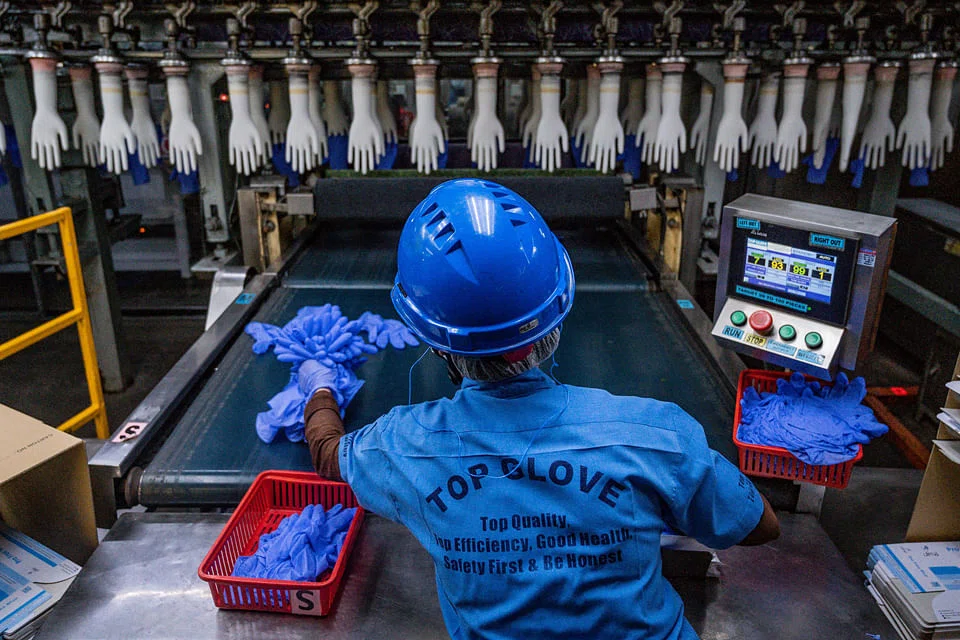
TOP Glove could be in danger of being downgraded or booted out of indices based on environmental, social and governance (ESG) factors, after the company was once again thrust in the spotlight over labour practices.
Announcing its financial results for the second quarter of fiscal year 2021 ended February, the glove manufacturer had last month said it remains on the FTSE4Good Bursa Malaysia Index and the Dow Jones Sustainability Emerging Markets Index (DJSEMDUP).
The FTSE4Good Bursa Malaysia Index analyses companies' ESG compliance across 14 themes including climate change, anti-corruption, corporate governance and labour standards. The index uses more than 300 quantitative and qualitative indicators.
The DJSEMDUP, meanwhile, comprises "emerging-market sustainability leaders" selected on economic, environmental and social criteria.
The former is reviewed semi-annually in June and December, while the latter is rebalanced in September each year and also reviewed on an ongoing basis to account for corporate actions.
Between annual rebalancings, a company can be deleted from the DJSEMDUP if the index committee determines a company is "no longer behaving in a matter that is consistent with the Corporate Governance Compliance". Issues could include labour disputes, or human rights or workplace safety matters.
A spokesperson for S&P Dow Jones Indices told The Business Times that while it does not comment on individual companies and potential index changes, the index committees "monitor market events and controversies that may affect index constituents".
Any potential changes to its indices and related matters will be kept confidential until publicly announced, added the spokesperson.
In light of recent developments, associate professor of accounting at the NUS Business School Mak Yuen Teen said there is "a good chance" Top Glove's presence on ESG-linked indices will be re-evaluated. The impact would vary depending on the weighting of social aspects in the different indices, he said, as the company's issues are predominantly in that area.
"Whether Top Glove gets booted out (of the indices) depends on how quickly it addresses the issues," added Prof Mak.
Sustainalytics - an ESG solutions provider owned by Morningstar - on March 18 assigned Top Glove an overall social controversy assessment of 4 out of 5, indicating that the events under this category have a "high impact on the environment and society" and pose "significant risks" to the company. This category often reflects structural problems in the company, said Sustainalytics.
But Top Glove was also assigned an overall rating of 1 out of 5 for governance controversy, while no evidence of relevant controversies were found on the environmental front.
On the whole, Top Glove's most recent ESG risk rating on Sustainalytics stood at 26.1 - meaning it is at a medium risk. Its top material ESG issues are corporate governance, business ethics, human capital and product governance.
On March 29, the US Customs and Border Protection (CBP) directed personnel at its ports to seize gloves produced in Malaysia by Top Glove. This directive came after the CBP Office of Trade, in consultation with the Secretary of the Treasury, published a forced labour finding on Top Glove.
In a statement on April 1, Top Glove clarified "no new additional issue on forced labour" has been discovered or added. The company however acknowledged that "a few rectification and verification works" are required on earlier findings.
Top Glove's shares, which are dual-listed on the Singapore and Malaysia exchanges, are already under siege.
This year, Top Glove is down 18.2 per cent in Singapore and 15.6 per cent in Malaysia.
The shares recovered some ground on Thursday, rising 0.7 per cent or S$0.01 in Singapore to close at S$1.53. In Malaysia, Top Glove gained 2.7 per cent or RM0.12 to RM4.64.
Companies with weak ESG compliance are now more susceptible to flak from both institutional and retail investors. Brian Freitas, an analyst who publishes on Smartkarma, said ESG factors are playing a much-larger role in investment decisions.
"A serious ESG issue could lead to a drop in the stock price and affect the ability of the company to raise funds in the secondary market without diluting existing shareholder stakes to a large extent," he said.
If Top Glove were to drop out of any index, the impact could be severe.
Edris Boey, head of ESG research at Maitri Asset Management, said it is more significant that a company is booted out from an index than if it had been excluded in the first place: "Companies that are booted off an index tend to have experienced a severe controversy or issue during the assessment period."
At the same time, asset managers said index inclusion is just one of many variables that they consider.
Jenn-Hui Tan, global head of stewardship and sustainable investing at Fidelity International, said: "Different ESG metrics are relevant to different businesses, and so investors have to do their own due diligence."
David Smith, senior investment director at Aberdeen Standard Investments, said the asset manager conducts proprietary ESG research and assigns its own ESG ratings as part of the investment process.
While Mr Smith noted that third party ESG rating vendors help foster greater transparency and reporting standards, there are still "high levels of inefficiency" in the ESG information market.
Steve Freedman, head of sustainability and research for thematic equities at Pictet Asset Management, said that whether a company is included on such an index is "not directly relevant for (Pictet's) security selection".
Instead, Pictet's investment teams take it upon themselves to analyse and interpret ESG information from external providers.
TRENDING NOW
Looking beyond looming CEO succession, should UOB potentially pursue a transformative merger?

Once staunchly pro-China, Malaysian Chinese businesses are now distancing themselves from Beijing
Family offices ‘kept captive’ by relationship managers turn to independent advisers, direct deals
MAS holds monetary policy settings, pausing after two straight tightenings

