Issue 136: Singapore Budget 2025 funds sustainability for the long term; nuclear gains momentum

This week in ESG: Climate and energy trust funds receive substantial top-ups; government steps up assessment of nuclear power
Singapore Budget 2025
Rainy-day funding
The Singapore government’s 2025 Budget statement was a mixed bag for sustainability measures, going light on new initiatives, but heavy on allocations for future spending.
Most of what corporates were hoping for in terms of sustainability-related support did not come to pass. However, the government has committed two sizeable injections into trust funds earmarked for future spending on the national energy transition and on coastal protection.
In his capacity as Finance Minister, Prime Minister Lawrence Wong said on Tuesday that the Coastal and Flood Protection Fund and the Future Energy Fund will each receive top-ups of S$5 billion. The Singapore government uses trusts to fund specific programmes on an ongoing basis. Because trusts can last for as long as the programme exists, money ring-fenced through a trust can provide funding stability from year to year and election to election.
He also announced a new Heavy Vehicle Zero Emissions Scheme to provide incentives for companies to buy clean heavy vehicles, and an Electric Heavy Vehicle Charger Grant to co-fund charging infrastructure. Details will be shared by the Minister for Transport at the coming parliamentary Budget debates.
However, the government will levy an additional road tax – the Additional Flat Component – on electric heavy goods vehicles and buses as a form of usage charge. This is to make up for the usage charge in the form of fuel excise duties that are paid for internal combustion engine vehicles.
For households, the government will add another S$100 per household to an existing S$300-per-household Climate Vouchers scheme for households living in public Housing Board flats. The vouchers will also be made available to households living in private properties. These vouchers can be used to buy energy and water-efficient appliances and fittings.
Appended Budget materials that were not mentioned in the speech also included enhancements to tax concessions under the Maritime Sector Incentive. The incentives will now be expanded to cover offshore renewable energy activities to cover the subsea distribution of renewable energy generated onshore, including ships that support such activities.
Wish on
Except for the clean heavy vehicle incentives, every other sustainability-related allocation in the Budget went towards expanding or extending an existing initiative.
This fell far short of a long wishlist of sustainability-related proposals offered by the Big Four accounting consulting firms.
With those wishlists often reflecting existing and anticipated pain points faced by corporations, Singapore-based businesses found little help in becoming more sustainable from this Budget. Oft-highlighted issues in the wishlists included clarity on climate and social impact standards, frameworks and reporting; development of carbon markets; support for greening supply chains; and tax incentives for green real estate.
It’s not a complete loss, however. Some of those asks, such as matters related to standards and frameworks, could very well be rolled out over the course of the government’s normal operations later in the year even though they went unmentioned in the Budget speech.
Some of those proposals may also be premature. For example, Deloitte called for an extension and expansion of the Sustainability Reporting Grant, which can be used by companies producing their first International Sustainability Standards Board-aligned sustainability report ahead of mandatory reporting requirements to partially defray the cost of doing so.
However, the grant was only launched in November, and only S$500,000 of the S$37 million set aside for the programme is expected to be spent by end-March 2025. A further S$13.4 million is estimated to be disbursed in the year ending March 2026. Any extension or expansion of the grant will most likely take place only after there has been enough experience on the ground to know how to improve it.
Stockpiling
The S$10 billion in top-ups to the two trust funds will have limited impact in the current year.
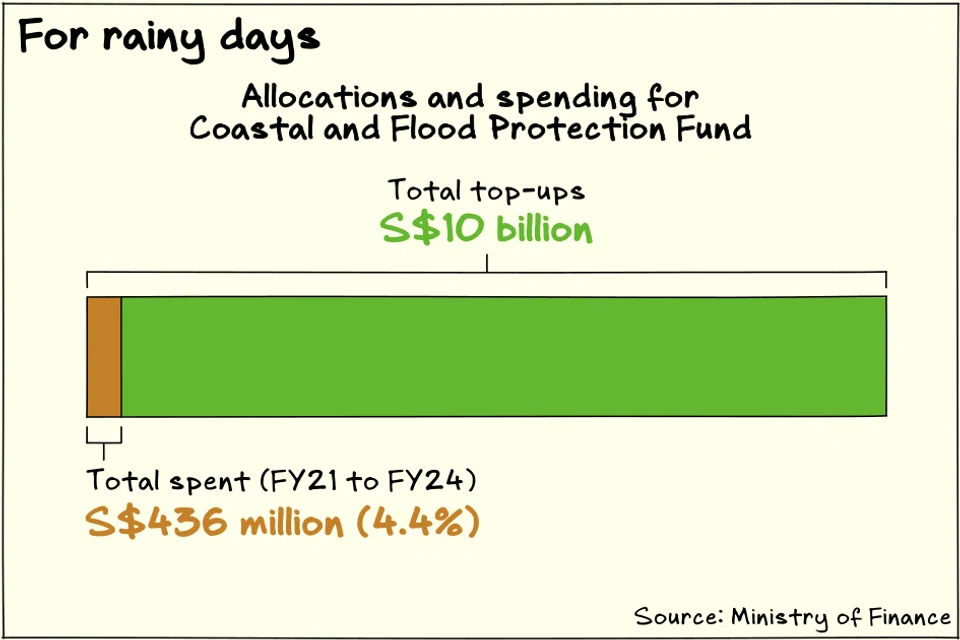
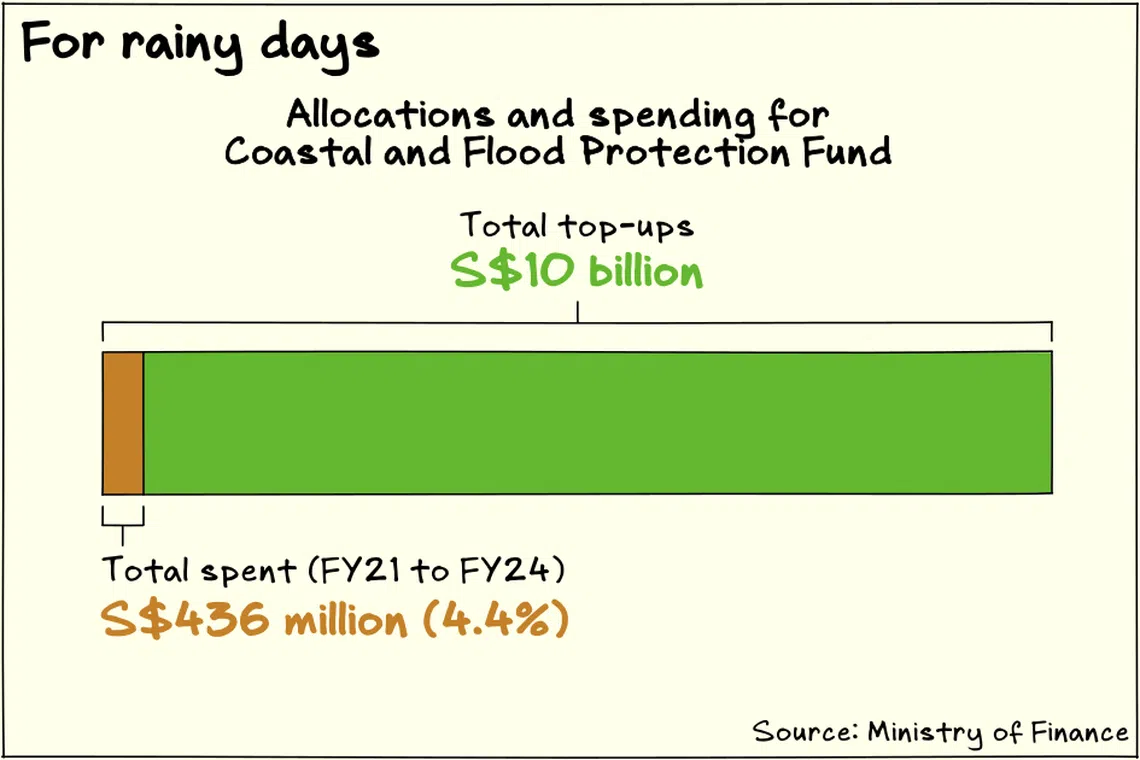
Since it was announced in 2020 with an initial S$5 billion in the vault, the Coastal and Flood Protection Fund is on track to have spent only S$436 million by end-March this year. The Future Energy Fund was also set up with an initial S$5 billion in the 2024 Budget, but none of that money has been spent.
That slow disbursement is because the funds are being set aside for the long term. For example, most of the adaptation measures envisioned for the Coastal and Flood Protection Fund will probably only be implemented over two decades from the 2030s onward, PM Wong said.
The funds demonstrate the scale of investment required – both in time and cost – for Singapore to achieve its climate goals and to adapt to climate change. Just as importantly, they also reflect Singapore’s commitment to address those issues.
From a sustainability perspective, this Budget eschewed short-term measures for the long term.
Energy transition
Going nuclear
The 2025 Budget speech marked an important shift in Singapore’s energy transition strategy, with nuclear power rising in priority over green hydrogen.
Prime Minister Lawrence Wong, who is also Finance Minister, said on Tuesday that the Singapore government would reorganise itself to “provide greater emphasis” on studying the potential deployment of nuclear energy, including systematically building capabilities in the technology.
Although Singapore had already previously signalled its intent to assess nuclear technology – in 2024, Singapore and the US signed a civil nuclear cooperation pact that is commonly called a 123 Agreement – this took the intent a step further with the announcement of plans to make structural changes within the government to facilitate the development of the technology.
Singapore appears to be in the midst of pivoting towards nuclear from earlier hopes for hydrogen. PM Wong noted that although Singapore has been “closely evaluating” the use of low-carbon hydrogen for electricity, “there are inherent challenges in the production, storage and transportation of hydrogen, which makes it hard to scale up in a commercially viable manner”.
Because of physical constraints, Singapore is unable to obtain enough power from more established renewable technologies like solar, wind and hydro. As a result, the country has been taking a keep-all-options-open approach to its energy transition, waiting for better clarity on the viability of different energy technologies before committing to any single solution. Nevertheless, the Energy 2050 Committee in 2022 envisioned different scenarios, with low-carbon hydrogen contributing a significant portion of Singapore’s energy mix.
But as the prime minister explained, viable green hydrogen at scale remains elusive. With interim climate targets approaching in 2030 and net zero ambitions for 2050 after that, Singapore might not have enough time to wait for hydrogen to turn the corner.
Nuclear, while expensive, is a relatively proven technology and can buy Singapore a bit of time alongside low-carbon electricity imports. While the technology is potentially promising, Singapore is still in the early stages of making a decision on whether to pursue nuclear power.
This doesn’t mean that Singapore will close the door on hydrogen. As a matter of energy security, maintaining a diverse power mix remains the national preference. But Singapore has targets to meet, and it’s not waiting for hydrogen to show up.
Other ESG reads
- Budget 2025: Incentives for cleaner heavy vehicles will cut carbon, costs, but more details needed
- Asia banks stick with net-zero group that Wall Street abandoned
- Neste sees potential for renewable diesel in Singapore’s maritime industry
- Higher carbon taxes may be needed for Singapore to meet its 2035 climate targets
- Shipping giants urge watchdog to avoid biofuels in clean-up push
- SMEs should start ESG reporting before regulation catches up