

Issue 141: Singapore banks face hard steel; UOB launches nature strategy

This week in ESG: DBS, OCBC, UOB report higher steel-sector financed emissions; UOB debuts plan to address nature-related issues
Net zero
Steel chasing the green dream
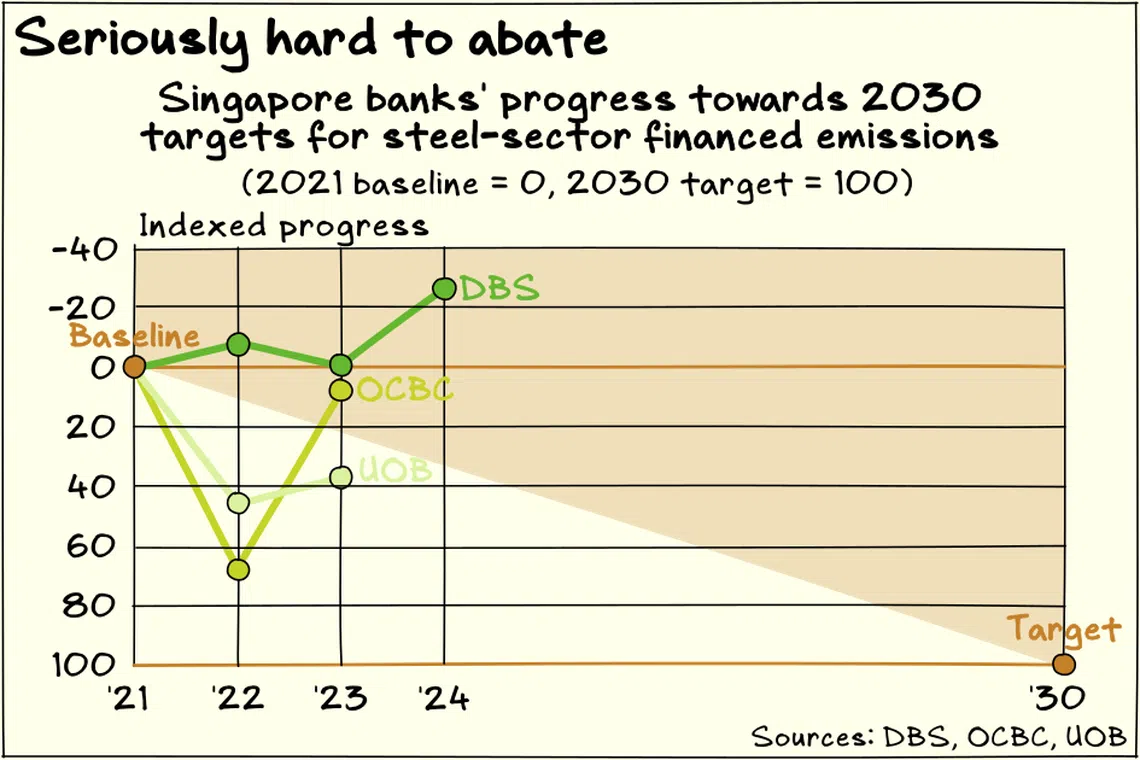
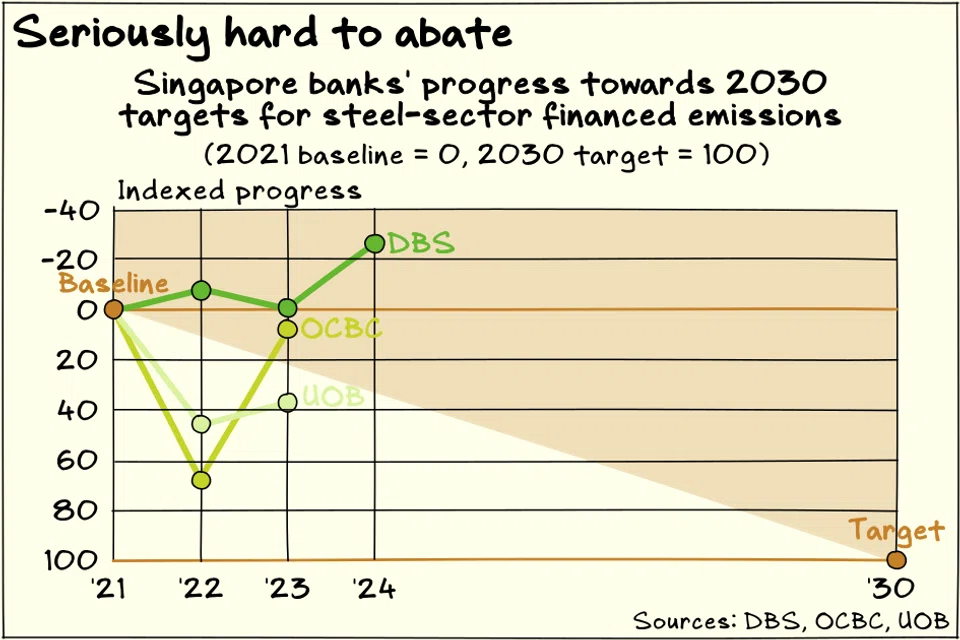
Steel is proving to be an especially hard-to-abate sector for Singapore’s three major banks.
The latest financed emissions data from DBS, OCBC and UOB showed the lenders slipping further from their 2030 targets for the steel sector.
DBS, which updated its numbers at the start of March, reported that the emissions intensity attributable to loans it provides to the steel sector rose to 2.09 kilogrammes of carbon dioxide equivalent per kilogramme of steel (kgCO2e/kg-steel) in 2024, from 1.95 kgCO2e/kg-steel the year before. That’s higher than the baseline year of 2021, when steel-sector emissions intensity was also 1.95 kgCO2e/kg-steel. DBS is aiming to cut emissions intensity for the sector to 1.42 kgCO2e/kg-steel by 2030 en route to a 2050 goal of 0.42 kgCO2e/kg-steel.
UOB reported in late 2024, but included in their sustainability report a week ago, that its steel-sector financed emissions intensity increased to 1.64 kgCO2e/kg-steel in 2023 from 1.76 kgCO2e/kg-steel in 2022, also taking it slightly further away from its interim 2030 goal of 1.42 kgCO2e/kg-steel.
This week, OCBC’s sustainability report showed that steel-sector financed emissions intensity rose to 1.91 kgCO2e/kg-steel in 2023 from 1.76 kgCO2e/kg-steel a year ago. Its 2030 target is 1.68 kgCO2e/kg-steel.
OCBC and UOB’s latest numbers are for 2023, while DBS’ numbers are for 2024.
Hurdles everywhere
Geography is a major reason for the spotty progress. The Singapore banks’ steel exposure is mostly in Asia, and steelmaking in the continent, especially in China and India, remains dominated by carbon-intensive blast furnaces. OCBC, citing the Climate Action Tracker, said that the Blast Furnace-Basic Oxygen Furnace (BF-BOF) production process supports 90 per cent of domestic steel production in China. The South East Asia Iron and Steel Institute estimates that about 83 per cent of steel-sector carbon emissions in the Asean-6 – which refers to Brunei, Indonesia, Malaysia, the Philippines, Singapore and Thailand – will be from blast furnaces.
As the banks grow their steel portfolios in the region, their financed emissions for the sector will probably increase as well. OCBC said portfolio growth was the main reason for the higher emissions intensity in 2023.
It’s an uphill battle trying to replace those blast furnaces with less-emitting electric arc furnaces (EAFs). For a start, Asia’s fleet of blast furnaces is quite young. The average lifespan of BF-BOF is about 40 years. In China and India, blast furnaces have an average age of only 10 to 15 years and are unlikely to be retired soon.
The need for steel is growing, with global demand expected to increase by about 32 per cent by 2050, according to the World Economic Forum’s analysis. Although the planned use of EAFs is increasing, about two-thirds of planned expanded capacity is still expected to be based on BF-BOF. Carbon lock-in, which occurs when persistent emissions-intensive sources delay or prevent the transition to low-carbon alternatives, is therefore a huge problem for the steel industry.
One factor holding back wider adoption of EAFs is the cost of “green” steel, which is generally higher than blast furnace steel, although the premium varies depending on a number of inputs including the prices of electricity, coal, hydrogen and carbon. EAF also uses scrap steel, of which there is insufficient supply. OCBC observes that while some buyers in the auto and real estate sectors might be willing to pay a higher price, green premiums “are not observed at scale globally”.
That premium could narrow with policy pressure. UOB notes that the European Union’s Carbon Border Adjustment Mechanism and Emissions Trading System are helping to drive the sector towards more sustainable practices globally. China, which produces most of the world’s steel, aims to peak emissions by 2030 are also driving greening in a key market.
Borrower’s market
The policy direction and the banks’ own decarbonisation targets mean that despite the challenges, the three banks remain committed to their emission targets for now. In fact, they appear to be using the opportunity to build up their sustainability and transition finance business.
This is a good time for steel industry businesses to obtain financing for green or transition purposes. The banks need to significantly redirect their lending to the industry towards more sustainable goals, or they will miss their net zero targets, and time is running out.
However, providing transition finance – such as sustainability-linked loans that reward borrowers for achieving decarbonisation targets – to steel companies can lead to increases in financed emissions in the short term, even though the financing is intended to drive those emissions down in the long term.
DBS states: “As we further extend support to the transition of high-emitting steel players on their path to decarbonisation, this will likely exert upward pressure on our short-term emissions performance. However, this will build up the much-needed momentum for the sector’s transition in Asia and enable greater decarbonisation of our portfolio in the longer-term.”
As the banks develop their transition finance portfolios, it’s possible that they might see benefits to changing the way they report financed emissions to provide better visibility into how much of their emissions are in transition and the progress of that transition.
It’s possible that the banks will still miss their 2030 targets despite their best efforts. The truth is that it probably doesn’t matter for the bank if it misses this target. The banks aren’t contractually obligated to hit those targets, so there’s no direct economic implication for a miss. It’s possible that there’s some reputational risk with falling short of the goal, but that would probably be minimal if the global steel sector as a whole fails to decarbonise quickly enough since the banks wouldn’t be the only ones struggling.
Nevertheless, even if the banks were to miss their targets, a significant mitigating factor would be how much progress they’ve made despite the miss. A good try’s better than none.
Sustainable finance
First steps
UOB has revealed its nature strategy in its latest sustainability report, a first for the Singapore banks.
While the banks have had climate and emissions frameworks and strategies for a few years now, addressing nature-related impact, risks and opportunities is still very nascent. That’s largely because approaches, definitions and policies around the world are still being formed. The Taskforce on Nature-related Finance Disclosures (TNFD) only released its recommendations in late 2023, so the industry has only had just over a year to work on implementing the framework.
At this stage, UOB’s strategy mainly consists of assessing dependencies and impacts in its portfolio. The bank identified agricultural production, mining and quarrying, building construction and development, oil and gas exploration and production, and waste management as priority sectors with material exposure to nature. Those sectors account for about 20 per cent of UOB’s loan book.
There is also some discussion about opportunities in nature-related financing, but no figures were provided.
UOB explains that it is only at the start of a “multi-year journey in implementing the TNFD Recommendations”, and it’s clear that the nature strategy is still a work-in-progress.
Consultant Boston Consulting Group (BCG) devised four steps to building a nature strategy: Identify sectors with high nature exposure; measure one’s nature footprint; determine avenues for value creation; and set clear targets. UOB has identified sectors and touched on value creation avenues, but has not provided any numbers to reflect its nature footprint or to set targets.
That omission is understandable, given the lack of good data and reporting frameworks available. One of the main enabling factors that has allowed climate reporting and decarbonisation strategies to become as sophisticated as they are today is the existence of widely accepted reporting standards, taxonomies and pathways. The same development is needed to help nature-related strategies take off.
These are especially important for the development of nature-related financing. For example, even though companies might already report on water usage under current sustainability reporting standards, widely recognised science-based pathways and taxonomies are needed in order to determine whether a water-saving initiative is achieving enough to qualify for nature-specific financing.
If the nature-based financing world’s infrastructural gaps can be closed, there’s a potentially lucrative business to be built. BCG estimates that reversing the decline in natural systems will require US$1.2 trillion a year in private capital. An individual bank that takes a lead in the market for financing and investing in activities that advance nature stands to generate up to US$250 million in incremental revenue, the consultant reckons.
It’s still early days, but UOB has wasted little time in preparing the ground to stake its claim to that lead.
Other ESG reads
- Temasek-backed Pentagreen, UK’s impact investor commit US$80 million to scale South-east Asia’s clean energy
- The continuing search for sustainable sand alternatives an imperative for Singapore
- High costs limit plastic recycling in South-east Asia: Bain
- Indonesia accelerates transfer of confiscated palm plantations to state company
- The unreliable and fickle flavours of corporate values
- The global path to net zero: A call for Asean+3 leadership
TRENDING NOW

LTA proposes combining car COE categories, adding rebate-surcharge system

StarHub to acquire MyRepublic’s mobile business amid ongoing telco consolidation

DBS, OCBC, UOB rout lops billions off STI as inflation, rate concerns spook investors

Grab CEO’s wife Chloe Tong on life with Anthony Tan and finding her purpose

