

Issue 118: Convergence S-E Asia lead – Regulators should get hands dirty, build sandboxes to grow blended finance

This week in ESG: Convergence’s Ritesh Thakkar shares a blended finance must-do list for South-east Asia.
Blended finance
Catalysing a region of potential
Regulatory sandboxes could close the gaps between perceived and actual risk in blended finance in South-east Asia, says Ritesh Thakkar, Asia-Pacific senior adviser for blended finance development group Convergence.
At the same time, developmental finance and regional philanthropic capital need to prioritise private capital mobilisation in order to meaningfully scale up blended finance, Thakkar tells ESG Insights.
Blended finance refers to funding structures that use concessional capital to improve the risk or return of a deal so that commercial capital is able to take part. The structure is widely viewed in sustainable finance circles as critical to accelerating environmental and social progress in developing economies, although blended finance remains a small portion of overall financing.
Region of potential
Thakkar lays out his wish list for scaling up blended finance in South-east Asia as the climate finance world marks the end of 2024 with key events: The first is taking place in the US with New York Climate Week, and the second takes place in November in Baku, Azerbaijan, with the United Nations Climate Conference – commonly referred to as COP29.
COP29, in particular, will see negotiations for a new global climate finance target to replace a 2009 goal of US$100 billion by 2020. The world missed that old target, which in any case was severely inadequate for a financing gap estimated to be in the trillions.
“What we want to see is how much of that money is focused on private-sector mobilisation,” he says.
But grand global pledges are one thing; actually putting money to work in a region like South-east Asia is another.
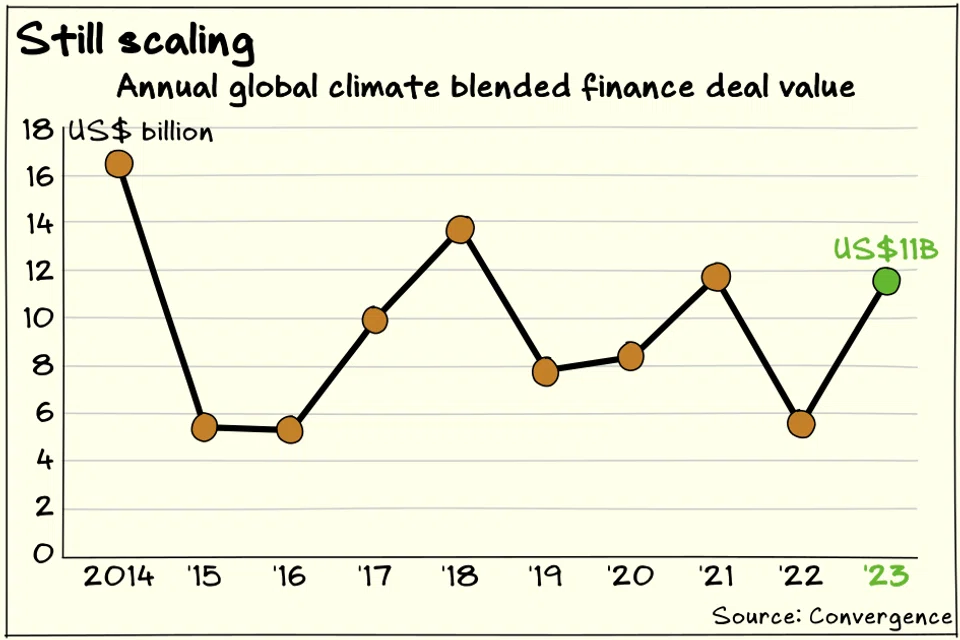
Thakkar, who took up his current role in 2023, says South-east Asia has been a resilient market for blended finance, demonstrating growth in 2023 despite declines in many other parts of the world. Although last year’s US$23 billion of blended deals recorded in South-east Asia by Convergence represented only a fraction of the region’s overall financial markets, the momentum remains positive.
“We’re not seeing scale,” he says. “We are far from that, to be honest, in terms of the number of transactions. But what we are seeing definitely is a consistent growth of the market, which is very encouraging.”
Regulatory interest
Thakkar is particularly optimistic about the level of interest shown by the region’s financial-sector regulators, central banks and ministries of finance in blended finance. For instance, the Monetary Authority of Singapore has introduced a Financing Asia’s Transition Partnership (Fast-P) initiative to raise US$5 billion for climate transition in the region.
He also shared that in Indonesia, Convergence has been commissioned by OJK, the country’s financial services regulator, to provide capacity-building solutions for the financial sector on blended finance.
“It’s very interesting. You don’t (typically) see central banks and financial regulators doing market intermediation in areas where there are market failures,” he says.
It’s important that rulemakers get into the thick of blended finance, he adds.
“Once they have a better understanding of these concepts they can really reflect on their regulations and see where blended finance is being blocked because of regulation, and then reflect on whether it makes sense for them to ease it,” he says.
Thakkar suggests creating regulatory sandboxes for blended finance, which could allow experimentation with the rules without creating greater systemic risk. Convergence has identified regulatory bottlenecks and risk perception as key obstacles to scaling up blended finance. For example, regulations might assign more risk to blended deals in emerging markets than necessary, making such deals costlier for banks to finance.
“Fintech also came with its own risks and it was a warm-up to a certain extent,” Thakkar says, referring to the existence of fintech regulatory sandboxes. “If you feel this is an angle which is important, why don’t you put blended finance into a sandbox environment and monitor it on how it goes, and once you feel comfortable, then you tweak the regulations.”
Local power
The region’s financial-sector overseers can also help to drive more domestic private-sector participation in blended deals. Local funds have an advantage over international capital because they do not need to hedge their currency risk, Thakkar explains.
“If you look at countries like Indonesia, Vietnam, Philippines, they’re all sitting at decent GDP per capita, they have decent savings rates, decent liquidity in their banking system and the financial markets,” he says. “There is nothing that stops them from bringing their own capital in, towards channelling sustainable development goals financing in their own countries for their own benefit.”
In terms of local concessional capital – which includes public development funds, philanthropies and impact funds – Thakkar sees a need to focus more on enabling private-sector mobilisation instead of merely providing project grants. Using concessional capital to catalyse multiples more in private funding allows the concessional dollar to go further, so the argument goes.
Putting capital to work through blended finance funds and facilities is one way to do that. This is especially true in South-east Asia, where development opportunities in sectors like agriculture are dominated by small project sizes. Channelling the financing for those small projects through funds or facilities allows for larger ticket sizes, which in turn opens the doors to institutional participation.
Concessional capital needs to understand that “their money is not going to do enough unless we bring private finance in”, he says.
Thakkar stresses that blended finance cannot be a “silver bullet” for all the financing gaps in the world. The fact that it taps concessional capital necessarily imposes certain conditions, such as the existence of market failure with a viable pathway towards commercial sustainability.
But with every concessional dollar catalysing about four dollars of private capital on average globally for blended finance, blending is a much more efficient use of altruistic money.
“If you really use this money strategically, it’s going to go a long way for everyone. For beneficiaries. For concessional capital providers to report impact,” Thakkar says. “Technically it’s a win-win for everyone.”
Other ESG reads
- Singapore issues S$1.5 billion of 50-year green bonds at 2.62% cut-off yield
- Singapore sets aside S$2.1 billion of green bond proceeds for electric rail expansion in FY2023
- Brookfield fund raises US$2.4 billion for clean energy investment
- Temasek sets aside S$100 million as concessional capital for climate finance
- EVs in India and South-east Asia could be US$1.3 trillion market by 2030: report
- Singapore listcos must report direct and indirect greenhouse gas emissions from FY2025
TRENDING NOW

Could stablecoins be the future of money?

Once staunchly pro-China, Malaysian Chinese businesses are now distancing themselves from Beijing

Vietnam’s data-centre investment rush faces reality check on power and site constraints

‘My grandfather’s legacy’: Sherman Kwek lays out three-year plan for CDL to drive returns

