

Issue 129: LReit’s new debt sticks to sustainability-linked structure; Oxford Economics weighs food cost of net zero

This week in ESG: Lendlease Global Commercial Reit’s commitment to sustainability-linked financing; net zero could significantly raise food production costs in South-east Asia
Sustainable finance
LReit all linked to sustainability
Note: ESG Insights will take a break on Dec 20 and return on Jan 3.
Lendlease Global Commercial Real Estate Investment Trust (LReit) has secured up to S$760 million of sustainable-linked debt facilities, further cementing the retail and office property trust’s commitment to sustainable finance.
With structural incentives in place to tie sustainability outcomes to financial performance, LReit’s next challenge is setting a credible set of interim targets towards its longer-term goals.
On Dec 6, LReit announced two sizeable sustainability-linked term-and-revolving facilities. The first is for up to S$420 million of borrowings with an option to increase it by a further S$200 million – also known as an accordion. The second is for up to S$140 million.
LReit will use the proceeds to refinance existing debt and for general corporate purposes.
The facilities come as LReit enters a crucial three-year period for potentially refinancing S$850 million of Singapore-dollar debt. As at Sep 30, LReit had S$360 million of committed and drawn debt maturing by the end of its fiscal year in June 30, 2025. A further S$290 comes due in FY2026, and S$200 million in FY2027.
The new facilities bear sustainability-linked structures, which vary the interest rates on the loans depending on a borrower’s performance against sustainability key performance indicators (KPIs). While exact structures and terms can vary, the general principle is that borrowers will pay a higher interest if the KPIs are missed, and a lower one if the targets are met.
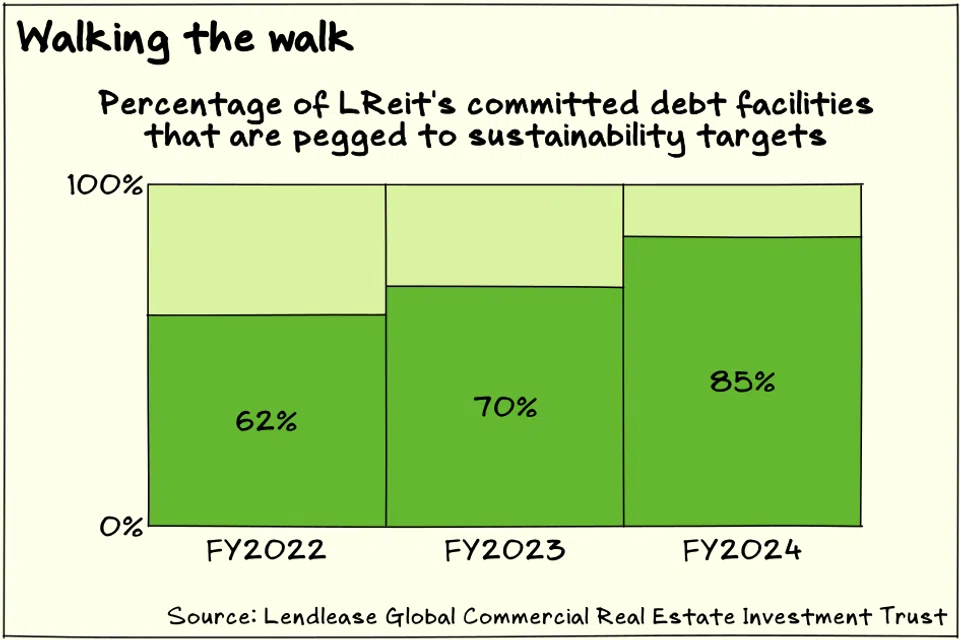
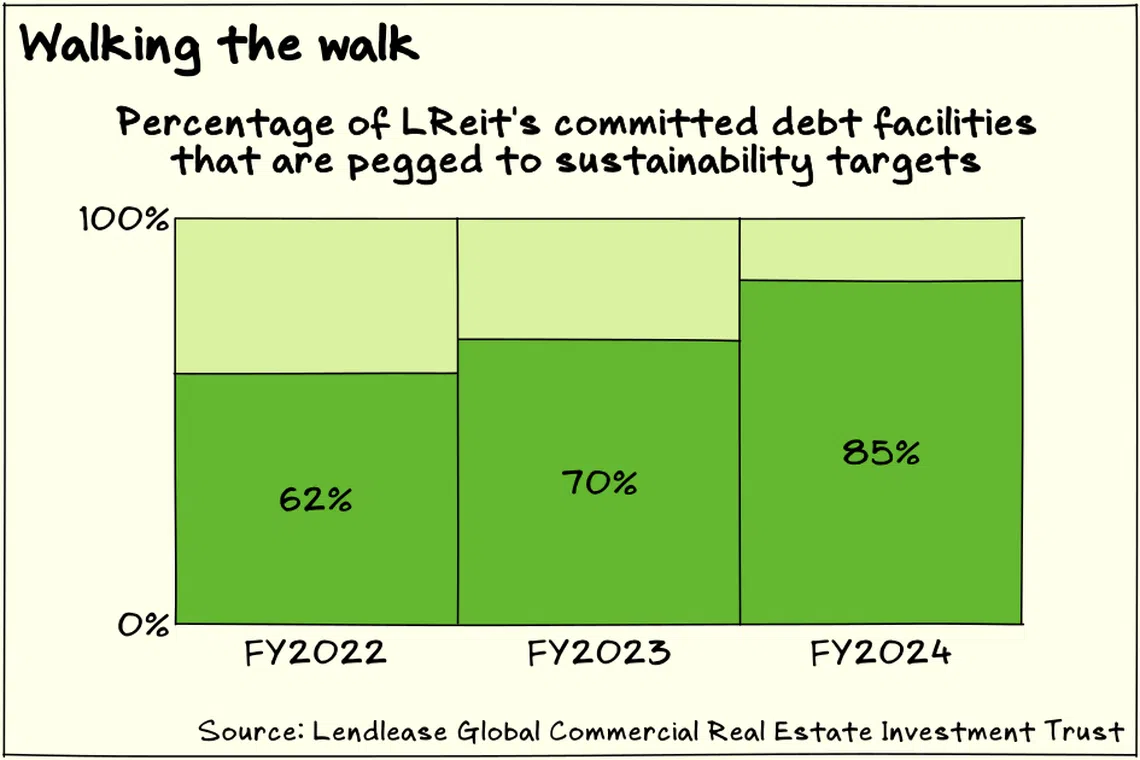
About 85 per cent of LReit’s total committed debt facilities used sustainability-linked structures as at end-September. The new facilities ensure that even after refinancing, LReit will maintain or increase that percentage – already one of the highest among Singapore-listed Reits.
With such a high proportion of its borrowings tied to sustainability outcomes, LReit has put its money where its sustainability mouth is. Companies might declare all manner of ambitious greenhouse gas emissions targets, but in many cases those targets are backed by little more than stated intention. That’s because most companies do not face any economic consequences for missing their climate targets.
However, in LReit’s case, failure to meet the targets directly translates to a higher cost of capital.
It’s a powerful incentive structure that ties financial performance to sustainability outcomes. It aligns shareholders with the company’s other stakeholder groups so that management doesn’t have to choose between higher dividends for the benefit of shareholders and lowering emissions for the benefit of society.
At least that’s how it should work in theory.
Two key variables are unknown in LReit’s case.
The first are the KPIs used for the loans. Climate-related KPIs are typically aligned with a company’s emissions targets.
For LReit, that means an interim goal to achieve net zero carbon by FY2025 for Scope 1 and 2 emissions – referring to greenhouse gases generated directly and from LReit’s purchases of electricity, heating and cooling. This allows LReit to use carbon offsets, and LReit has already reached this target.
LReit’s long-term emissions target is to achieve absolute zero carbon emissions by FY2040 for both direct and indirect emissions, which means its business activities, including supply chain emissions, would generate no greenhouse gases without the need for offsets.
Because LReit’s FY2025 target is quickly becoming obsolete, LReit is now in the process of determining its next set of interim targets en route to the FY2040 goal. Until then, it’s not clear how existing KPIs are measured against the FY2040 goals. For the sustainability-linked loans to be meaningful, LReit’s interim targets and KPIs need to be credible.
The second unknown variable is how much its interest expense is affected by its sustainability performance. The terms of LReit’s sustainability-linked loans are not disclosed, and interest increments could range from five to 25 basis points. That would represent between 1 per cent to 7 per cent or so of total interest expense for a borrower like LReit, which had a weighted average cost of debt of 3.58 per cent in FY2024. Given that LReit paid about S$56 million in interest expense in FY2024, missing its sustainability KPIs could mean a hit of over S$3 million in one year.
That would be up to around 4 per cent or 5 per cent of profit before tax, change in fair value, impairment and share of profit. Of course, these are just hypothetical numbers, but the point is that the strength of the incentive could vary widely.
Companies are not required to – and almost never – disclose the KPIs and margin increments of their sustainability-linked loans. However, in LReit’s case unitholders might desire more transparency simply because almost all of LReit’s borrowings are subject to this variability. While the potential impact on profit is probably small, it’s not non-trivial, and unitholders might want to know how much of the trust’s profits are at risk if the trust doesn’t meet its sustainability goals.
Net zero
Net-zero rice comes with a price
A sobering report by Oxford Economics estimates that net-zero policy measures could raise food production costs in South-east Asia between 30.8 per cent and 58.9 per cent by 2050.
A substantial component of the increase would come from the need to raise the price of fossil fuels, on which the region would remain highly dependent for energy. This would also push up costs for labour and transportation.
That could create a situation where decarbonisation costs more for food production than global warming itself. The report estimated that a 1 per cent increase in average temperature raises food production costs by 0.96 per cent to 2.17 per cent.
The report highlighted foreign direct investment (FDI) as an important way to mitigate the impact of the transition. FDI can transfer expertise and knowledge to positively transform domestic food production systems, as well as provide jobs and unlock broader international market access, the report argued.
However, the report also noted that South-east Asia is currently relatively restrictive towards food production FDI. For instance, countries in the region have introduced eight export restrictions since the Russian-Ukraine war.
The call for a more open stance towards food production FDI could come up against political resistance in the region.
While FDI can certainly accelerate development, food production is also seen as a security and equity issue in the region. For instance, export bans in Indonesia on palm oil and Malaysia on chicken were fuelled by concerns about domestic shortages.
Academic research generally supports the position that FDI can spur improvements in the domestic food production sector. But the investment channels can be widened only if the political hurdles are removed.
Other ESG reads
- Apac companies unprepared for full-scale sustainability reporting: LSEG report
- Asean’s carbon market could generate US$3 trillion revenue by 2050: report
- China’s solar industry looks to Opec for guide to survival
- Global airlines could miss sustainable fuel targets: Iata’s chief
- Goldman Sachs quits global climate coalition for banks
- A US$319 billion corner of ESG bond market faces ‘slow demise’
TRENDING NOW

What role can Japan play in Asean’s future?

IOI Properties and CapitaLand Investment closer to acquiring One Raffles Place in joint bid

AI bubble may burst soon amid financing concentration, rising rates: Ray Dalio
OCBC sheds S$8 billion in value as shares close nearly 6% down; analysts cautious on banks

