


Asean-6 poised to outpace China’s growth in the next decade: report
The region has strengthened its fundamentals by boosting key areas such as manufacturing and investing in emerging sectors

SOUTH-east Asia could outpace China’s growth in the next decade with the top six Asean economies – Indonesia, Malaysia, the Philippines, Singapore, Thailand, and Vietnam – expected to average a 5 per cent annual gross domestic product growth, according to a recent report.
In contrast, China is forecast to maintain a steady GDP growth of 3.5 to 4.5 per cent over the same period from 2024 to 2034, according to a new report by DBS Bank, consulting firm Bain & Company, and Angsana Council, a non-profit advisory group founded by Singapore-based tech investor Monk’s Hill Ventures.
Notably, for the first time in 10 years, South-east Asia drew more foreign direct investment (FDI) than China last year.
Asean-6’s FDI amounted to US$206 billion, while China recorded US$43 billion.
Between 2018 and 2022, Asean-6 grew its FDI by 37 per cent, much higher than China’s 10 per cent. Notably, Singapore was the primary recipient, accounting for more than 60 per cent of the FDI into Asean-6 since 2018.
“As a result of strong domestic growth and the China+1 strategy, we are increasingly optimistic that South-east Asia will outpace China’s growth in both GDP and FDI in the next decade,” noted Charles Ormiston, advisory partner at Bain and chair of Angsana Council.
That said, he added that China’s manufacturing and innovation remain “ultra-competitive”, and the fact that South-east Asia is now attracting more FDI than China is mainly due to politics rather than any decline in China’s competitiveness.
Vietnam - leader of the pack
The report Navigating High Winds: Southeast Asia Outlook 2024 - 2034, launched on Thursday (Aug 1), provides a 10-year growth forecast for Asean-6 by examining factors that have an impact on the economies’ capital, labour and productivity.
Despite a slowdown in growth, Vietnam is projected to lead the region with an average GDP growth rate of 6.6 per cent over the next decade.
The country’s export-oriented economy is well-positioned to capture “China+1” opportunities, noted the study. It added that Vietnam’s domestic ecosystem promotes healthy inter-provincial competition and cultivates a strong workforce, making it more attractive in the eyes of investors.
Next in line, the Philippines is expected to grow at 6.1 per cent. The archipelago is said to benefit from a pro-growth administration that prioritises infrastructure investments, particularly in renewable energy projects that are attracting investor interest. It can also leverage its growing population and workforce, unlike Singapore and Thailand, where demographic issues pose significant negative drivers of growth, pointed out the report.
Indonesia is another fast-growing country, with a forecasted growth rate of 5.7 per cent. However, the report suggested that Indonesia has strong potential to exceed this forecast, thanks to its abundant resources, growing population, and thriving ecosystem of entrepreneurship and innovation.
As the region’s largest economy, Indonesia should focus on moving beyond basic commodities to higher-value production while maintaining an open and competitive economy, said the study.
Improved fundamentals
The report highlighted that over the past 30 years, South-east Asia’s GDP growth has been moderate. Between 1993 and 2023, real GDP in the Asean-6 countries grew by an average of 3.8 times, while China’s GDP grew 11 times and India’s 6.6 times.
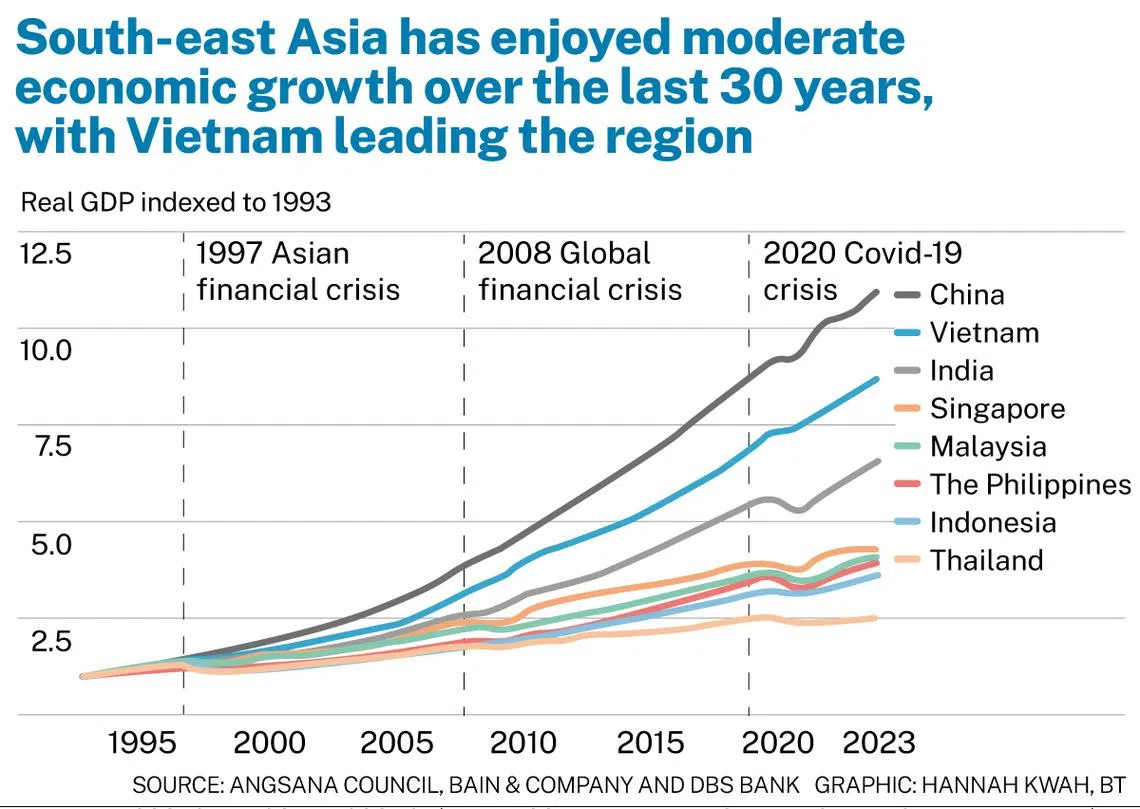
One reason for this lag is that most South-east Asian countries saw their manufacturing value-added as a share of GDP peak in the 2000s. The region then “prematurely de-industrialised” as China became more competitive, drawing investment away from high-value manufacturing in South-east Asia.
The region has now improved its fundamentals for renewed growth by strengthening key areas such as manufacturing and semiconductor packaging, as well as by attracting investments in growing sectors such as data centres.
Taimur Baig, managing director and chief economist at DBS, said: “The world has turned increasingly protectionist and inward-looking in recent years, a trend unlikely to change. Yet, most South-east Asian economies and companies are well placed to find opportunities as capital allocation is recalibrated across geographies and sectors, while dealing with tech disruption and climate change.”
For example, as global players diversify their semiconductor supply chains, Asean-6 has the opportunity to capture investment inflows by enhancing its capabilities.
Malaysia currently leads the region in packaging and testing, attracting more than 61 per cent of FDI committed in the sector since 2019. The country could also be a major beneficiary of opportunities flowing from Singapore, especially with the recent surge in data centre investments.
While Malaysia’s growth rate is forecasted at 4.5 per cent, Baig added that the Johor-Singapore Special Economic Zone (SEZ), which is coming into fruition, can induce “substantial upside for both Singapore and Malaysia”.
“We think there are many alignments taking place. The fact that Singapore is drawing a lot of FDI means some of it could spill over into Johor. (With the SEZ), you can create a huge amount of synergy by solving issues related to water, land and electricity prices,” he explained.

Green opportunities
While traditional priorities such as raising workforce skill levels, promoting competition in domestic markets and strengthening government institutions remain crucial to boosting South-east Asia’s growth, the report highlighted that the region stands to benefit from the accelerating green transition.
In particular, Asean-6 is well-positioned to produce low-cost energy due to its abundance of natural resources such as having more than 30,000 gigawatts of total solar power potential and substantial offshore wind potential in the Philippines and Vietnam.
The report suggested that South-east Asian countries should aggressively pursue the green transition to meet climate goals and expand renewable energy availability and revenue through emerging green sectors.
“We think low-cost green energy is going to start to be a major driver for some of the most attractive FDI investments over the next 10 years,” said Bain’s Ormiston.
“Although controversial, the best strategy for most South-east Asian countries may be to work closely as they can with China. Because China offers the lowest-cost products for wind, solar and power transmission. They have also been willing to provide financing in the past,” he added.
TRENDING NOW

Philippine power giant First Gen rebuffs foreign offers, plans up to US$2.6 billion in expansion

Cliff Tan has 7 million followers and a 4-month waitlist. Why won’t he expand his business?

Could stablecoins be the future of money?

From finance aspirant to Asean CEO: TUV SUD’s Jonas Strahberger on finding people who believe in you

