


To be Asia’s next tiger economy, Vietnam needs to achieve close to double-digit GDP growth
Economic growth of more than 10% is rare, even among the most developed nations, analysts say

[HO CHI MINH CITY] Vietnam’s bold push for double-digit gross domestic product growth in 2025, unveiled by Prime Minister Pham Minh Chinh, has sparked debate over its feasibility and fuelled fresh questions about whether South-east Asia’s rising star can cement its place among East Asia’s elite tiger economies.
While the ambition aligns with the country’s vision of becoming a high-income nation by 2045, experts caution that achieving more than 10 per cent growth – something Vietnam has not accomplished at least since 1985 – may be overly optimistic.
“It probably doesn’t need to be double-digit, but it needs to approach 8 per cent for a decade to lift Vietnam to a position of permanently high income,” said Sam Korsmoe, the co-author of Vietnam: Asia’s Rising Star.
Observers note that the ultimate goal for the country, which is entering the upper-middle income group, is not just rapid growth, but sustained prosperity and long-term economic stability.
Some expect Vietnam to join the ranks of the original Four Asian Tigers – referring to the rapid economic rise of Singapore, Hong Kong, Taiwan and South Korea in the 20th century.
Sceptics, however, have questioned whether the country would eventually be locked in the middle-income trap with stagnated growth, similar to what its South-east Asian peers Thailand and Malaysia – once touted as the next-generation Asian tigers – are now grappling with.
Ambitions v reality
In the last days of 2024, the prime minister issued an instruction on the government’s efforts to drive a two-digit GDP growth in 2025 and sustain a high growth trajectory during the 2026-2030 period.
However, in a trade-dependent economy such as Vietnam, where total import-export turnover is roughly double the nation’s total output, the saying “prediction is hazardous, especially about the future” rings particularly true.
“It is impractical to set a long-term goal because Vietnam’s economy relies heavily on external factors and the geopolitical dynamics are increasingly becoming more unpredictable,” said Linh Nguyen, lead analyst for Vietnam at London-based consultancy Control Risks.
“Both political and economic situations in Vietnam are changing so fast,” she noted, adding that it is challenging to analyse the country’s opportunities and risks over the next decade.
Vietnam posted year-on-year GDP growth of 7.09 per cent in 2024. This comes after an expansion of 5.05 per cent in 2023, and 8.02 per cent in 2022.
In their book, which was published in 2023, Korsmoe and VinaCapital chief operating officer Brook Taylor argued that Vietnam has the potential to follow in the footsteps of South Korea and Taiwan, which experienced rapid growth in the 1980s and 1990s.
They combined numerical and anecdotal evidence with cultural and historical analysis to bolster the case that Vietnam is emerging as a tiger economy.
During their peak growth periods, South Korea and Taiwan achieved average annual GDP growth rates more than two percentage points higher than Vietnam’s 6.23 per cent average over the 2003-2022 period.
It also took these two Asian Tigers less than a decade to attain high-income status after reaching a GDP per capita of US$4,100 – a level Vietnam reached in 2022.
Believing that Vietnam needs a longer time to get there in the present-day context, Korsmoe and Taylor in their book predicted that the country will hit this much-coveted goal between 2035 and 2045.
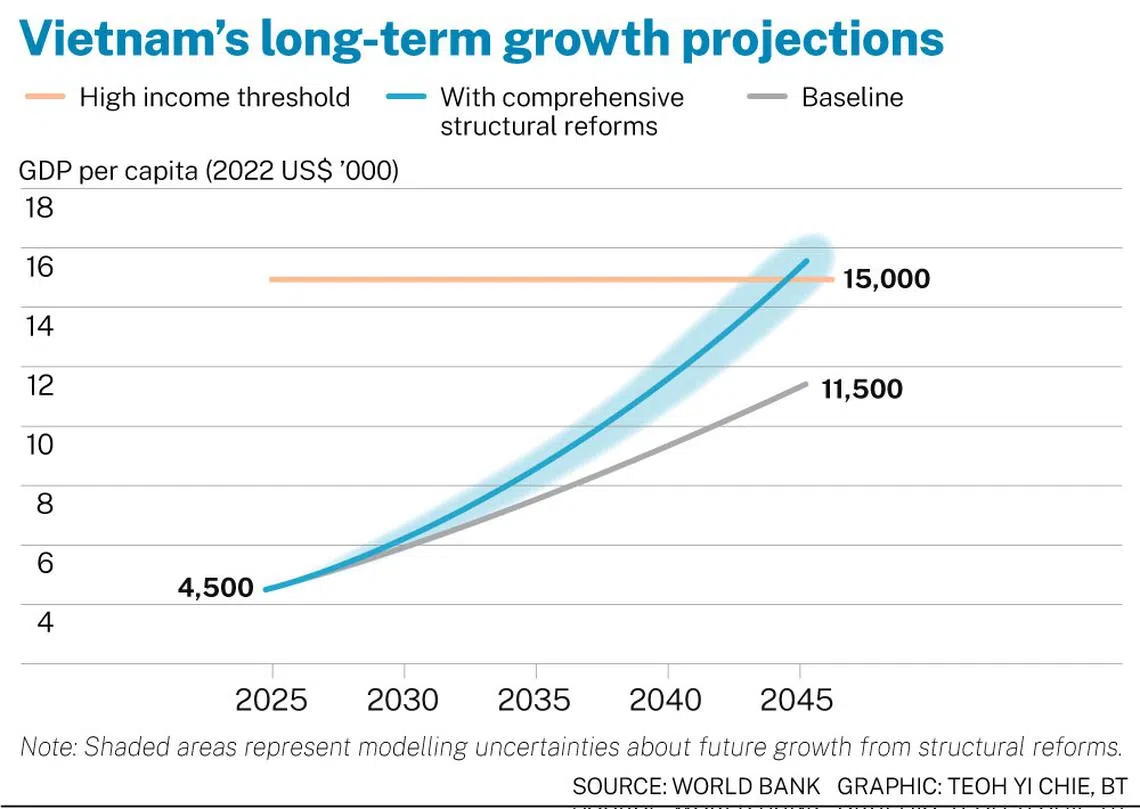
The World Bank, however, cautioned that without significant policy reforms, Vietnam’s growth could slow to an average of 5 per cent annually over the next two decades, falling short of its 2045 goal.
Achieving even a sustained 6 per cent annual growth during this period would be ambitious but attainable, requiring higher productivity and increased public and private investment to offset a shrinking working-age population, it noted in a 2024 report.
Implications of chasing double-digit growth
Nguyen noted that extremely rapid growth could lead to problems such as inflation, inequality, environmental damage and financial instability, even though it might bring about higher incomes, greater global influence, and a more diverse economy.
A 2012 paper by Eric Werker on Liberia’s goal for double-digit growth highlighted that maintaining steady, sustainable growth was just as important as achieving rapid economic expansion.
He examined periods of sustained double-digit GDP growth in 33 countries and identified the key factors behind their success. This included natural resource exports, economic reforms, foreign aid or remittances, recovery from conflict, and government investments in infrastructure or human development.
“Although their macroeconomic numbers look better than (those of) the slower growers, the double-digit club looks precarious in other respects – notably governance and the regulatory environment,” Werker noted.
Vietnam is addressing this challenge. It plans to streamline its state apparatus, including merging and slashing ministries and party organisations, among others. This is in a bid to reduce red tape and improve efficiency in governance.
The bureaucratic overhaul – which is expected to be finalised by the end of the first quarter of 2025 – is also taking place against the backdrop of an anti-corruption campaign that has implicated thousands of government and party officials and corrupt businesspeople over the past few years.
Korsmoe described the new wave of reforms as a kind of “Doi Moi 2.0”, referencing the original 1986 renovation period, when Vietnam’s ruling Communist Party introduced sweeping free-market reforms that transformed the country’s economy.
“Ideally, this will lead to more efficient governance, which we view as crucial for Vietnam to replicate the South Korea and Taiwan model,” he added.
Hunt for growth pathways
Scholars and analysts have agreed that Vietnam must transition from labour-intensive industries to capital and knowledge-intensive sectors that offer higher value-added opportunities to accelerate its economic progress.
Some experts have noted that the East Asian development model, exemplified by the strategies of South Korea and Taiwan, could serve as a valuable blueprint for Vietnam to follow.
Those nations often utilise cheap labour resources to generate export-oriented production and adopt high levels of investment in education, infrastructure and technology. They also implement notable policy interventions to support domestic businesses.
Professor Lee Keun, in his 2024 book Innovation–Development Detours for Latecomers, dived deeper into the innovation and development detours those countries made and drew out key strategies for latecomers to catch up.
He suggested that developing nations should first target short-cycle technologies, such as IT or electrical and electronics sectors, where entry barriers are low, the pace of innovation is rapid, and growth prospects are high.
In this sense, Vietnam already shows advantages with its outbound shipment of smartphones, computers, electronics and components accounting for about a third of its total exports.
“Vietnam’s trajectory is more naturally aligned with the ‘Asian Tiger’ model of leveraging global manufacturing networks and advancing into high-tech industries,” said Richard McClellan, country director for Vietnam at the Tony Blair Institute for Global Change.
However, electronics manufacturing is not the only way to go, Prof Lee argued, with resource-based or services-based sectors also able to offer countries alternative and complementary pathways to escape the middle-income trap.
Korsmoe also pointed out Vietnam’s distinctiveness in its rich natural resources in agricultural, mineral and renewable energy – advantages that South Korea and Taiwan did not have when they were growing their economies.
“I think the reality is that Vietnam will achieve economic development through both its manufacturing and resource capabilities, making the economy more stable and resilient,” he noted.
Weakest link
Experts remain concerned about major weaknesses in Vietnam’s economy after the past few decades of deeper international integration: The country has mainly focused on low-cost final assembly and experienced few spillover effects of technological transfer from foreign direct investment (FDI) companies.
Domestic value contribution in key export sectors remains relatively shallow amid heavy reliance on imported content. For example, electronics manufacturing, for example, made up only about 15 per cent of total domestic value-added, based on the World Bank’s estimates.
In 2023, only 18 per cent of domestic companies had global value chain linkages, a slump of 17 percentage points compared to 2009.
“It is not sufficient for latecomers to integrate themselves into global value chains by inviting FDI or (multinational corporations) at an early stage of development,” Prof Lee wrote in his book, underlining that FDI firms are always inclined to move to locations with lower wage costs and are increasingly unwilling to transfer or sell their technology.
“The ultimate challenge for latecomer economies is how to eventually create domestic sources of innovation and economic growth,” he added.
TRENDING NOW

Malaysian king buys stake in Singapore-listed mining firm expanding into rare earths

Grab CEO’s wife Chloe Tong on life with Anthony Tan and finding her purpose

Once staunchly pro-China, Malaysian Chinese businesses are now distancing themselves from Beijing

Longer wait times expected as S’pore healthcare institutions report system disruptions

