Corporate venturing gains traction in Malaysia – a boost to local tech startups
To attract direct investments from companies, strategic reforms are needed to unlock the sector’s full capabilities, market observers say


[KUALA LUMPUR] As Malaysia pushes to climb the value chain in the technology sector, its fledgling corporate venture capital landscape is beginning to show promise, with rising investments fuelling opportunities to reshape the country’s tech ecosystem.
Several key developments in Malaysia’s corporate venturing space – or corporate venture capital (CVC), where corporations invest directly in startups – lend hope to its potential, even as the country ranks among the top three in South-east Asia for funding, but lags regional peers in activity.
In December last year, the country’s sovereign fund Khazanah Nasional lent its heft to crank things up in the CVC space, with the launch of two strategic investments totalling RM1 billion (S$307.5 million) under its Dana Impak Initiative.
The initiative hopes to bolster Malaysia’s Industrial Revolution 4.0 (IR4.0) capabilities and advance research and development (R&D) in artificial intelligence (AI) and semiconductor technologies.
One of the investments by Khazanah under this initiative involved Cambrian Fund – a fund set up in July 2024 by the founders of Penang-based automated test equipment manufacturer ViTrox and regional private equity firm Southern Capital Group to support Malaysia’s tech startups.
With RM100 million raised in its first closing with Khazanah as one of its anchor investors, the Cambrian fund focuses on supporting small and medium-sized enterprises (SMEs) and entrepreneurs advancing IR4.0 technologies, including AI, robotics and machine vision.
For Chu Jenn Weng, ViTrox’s chief executive officer and founder, corporate venturing is not just a tool for investment; it is a cornerstone for building a thriving tech ecosystem.
The Cambrian Fund aims to raise RM150 million, of which RM60 million is to be secured from ViTrox founders and Southern Capital, said Chu in an interview with The Business Times.
The other founders of ViTrox are its executive vice-president Steven Siaw, and executive director Yeoh Shih Hoong.
Chu, who also serves as president of ViTrox, pointed out that while venture capital is available in Malaysia, corporate venturing – common in advanced economies – remains underdeveloped in the country.
Funding vibrancy
Southern Capital’s managing director, Wong Chin Toh, echoed Chu’s sentiment, emphasising that corporate venturing promotes collaboration over competition.
“With funding and knowledge sharing, corporate venturing can expand Malaysia’s tech sector, enhance vibrancy and drive creativity,” he added.
The Cambrian Fund is expected to transform Malaysia’s semiconductor and advanced manufacturing ecosystem by unlocking growth opportunities, nurturing local talent and helping innovative businesses scale regionally.
The fund also plans to leverage industry leaders’ expertise to provide mentorship and network access to its portfolio companies.
Additionally, Khazanah’s investment in California-based Syntiant, which was announced alongside its investment in Cambrian fund, aims to establish a world-class AI R&D centre in Malaysia. Syntiant provides innovative hardware and software solutions for edge AI deployment.
“These investments reinforce our commitment to developing Malaysia’s semiconductor ecosystem and driving technological innovation,” said Khazanah managing director Amirul Feisal in a statement.
Challenges and opportunities
A recent report by Capital Markets Malaysia, the Securities Commission Malaysia and Boston Consulting Group suggests that Malaysia’s venture capital ecosystem could double in size, reaching RM1.1 billion by 2030.
The report, which was released in mid-November last year, highlighted challenges, which included risk aversion among corporations and low investment levels compared to regional peers.
One of the notable findings was that while 64 per cent of Malaysian corporate leaders link innovation to corporate strategy, only 39 per cent plan to adopt corporate venturing in the next three years.
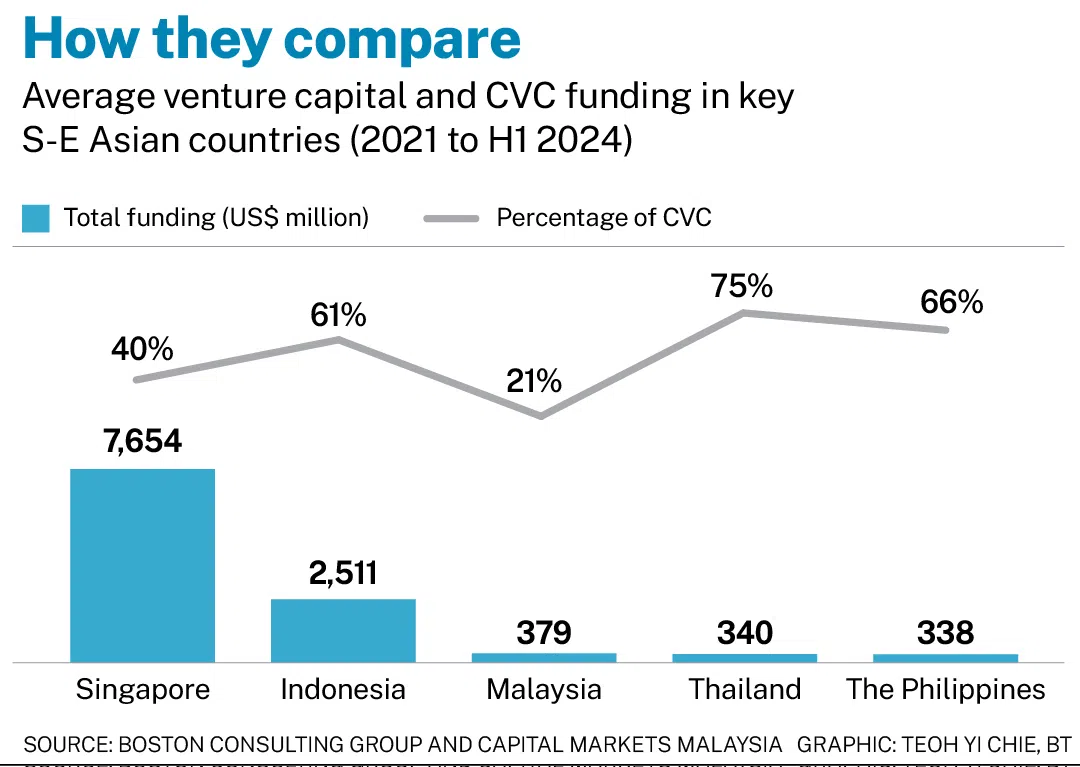
The report pointed out that although Malaysia ranks among the top three countries in South-east Asia for venture capital and CVC funding, there is still room for improvement compared with other regional leaders.
Malaysia’s average venture capital and CVC funding is around US$379 million between 2021 and the first half of 2024, substantially lower than Singapore’s US$7.7 billion.
Among regional peers – including Singapore, Indonesia, Thailand and the Philippines – Malaysia has the lowest level of CVC activity at 21 per cent of total venture capital funding. This is in stark contrast to Thailand’s 75 per cent and the Philippines’ 66 per cent.
Baby steps
While corporate venturing is still in its infancy in Malaysia, it has seen notable growth in recent years.
Julien Salanave, professor of practice entrepreneurship and innovation and director of Essec Ventures Asia-Pacific, highlighted that Malaysia’s CVC market remains nascent compared to more developed ecosystems in Singapore and Indonesia. (* see amendment note below)
“Malaysia’s CVC market mirrors the maturity levels of its overall venture capital market,” he said, adding that the technology, financial technology and energy sectors lead in attracting corporate venture capital investments.
He credited government-linked companies such as Petronas Ventures and Telekom Malaysia for spearheading such efforts.
Salanave also noted that Malaysian corporations often prioritise accessing external innovation opportunities over financial goals, which aligns with broader trends across South-east Asia.
“Corporations here are eager to collaborate with experienced investors while maintaining operational independence for the startups they support,” he noted.
Strategic reforms
Sean Cory, head of private capital at Oliver Wyman Asia-Pacific, emphasised that corporate venturing could significantly enhance Malaysia’s startup ecosystem by providing funding, fostering collaboration and attracting foreign investment.
“Corporate ventures drive the emergence of unicorns and spur innovation,” Cory said, highlighting a focus on areas like sustainability, blockchain and Internet of Things.
Yet, Malaysia faces stiff competition from regional neighbors.
Singapore benefits from strong government support, including its Launchpad 3.0 programme, while Thailand’s late-stage investment focus has lessons for addressing Malaysia’s seed-stage funding gaps.
To strengthen its corporate venturing ecosystem, Malaysia has introduced the Malaysia Venture Capital Roadmap 2024-2030. The roadmap aims to improve strategic funding, regulatory reforms and corporate engagement.
Market observers agree that Malaysia’s corporate venturing sector has potential, but needs strategic reforms to unlock its full capabilities.
Cory noted that addressing risk aversion, clarifying regulations, and creating incentives for corporate venture capital investors will be key.
Additionally, fostering partnerships between startups and corporations is essential for attracting top talent and driving innovation. “Collaboration in regulation, risk management and talent development will enhance Malaysia’s corporate venture ecosystem,” he added.
As Malaysia pushes forward with initiatives such as the Cambrian Fund and Dana Impak, Southern Capital’s Wong said the country is taking critical steps towards building a vibrant corporate venturing landscape capable of competing on the global stage.
However, sustained efforts and strategic collaboration will determine its success in transforming Malaysia into a hub for innovation and technology, he noted.
* Amendment note: Changes in designation