


Credit boom, rule shifts fire up Vietnam banks’ capital-raising sprint
High system leverage, however, may leave them vulnerable to economic shocks, say analysts

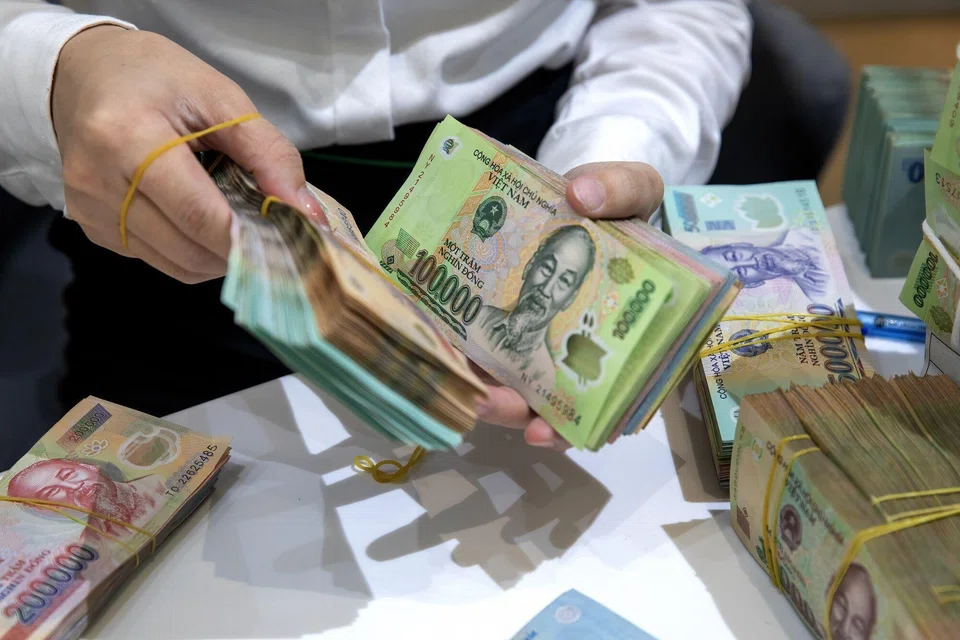
[HO CHI MINH CITY] Vietnam’s banks are starting on a capital-raising sprint, driven by fresh regulatory changes and surging credit demand as the country chases ambitious double-digit growth in the coming years, said analysts.
Banking system-wide lending – the primary financing channel for the country’s economic growth – expanded nearly 15 per cent in the year through October, the fastest pace in five years.
Analysts are forecasting a full-year credit growth of 18 to 20 per cent, powered by the US Federal Reserve’s monetary easing and a domestic low-rate environment to support the economy. The initial target was 16 per cent growth.
This comes with the implementation of the State Bank of Vietnam’s regulatory guidance known as Circular 14, effective from Sep 15, which marks a significant shift towards aligning the country’s banking system with the stricter Basel III standards.
Nguyen Thao Linh, analyst at Hanoi-headquartered securities firm VNDirect, wrote in a note on Dec 3: “With higher capital requirements and supplementary buffers, we expect Circular 14 to trigger a capital-raising race across the entire system.”
She said that the state-owned commercial banks (SOCBs), which hold the largest market share and play a critical role in funding large public projects, face greater pressure to raise capital.
As their capital adequacy ratio remains lower than that of private banks, they will be forced to retain earnings, restrict dividend payouts or ultimately increase capital or decelerate credit growth.
“SOCBs need timely capital replenishment to proactively increase credit growth on a foundation of sustainable risk management,” said Linh.
As at end-September, Vietnam’s four SOCBs – BIDV, VietinBank, Vietcombank and Agribank – held a combined 10.51 quadrillion dong (S$516 billion) in assets, accounting for about 42 per cent of the assets of the country’s banking system.
However, the total registered capital of these SOCBs currently stands at 259 trillion dong, only about a fifth of the total.
Linh said that private banks with high credit growth targets, such as HDBank and MB, will also be motivated to increase capital in the medium and long term to meet the rising credit demand to support the economy and improve their business performances.
Buoyant volumes
In the first nine months of 2025, Vietnam’s gross domestic product expanded by 7.9 per cent, making it one of the fastest growing economies in the region.
FitchRatings analysts Tamma Febrian and Willie Tanoto said in their note on Dec 2: “We expect the banking sector to play a central role in the government’s ambitious growth agenda, which should keep banking business volumes buoyant.
“The supportive economic backdrop should also aid banks’ asset-quality metrics in the near term.”
However, analysts pointed out that the resulting rapid loan growth, especially if credit growth limits are lifted for individual banks in 2026, could further raise the already-high system leverage, rendering the banks more vulnerable to economic shocks.
“This highlights the urgent need for banks to strengthen capital buffers to enhance the system’s resilience against increasing risk,” VNDirect’s Linh noted.
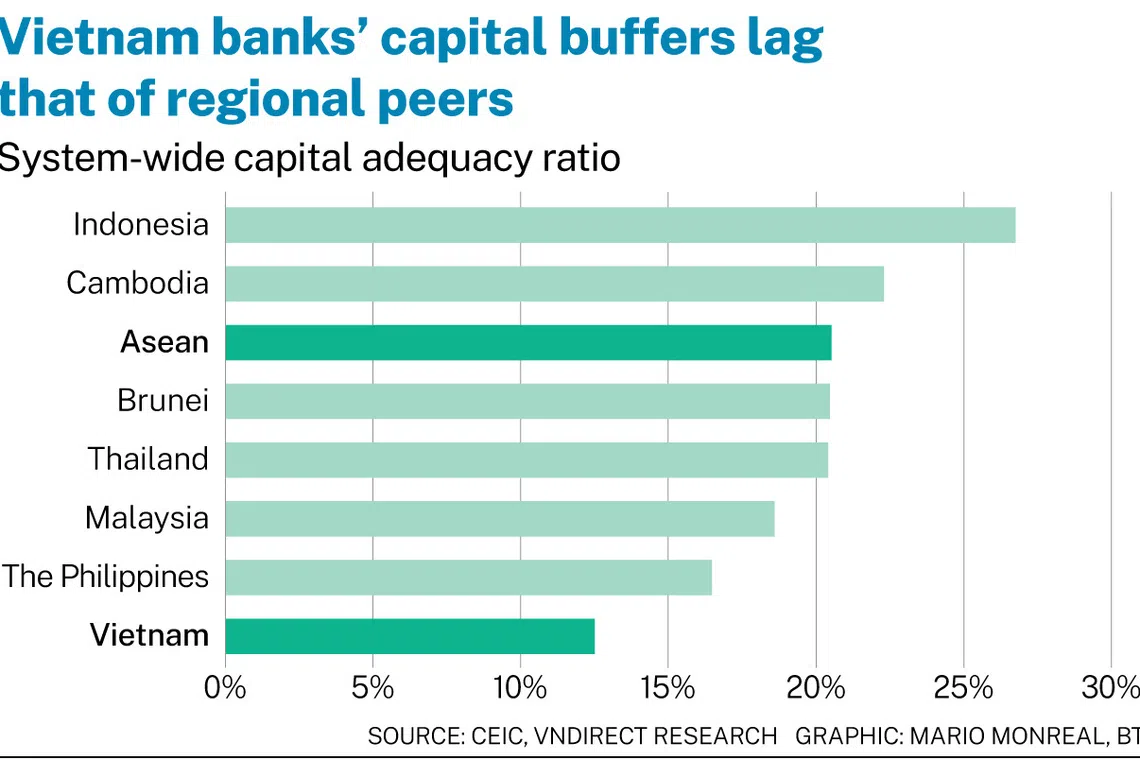
Vietnam’s system-wide capital adequacy ratio of 12.5 per cent is low, relative to the Asean average of 20.5 per cent. The loan-to-deposit ratio of most commercial banks rose in the third quarter of 2025 from end-2024 levels, as credit growth outpaced deposit growth, widening the gap between lending and funding.
Stress scenarios run by S&P Global Ratings in October found that while the large state-owned banks would suffer only a minor decline on the back of their more defensive nature, small privately owned banks would be particularly at risk.
The ratings firm said: “(They) would bear the brunt if non-performing loans rise moderately to necessitate increased provisioning.”
This group of banks has a history of failure due to weak asset quality and poor liquidity buffers. The government has acted as a backstop for struggling banks, offering complete takeovers or liquidity support; this happened in the 2023-2024 bailout of Saigon Commercial Bank, which is linked to imprisoned tycoon Truong My Lan.
S&P said in its report: “Healthy economic growth prospects and a highly supportive government mitigate thin capital levels, which have been a long-standing fundamental weakness in the Vietnamese banking system.”
Vietnam is ambitiously planning for an annual GDP growth of 10 per cent or more between 2026 and 2030; its long-term goal is to become a high-income nation by 2045.
The country also plans to invest about US$1.4 trillion over the next five years, particularly to improve infrastructure, boost productivity and expand private-sector involvement in key national development initiatives.
“We believe this will essentially translate into robust and more diversified corporate credit demand,” noted Quan Trong Thanh and Vu Viet Linh, analysts at Maybank Securities. “Infrastructure-related construction, industrials, utilities, trade and services are key drivers (of corporate lending)”.
To support its nation-building agenda, the Vietnamese government is also working to deepen its capital markets, including upgrading the stock market to emerging status, and strengthening its sovereign credit rating.
The Maybank analysts forecast that S&P could give the country an “investment grade” rating between 2028 and 2030, provided that its current reform agenda is well executed.
“All these developments will materially benefit local banks on both sides of their balance sheets, including raising funds at lower costs and having a larger space for credit expansion,” they added.
TRENDING NOW

Malaysian king buys stake in Singapore-listed mining firm expanding into rare earths

Grab CEO’s wife Chloe Tong on life with Anthony Tan and finding her purpose

Once staunchly pro-China, Malaysian Chinese businesses are now distancing themselves from Beijing

Longer wait times expected as S’pore healthcare institutions report system disruptions

