Don’t wait for an ‘investor’s heaven’: Timor-Leste’s Ramos-Horta tells foreign firms to be adventurous as its economy opens up
Young nation pushes for structural reform, diversification from oil

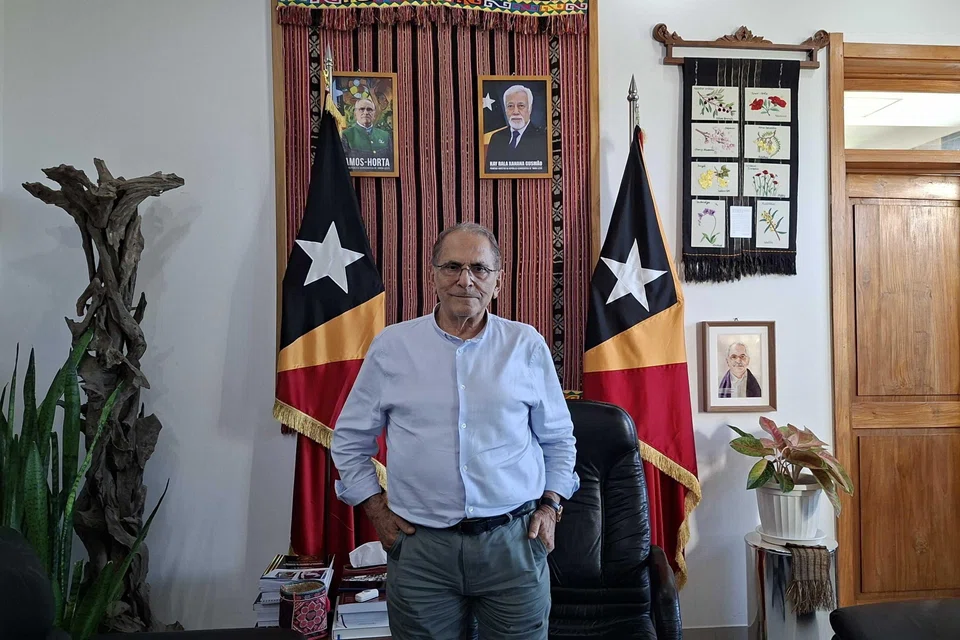
[DILI] Years ago, watching a Chinese travelling salesman in Timor-Leste pedal up a steep hill on a bicycle saddled with plastic containers, Jose Ramos-Horta thought to himself: give the man a year and he surely would have set up his own shop; five years, and it would have expanded.
To foreign investors watching from the sidelines and wondering whether the time is right to set up shop in Asia’s youngest nation, the Timor-Leste president has one response: be adventurous and take risks.
“Why the Chinese are all over the world is not only because China is big and has billions of dollars to invest – but because they are not waiting for perfection for them to go to a country,” he said during an interview with The Business Times at the Presidential Palace in the Timorese capital of Dili.
“They go when no one else wants to go, and patiently work through our labyrinthic bureaucracy; they know how to deal with the local situation (and) they don’t wait for a place to become heaven for investors. They came when no one else was coming.”
Even as the country actively seeks foreign investment, there is recognition that it needs to first strengthen its business environment.
Ramos-Horta noted that the government is doing this through sustained public expenditure, in particular via the expansion of Timor-Leste’s road networks and transportation, improvement of electricity services, connectivity, and the strengthening of its healthcare sector.
Timor-Leste currently attracts modest foreign direct investment (FDI). Total inflows in 2024 were up 11.2 per cent at US$228.6 million from US$205.5 million in 2023, based on latest available data from its central bank. The top three FDI sources are Indonesia, China and Singapore.
The bulk of its FDI inflows are concentrated in the non-tradable industries of retail, construction and finance. Examples of such businesses include supermarkets, construction contractors and consumer electronics retailers. They typically serve the domestic market, as the goods and services offered tend not to be exportable.
While important, these investments provide limited support to build export capacity or to narrow Timor-Leste’s current account deficit, said the World Bank Group in April.
Domestically, business activity in Timor-Leste has picked up significantly.
But even with new firm registrations reaching a more than 10-year high in 2025, sole traders and proprietors make up the vast majority.
As noted by the World Bank, such new business formation in Timor-Leste still lacks the depth required to channel liquidity needed for sustained private-sector growth.
Push for economic reform
As the Timorese government prepares for next year’s state budget, it is doubling down on economic diversification efforts, accelerating the pivot from petroleum to tourism, the blue economy, agriculture and fisheries.
These efforts began a few years ago, but the economic growth of Asia’s youngest nation remains heavily dependent on government spending; public expenditure accounts for 90 per cent of its gross domestic product.
Nearly three-quarters of its US$2.6 billion state budget last year was financed by withdrawals from its Petroleum Fund – which could be fully depleted by 2035. The fund stood at US$18.8 billion as at end-May.
What is also needed is a reliable judicial system, said Ramos-Horta, noting that the country plans to inaugurate its Supreme Court of Justice by year’s end, and establish an arbitration tribunal modelled after Singapore’s framework to settle contractual disputes.
“A Supreme Court is the ultimate guarantee of independence of judiciary, and of certainty and integrity in the application of the law,” he said. “Investments will come faster when we have an independent judiciary that is credible, that people can trust.”
Awakening to Asean’s promise
Having gained full Asean membership in October 2025, Timor-Leste is now laying the groundwork to chair the bloc in 2029, starting with a multimillion-dollar airport expansion and a new international convention centre in its capital.

The young nation has gained from Asean accession on many levels, said Ramos-Horta.
“It forces us to be more professional and expeditious in what we do, to deliver on our commitments, to respond to demands of Asean membership in terms of adapting ourselves, our laws, regulations and procedures to Asean rules and standards,” he told BT.
Asked what fresh perspectives Timor-Leste brings to the table, Ramos-Horta said its greatest contribution to Asean is stability.
“I always say we must not bring new headaches to Asean,” he added. “We must strive to contribute to consensus – that is Asean’s strength.”
Another unique asset Timor-Leste brings to the bloc that may not yet be fully appreciated by the region is the country’s track record in diplomacy and conflict mediation, noted the head of state.
“We had a very fractious relationship with Indonesia in the past... yet the two countries have shown exceptional statesmanship and began a new book in the relationship,” he said. Indeed, no two neighbouring countries have a better relationship, said Ramos-Horta.

Today, the 24-year-old country consistently outranks regional peers on major global benchmarks for democracy, peace, governance and press freedom.
It is the only country in South-east Asia whose democracy continues to be rated as “free” in the annual Freedom in the World report that measures access to political rights and civil liberties in 208 territories. Timor-Leste scored 73 out of 100 points this year, while the other Asean member states scored between four and 58 points.
In the Global Peace Index 2026, Timor-Leste ranks 32nd out of 163 territories, rising 12 spots from the previous year. It stands as the sixth most peaceful country in the Asia-Pacific region and the third in Asean, just after Singapore and Malaysia.
Ramos-Horta concluded: “We have zero political violence; we have zero ethnic or religious tension; our democracy is considered No 1 in South-east Asia; freedom of press worldwide is 30th place; safety, No 3 in (the region) – that’s our contribution to Asean.”