‘Fighting the sea every day’: Indonesia’s US$80 billion bid to save sinking Java coast
As rising seas threaten Indonesia’s industrial belt, the government is counting on a 500 km seawall to keep its economic engine afloat

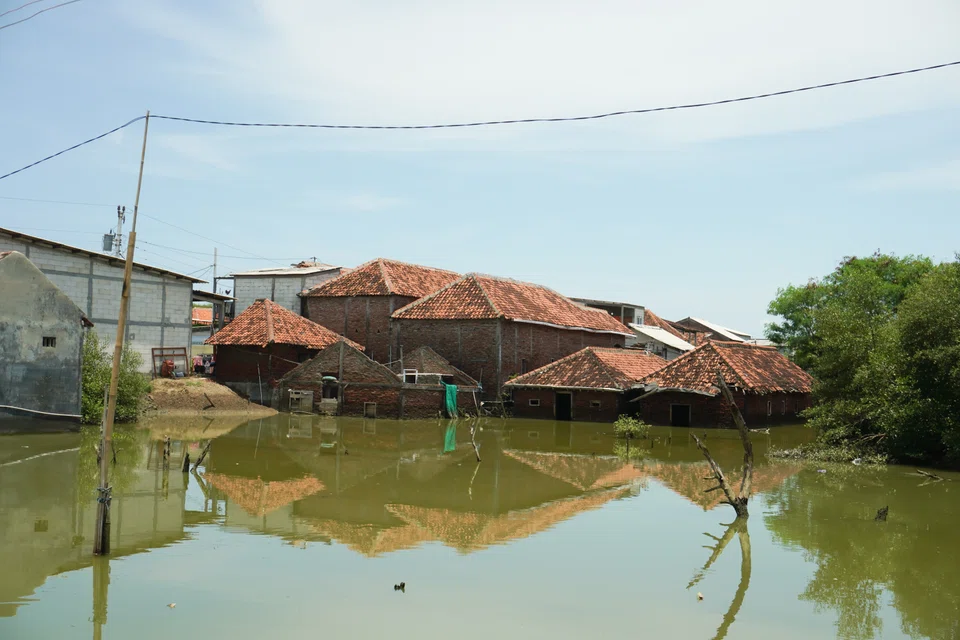
[SEMARANG] On a quiet afternoon in Sayung, an industrial district in Demak Regency, Central Java, the steady hum of factory machines has long been replaced by the rhythmic splash of seawater against concrete walls.
Rusted gates and shuttered shopfronts now line the flooded streets. Muhammad Kharis, 52, said flooding is part and parcel of life in his hometown, but over the past decade, it has become more severe.
“It feels like fighting the sea every day,” he lamented. “We spend money just to stay afloat. The moment we stop, the water takes over.”
During rainy seasons, floodwaters can linger for weeks, leaving homes and roads submerged. Property values have plunged since 2015, making it nearly impossible for residents to sell their land.

For decades, the industrial zones along Java’s northern coast have been sinking – both literally and economically. Flooding strikes from two fronts: swollen rivers that overflow during heavy rains, and relentless tidal surges from the Java Sea.
In Demak alone, three villages have been lost to rising waters in the past decade, with one completely submerged last year, forcing more than 100 families to relocate.
Wall of life
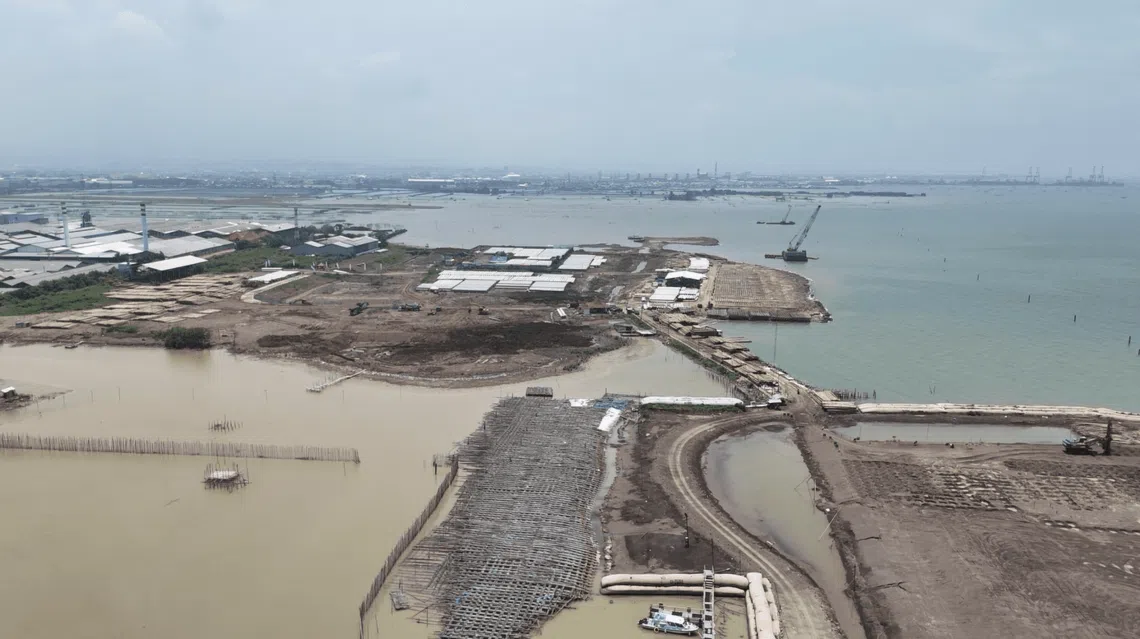
But the ongoing construction of a 6.67 km seawall, which doubles as a toll road, has become a vital lifeline for locals. When The Business Times visited the site in late October, construction was already more than 45 per cent complete.
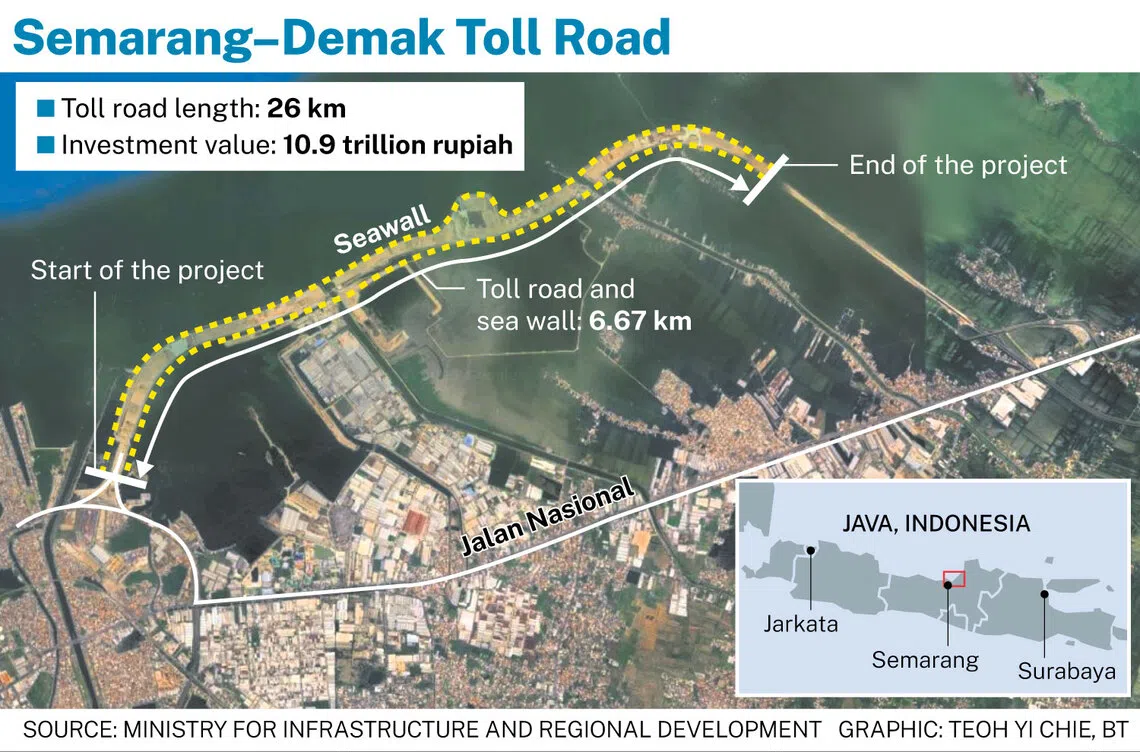
The seawall project marks the first phase of a 26 km toll road worth about 10.9 trillion rupiah (S$850.2 million), stretching from Semarang to Demak. Launched in 2024 under former president Joko Widodo’s administration, it is designed to serve both as a critical transport route and a formidable barrier against coastal flooding.
The project is led by state-owned builders Pembangunan Perumahan and Wijaya Karya, alongside China’s infrastructure giant China Road and Bridge Corporation, and is slated for completion in 2027.
Millions of bamboo poles serve as scaffolding and formwork for the seawall’s construction, supporting its structure and shaping the concrete until it hardens in place.
“It’s a race against time. If nothing is done, this village could disappear in just a few years,” said Aslor, a village official in Bedono, Demak, adding that the construction of the seawall has been long awaited.
Bedono is one of the coastal villages in Demak that has suffered severe shoreline damage due to coastal erosion and shifting coastlines. Over the past 15 years, the coastline has retreated by nearly 5 km.
Giant seawall
There are bigger ambitions afoot, with the 6.67 km seawall marking the opening phase of efforts to fortify Java’s coastline and shield Indonesia’s economic core from rising seas and coastal erosion.
President Prabowo Subianto’s administration is reviving plans for a colossal 500 km barrier along Java’s northern coastline, stretching from Banten in West Java to Gresik in East Java.
In August, Prabowo established the North Coast Sea Wall Authority of Java to oversee the long-delayed seawall project, which has been part of Indonesia’s national blueprint since the 1990s.
Estimated to cost US$80 billion, the project aims to safeguard 50 million people from the twin threats of rising seas and sinking land.
Private investors from far and wide
Given that Indonesia’s fiscal resources are stretched owing to other spending priorities, the massive project will likely rely on private investment.
Rachmat Kaimuddin, deputy for basic infrastructure at the Coordinating Ministry of Infrastructure and Regional Development, told BT that the government plans to undertake the project through a public-private partnership.
He said investors from China, the Netherlands and Japan have already shown interest.
“We have completed extensive technical studies and interagency discussions. Now, the president wants to move forward with execution,” Rachmat added.

He said that the government will not adopt a one-size-fits-all approach to building the seawall. Instead, the project will be tailored to the geographical and socioeconomic characteristics of each region along the northern coast.
“We are not building a Great Wall of China stretching uniformly from Banten to Gresik,” Rachmat noted. “Our approach will be adaptive, designed to fit the local context, including environmental, social and economic conditions.”
Sinking land
For decades, northern Java has been a hub of industry as the Indonesian government has developed industrial zones to boost local economies.
Its landscape is lined with factories, workshops and bustling trade centres producing everything from textiles and furniture to cosmetics, electronics and household appliances.
Investment in Demak hit five trillion rupiah last year, with dozens of new foreign-owned factories opening, creating a multiplier effect that has bolstered the region’s economy. However, persistent tidal floods, ongoing land subsidence and limited access to clean water continue to pose major obstacles in attracting larger investors.
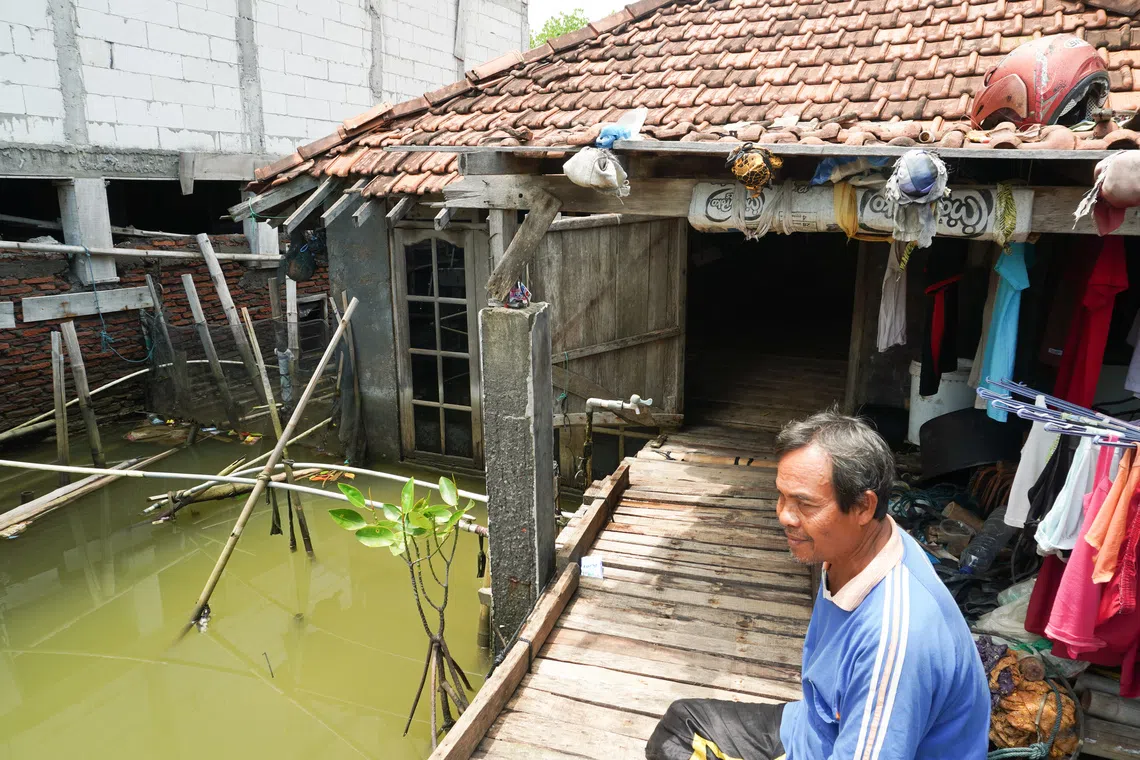
The cost of holding on has driven many businesses away. Muhammad Yunus, chairman of the Demak Region Employers Association, said the battle with flooding has been relentless and costly. Routine floods disrupt production and distribution supply chains, costing hundreds of billions of rupiah each year.
“In some industrial zones, warehouses lie abandoned, their owners unable to justify another round of reconstruction,” he said.
Many factory owners and small business operators have spent tens of billions of rupiah, sometimes hundreds of billions, to elevate their floors, rebuild their foundations and install pumps that never rest.
Back against the wall
While the seawall offers a glimmer of hope for some, in places such as Semarang, where the water has already pushed inland, residents know a concrete barrier alone may not be enough.
Djoko Setijowarno, an infrastructure expert at Soegijapranata Catholic University in Semarang, pointed out that while industrial growth in the region has been massive, groundwater extraction has continued unchecked.
Decades of overuse have caused the land to subside, while rising seas have steadily claimed what remains. In some coastal areas of Semarang, the ground has sunk by as much as 20 cm per year.
“As long as this continues, flooding cannot be fully resolved, even with seawalls in place,” he warned.

Environmental experts from Diponegoro University Semarang warned that while the concrete seawall aims to protect cities from floods and land subsidence, it could harm fishermen and coastal communities economically and disrupt the marine ecosystem.
For some residents, it’s better to take action than be swept away by the flood.
Beyond the concrete, the community of Sayung village has already taken the initiative with a hybrid seawall concept. The design blends engineered structures with nature-based solutions, such as mangrove restoration and intertidal zone rehabilitation.
Sukarman, a village official, said that the approach is more sustainable, combining physical protection with ecological recovery. The community has planted two million mangrove trees this year.
“We cannot fight nature forever,” he added. “Solving environmental problems must also involve restoring it.”