


Five ways US$100 oil cuts both ways for Malaysia
Whether the country gains depends on factors such as what it exports and imports and its subsidy exposure

[JOHOR BAHRU] Brent crude’s return to above US$100 a barrel raises a familiar question for Malaysia: Does an energy-exporting economy gain more from higher prices than it loses through subsidies, import costs and pressure on businesses and consumers?
Oil crossed the threshold on Sep 9 as renewed tensions between the US and Iran heightened concerns over supplies through the Strait of Hormuz, while Chinese crude purchases picked up. Brent remained above US$104 during Asian trading on Friday (Sep 18).
Whether Malaysia ultimately gains depends on what it exports and imports, its subsidy exposure and how long prices remain elevated. Here are five things to know.
Malaysia is a net oil importer but a net energy exporter
Malaysia is a net importer of crude petroleum and refined petroleum products, but its liquefied natural gas (LNG) exports keep the country in an overall energy surplus.
Lee Heng Guie, executive director of the Socio-Economic Research Centre, said Malaysia recorded a RM13.7 billion (US$3.4 billion) deficit in crude petroleum and a RM3.3 billion deficit in petroleum products in the first seven months of 2026.
These were more than offset by a RM30.5 billion LNG surplus, leaving an overall energy surplus of RM13.5 billion.
The composition of the crude trade also matters.
Xavier Tang, senior market analyst at Vortexa, said Malaysia’s seaborne exports consist mainly of light-sweet and medium-sweet grades, with Kimanis oil accounting for the largest share, although its volumes have fallen significantly since 2022. (Sweet crude has lower sulphur content and typically commands a premium.)
Imports are mainly medium-sour and heavy-sweet grades, while the share of light-sour crude has also increased.
Tang said refinery configuration is the main reason for the imports: newer, more complex refineries can process heavier and sourer crude into higher-value products. Pengerang, for example, imports mostly medium-sour and light-sour crude from the Middle East.
Premium Malaysian crude provides partial cushion
A Sep 10 report by RHB Bank group chief economist and head of market research Barnabas Gan said Malaysian crude grades continued to command sizeable premiums over Dated Brent even when the benchmark price fell from its earlier conflict-driven peak.
It showed the Malaysian Crude Oil benchmark’s differential widening from about US$7 a barrel in March and April to US$18-US$19 in June and July, before easing to around US$12 in August.
Gan attributed the premiums to the low sulphur content and refining yields of Malaysian grades, limited supply from mature fields and demand from refiners.
He said the wider differential partly cushioned the decline in realised selling prices, although total revenue per barrel still fell with the broader market.
Petroleum revenue and subsidies both rise
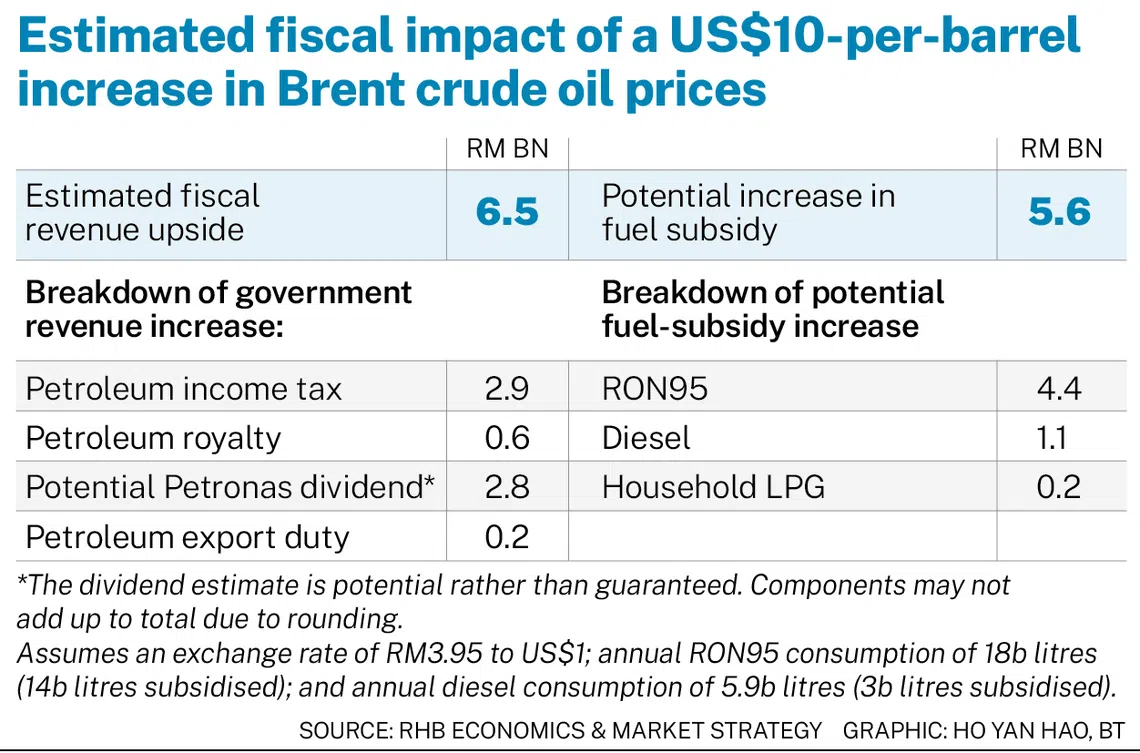
Gan estimated that every US$10 increase in Brent would raise annual government revenue by about RM6.5 billion. This comprises RM2.9 billion from petroleum income tax, RM600 million from royalties, RM200 million from export duty and a potential RM2.8 billion increase in Petronas dividends.
Against that, RHB estimated an additional RM5.6 billion in fuel subsidies. The bank said higher petroleum revenue and potential support for Petronas dividends could offset the higher subsidy cost.
OCBC senior Asean economist Lavanya Venkateswaran said higher oil prices were likely to be mildly negative for the fiscal balance, noting that additional subsidy obligations tend to exceed incremental revenue.
Assuming Brent averages US$100 for a full year, she estimated that subsidies for RON95 and diesel could approach RM40 billion, or about 1.8 per cent of gross domestic product, up from around 1.6 per cent currently.
Petronas dividends are another component of petroleum-related revenue. Venkateswaran expects the group to pay RM32 billion to the government this year, above the RM20 billion assumed in Budget 2026.
Socio-Economic Research Centre’s Lee cautioned that stronger Petronas earnings do not automatically result in higher dividends because the group must retain cash for capital expenditure and other commitments.
He said Petronas’ projected annual capex was RM45 billion to RM50 billion over the next five years.
Subsidies cushion consumers but not every cost
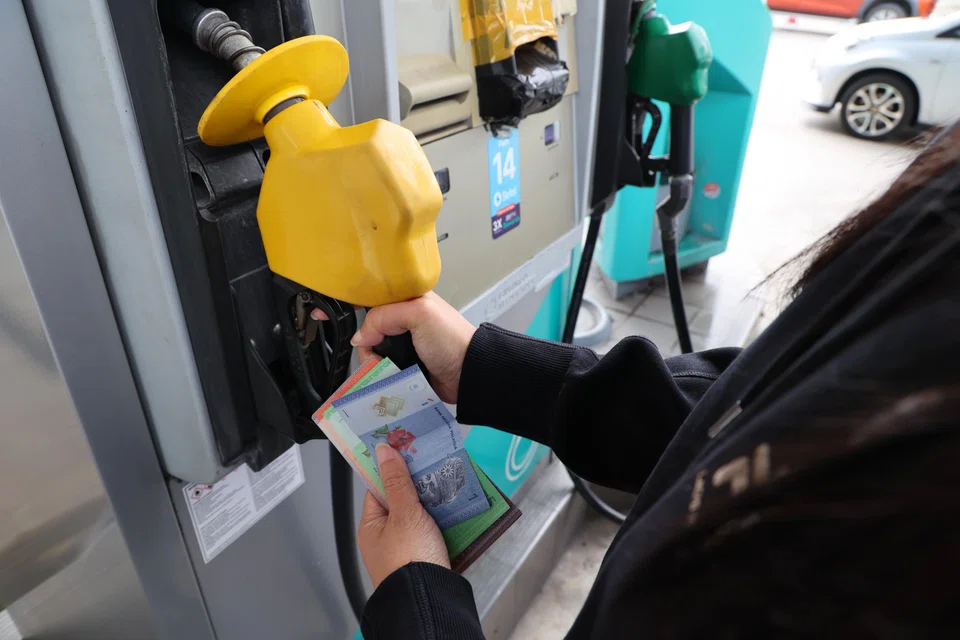
The government has kept subsidised RON95 at RM1.99 a litre even as unsubsidised fuel prices have risen. That limits the immediate impact on motorists, but leaves the government paying a larger share of the fuel bill when global oil prices climb.
Venkateswaran said subsidised fuel prices largely shield households from a direct inflation hit, though sustained oil prices above US$100 a barrel could push up producer prices and eventually feed through to consumers.
Lee said businesses would face higher fuel, transport and imported raw-material costs, some of which could erode household purchasing power.
Malaysia’s position as a net commodity exporter should continue to support its current account, Venkateswaran said. Portfolio flows, however, remain vulnerable to shifts in global and domestic sentiment.
Higher oil prices do not guarantee an immediate lift for oil and gas companies
Hong Leong Investment Bank said upstream expenditure accounted for 21 per cent of Petronas’ total capex in the first half of 2026, compared with 43 to 52 per cent between 2019 and 2025, although absolute upstream spending was broadly steady at RM9 billion.
The research house linked slower work-order issuance to weaker earnings among several upstream service providers.
Dayang Enterprise’s first-half core profit fell 17 per cent to RM54.8 million as order-book conversion was slower than expected, according to AmInvestment Bank.
Velesto Energy’s first-half profit after tax fell 72.4 per cent to RM28.4 million. Its president Megat Zariman Abdul Rahim attributed the softer Q2 performance mainly to lower rig utilisation and daily charter rates.
Neither Dayang nor Velesto has publicly attributed its results to the return of US$100-a-barrel oil.
On balance, Lee assessed the overall effect of oil remaining above US$100 as neutral to slightly negative for Malaysia.
The ultimate outcome will depend on how long prices remain elevated, whether other major exports such as LNG and palm oil also strengthen, and how much of the resulting cost pressure the government absorbs.
TRENDING NOW

LTA proposes combining car COE categories, adding rebate-surcharge system

StarHub to acquire MyRepublic’s mobile business amid ongoing telco consolidation

DBS, OCBC, UOB rout lops billions off STI as inflation, rate concerns spook investors

Grab CEO’s wife Chloe Tong on life with Anthony Tan and finding her purpose

