‘I still wash dishes’: How Calvin Chan turned Oriental Kopi into a RM2.5 billion kopitiam empire
The founder still returns to the kitchen, showing how far staying grounded can take you



The strategies and stories that shape today’s leaders.
[KUALA LUMPUR] The kitchen is where Calvin Chan finds his centre.
It is the place he and his siblings first brewed coffee, slow-cooked kaya, handcrafted egg tarts and experimented with beans long before Oriental Kopi became a Malaysian-listed kopitiam empire, valued at RM2.5 billion (S$785 million).
“When I feel tired, I go back to the kitchen. Not to manage, but to help out... checking orders, packing deliveries,” said Chan, Oriental Kopi’s founder and managing director. “It reminds me why we started,” he told The Business Times in an interview.
From its humble start with just five staff in 2020, Oriental Kopi now employs more than 1,800 people across 28 outlets – 25 in Malaysia and three in Singapore.
The brand was built during the quiet months of the pandemic, when lockdowns brought the food and beverage (F&B) industry to a standstill. Eight more outlets are being planned next year, including in Sabah, as part of the company’s expansion drive across Malaysia and the region.
Its momentum shows up clearly in the numbers. For the first three quarters to June, Oriental Kopi pulled in almost RM318 million in revenue and RM44.9 million in net profit.
The latest quarter showed a nearly 30 per cent jump in net profit to RM18 million for the third quarter, with revenue rising 13 per cent to RM116.7 million.
The company made its debut on Bursa Malaysia in January this year and raised gross proceeds of nearly RM184 million. Its stock skyrocketed about 243 per cent from its RM0.44 initial public offering price to its peak of RM1.51 on Oct 22.
At the current price of RM1.25 (as at Nov 19), it is still nearly three times higher.
The momentum is no fluke. Analysts say the chain’s steady expansion and strong branding amid rising consumer demand have enabled it to tap a growing appetite for mid-range dining in Malaysia and Singapore.
RHB Research forecasts a robust double-digit cafe revenue growth and the possibility of the business surpassing RM580 million in annual sales by FY2027.
A three-storey operations facility in Selangor – slated for completion in late 2026, will anchor the next phase of Oriental Kopi’s growth, bringing its research and development (R&D), food preparation and logistics under one roof.
Yet, behind all the expansion plans and impressive numbers, lies an origin story that did not begin with deep pockets or the right connections, but with urgency and a family figuring things out on the stove.
Chan, 42, never believed in needing a perfect starting point.
Before founding the kopitiam brand now drawing queues in Johor Bahru, the Klang Valley and Singapore, he was a teenage mobile phone seller. He started on this after finishing secondary school, by renting a small corner in a grocery shop in Bandar Tenggara, a small town in Johor.
A dream deferred

After six months, he had saved RM4,000.
He travelled to Kuala Lumpur, intending to study electronic engineering in a college, only to discover that the room he had arranged for was no longer available. With no accommodation, no job and funds draining fast, he gave up on college and returned to Johor.
“My mother didn’t scold me. She didn’t even say anything. She just looked at me. That silence said enough,” he recalled.
His father was a rubber tapper; the family had one motorcycle and no savings. There was no safety net.
With no qualifications and no capital, he returned to selling phones, not out of ambition, but survival. “I didn’t have many choices… If I don’t work, there would be no income,” he said.
This willingness to work through adversity allowed him to open his first independent shop by 2003, while still in his early 20s.
Then another curve ball came, this time in the form of devastating floods in Kota Tinggi, which wiped out his entire inventory. “All gone,” he said.
It didn’t stop him; he rebuilt and became a dealer for major brands, then a distributor; he then launched his own phone brand, MMD.
The pivot to kaya, polo buns

As business grew, so did Chan’s overseas travel. It was during these trips that he felt a persistent longing for Malaysian flavours – kopi, kaya toast, polo buns and nasi lemak.
“Whenever I travelled, I missed Malaysian food. I thought, why not build our own F&B brand? It was something I could introduce to friends overseas too,” he said.
He had experimented with F&B before through the Black Whale – a retail franchise brand he co-founded with his sister Yen Min back in 2018, which grew to 50 outlets in two years. But that experience taught him scale, not ownership. “We just followed someone else’s SOP (in managing a bubble tea chain). It didn’t feel like ours.”
So in 2019, just before Covid-19 hit, Chan and his siblings began developing what would become Oriental Kopi. When Malaysia went into protracted lockdown, the team did not shelve its plans. They used those stalled months to develop a full-fledged test kitchen.
“During the pandemic, we did R&D almost every day. We made kaya, baked bread, tested egg tarts and tried different coffee beans. Only the five of us – my sisters, brother-in-law and a friend who is our head chef,” he recalled.
The first Oriental Kopi opened in Johor Jaya – about 16 km from Johor Bahru city centre – in December 2020. There was no franchising model, no listing ambition – only a belief that quality would speak for itself.
And it did. The bread was made in-house and cut thicker for a crisp-yet-soft texture. The kaya was rich and slow-cooked. Egg tarts were handcrafted with layered pastry. Even the nasi lemak was treated as a craft, not a commodity.
“It’s just the attitude… If you care enough, people can taste it,” he said.
Customers drove from as far as Kuala Lumpur to try it. They packed kopi to take home. Some urged Chan to expand to the Klang Valley.
Out of one’s comfort zone

Despite the buzz around the brand, expanding into Kuala Lumpur felt daunting.
“We were worried. We’re Johoreans… Some of us hardly went to KL. Even the way the people there speak is different,” Chan said, recalling how the Klang Valley felt tougher, faster and far more competitive.
But demand kept building, and eventually they took the leap – first opening at a shop in Bandar Puteri Puchong, then steadily moving into major Klang Valley centres such as Pavilion Bukit Jalil and Mid Valley.
The company’s big break came when it opened a store in Mid Valley Southkey in Johor Bahru. Chan said this outlet turned out to be a hit, enjoying brisk sales and even drawing offers from other mall operators to set up shop in their premises.
Despite the rising popularity, Chan has resisted franchising his business as he wants to maintain standards. The brand’s central kitchen handles preparation, but every dish, especially wok-fired items, is cooked fresh on-site.
“We insist on cooking fresh even if it takes more effort. Wok hei can’t be transported, and that’s what makes Oriental Kopi unique,” he added.
From five-man team to nearly 2,000 employees
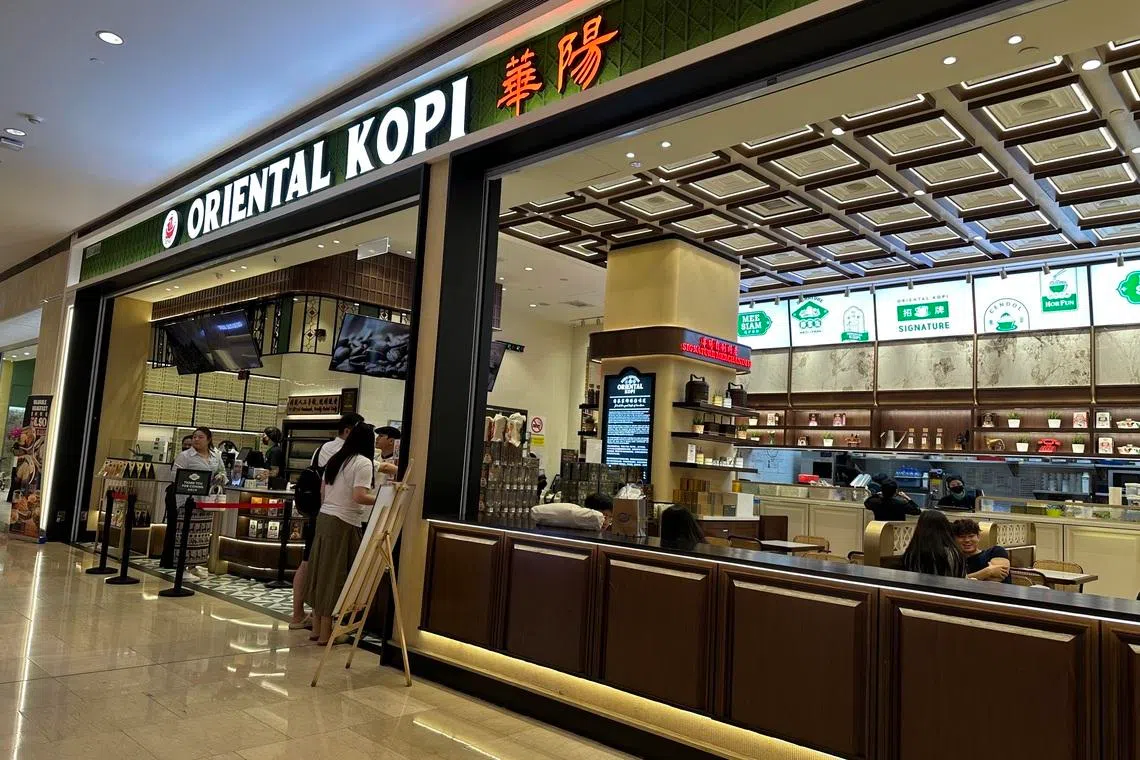
The kopitiam chain made its first international move in late 2024 through a strategic joint venture with Singapore’s Paradise Group, which holds a 70 per cent stake in the partnership.
The collaboration brought together Paradise’s operational scale and familiarity with the local market and Oriental Kopi’s brand DNA and product expertise.
Under the arrangement, the company supplies technical support, core ingredients and promotional direction, while Paradise manages on-ground operations.
Chan described the partnership as one built on “chemistry, not just pricing”, noting that alignment in pace, values and standards was crucial.
“This model is a proven success as all the three outlets in Singapore are performing strongly,” said Chan, noting that this will become a reference point for Oriental Kopi’s gradual, partnership-led regional expansion strategy.
The brand will open eight more outlets next year under a larger strategy to strengthen its domestic network, while it continues talking with potential partners on regional expansion.
Back to basics
The business may have scaled rapidly, but Chan’s philosophy remains unchanged.
“Do things properly. Care about the taste. Care about the people. We started from zero. If we remember that, we will not lose our way,” he said.
Till today, he visits kitchens unannounced. If a store is short-handed, he puts on an apron and helps. “I cannot ask my team to do something I have not done myself,” he said.
Three questions with Oriental Kopi founder Calvin Chan
Q: Was there a pivotal moment in your career or personal life that changed your approach to leadership?
When the Kota Tinggi floods wiped out my entire phone shop inventory twice, I realised leadership is not about giving instructions; it’s about showing how to rebuild from zero. I learnt to work side by side, not from above. Until today, I still wash dishes and serve customers when needed.
Q: What is one piece of “unconventional wisdom” you swear by that most business schools would tell you is wrong?
Most people chase efficiency first, then quality. I do the opposite. I insist on slow, repetitive R&D, thick bread, homemade kaya, and cooking on the spot even though it’s harder. Business schools would say scale first, but if the taste isn’t right, expansion is meaningless. Quality drives growth, not shortcuts.
Q: When you feel burnout creeping in, what’s your non-business-related “panic button” activity or routine that reliably resets your focus?
I go back to the kitchen. Not to manage – to make. Helping out others to check the orders, packing deliveries, this reminds me why I started. It resets my head immediately. It’s grounding. When your hands are busy, your mind becomes clear. Going back to the basics is my way of recharging.