Indonesia’s billionaire boom: record wealth, new entrants and rising fortunes
Hartono brothers lead with US$50.3 billion, followed by petrochemicals and energy tycoon Prajogo Pangestu, coal magnate Low Tuck Kwong, the Widjaja family of the Sinar Mas Group, and Anthoni Salim

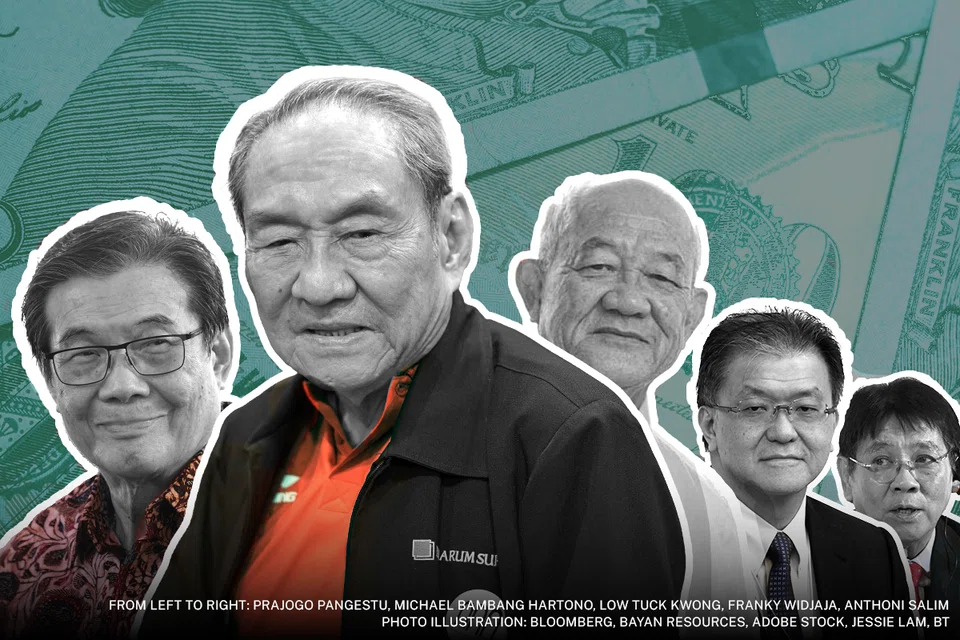
[JAKARTA] Top tycoons in Indonesia have defied a sluggish stock market, with their collective wealth surging by US$11 billion this year to reach a record US$263 billion, according to the 2024 Forbes Indonesia’s 50 Richest list.
For the first time, the minimum wealth to make the list crossed the US$1 billion mark, reflecting the country’s growing economic dynamism.

Fuelling this surge in wealth are booming sectors such as mining, agribusiness and cutting-edge digital ventures, especially data centres. The Business Times takes a look at the top five billionaires shaping South-east Asia’s largest economy.
1. Hartono brothers: tobacco and banking powerhouses
Indonesian tobacco and banking titans, the Hartono brothers, have maintained their position as the wealthiest individuals in Indonesia over the past decade, according to Forbes’ 2024 list.
Michael and Robert Hartono have run Djarum Group, Indonesia’s largest tobacco company, since inheriting it from their father in 1963. Over the years, Djarum expanded beyond tobacco to fields such as electronics, banking and real estate, which have all helped to fatten the brothers’ wallets even further.
The octogenarian brothers’ fortune soared to an impressive US$50.3 billion this year, driven by the stellar performance of Bank Central Asia (BCA), Indonesia’s largest private bank by assets, where Djarum is the majority shareholder.
BCA reported strong loan growth over the past nine months, reaching 877 trillion rupiah (S$73.9 billion), further fuelling the brothers’ wealth.
2. Prajogo Pangestu: petrochem and renewables visionary
Prajogo Pangestu, the petrochemicals and energy mogul, has solidified his position as Indonesia’s second-richest individual with a fortune of US$32.5 billion, despite a 25 per cent decline due to the sharp drop in the valuation of his renewable energy firm Barito Renewables Energy.
Pangestu, the founder of petrochemicals giant Barito Pacific, established in 1979, has been actively expanding into renewable energy, in line with Indonesia’s ambitious sustainability goals. Last April, Barito Renewables Energy acquired a US$101 million wind power plant in Sulawesi.
The company made headlines with its debut last October, raising US$220 million in the largest initial public offering (IPO) of the month. Since then, its share price has surged by a staggering 1,200 per cent.
However, in the months following its IPO, the stock price had a roller-coaster ride, with wild swings that caught the attention of market regulators, who promptly placed the company on a watch list due to its extreme volatility.
This triggered panic among retail investors, further intensifying the market fluctuations. The price volatility also led to the company’s removal from the FTSE index earlier this year.
Last October, Pangestu’s oil and gas company, Chandra Asri, acquired Shell Singapore’s refinery and chemical assets through a joint venture, CAPGC, owned by Chandra Asri Capital and Glencore.
3. Low Tuck Kwong: coal king
Singapore-born coal magnate Low Tuck Kwong retained the third spot on the richest list, with a fortune of U$27 billion, despite a dip in revenue from his mining company, Bayan Resources, due to falling commodity prices.
Bayan Resources, Indonesia’s fourth-largest mining company, runs four expansive mines across Kalimantan, with concessions spanning 126,000 hectares. These sites hold an estimated two million tonnes of coal reserves.
The company saw its profits tumble by 47.95 per cent, recording about US$376.8 million in the first half of this year.
Low renounced his Singaporean citizenship and embraced Indonesian nationality in 1992. He then made a bold move in 1997 by acquiring his first coal mine in Kalimantan, marking the start of his influential presence in the industry.
Despite his ties to Indonesia, Low has maintained a strong connection to Singapore, contributing to its community through his philanthropic activities in the city-state.
4. Widjaja family: digital growth pioneers
Indonesia’s rapidly growing digital economy has been a major driver behind the Sinar Mas Widjaja family’s wealth, with its fortune surging by 75 per cent to an impressive US$18.9 billion this year, securing its place as the fourth-richest family in the country.
Sinar Mas Group, which the family controls, is now led by Franky Oesman Widjaja, the eldest son, after the death of founder Eka Tjipta Widjaja in 2019.
The family’s energy and infrastructure flagship, Dian Swastatika Sentosa, saw its shares skyrocket more than sevenfold this year, driven by strategic investments in geothermal energy and data centres – key moves that have propelled Sinar Mas to new heights.
In September, the group announced its collaboration with South Korea’s LG CNS to build a cutting-edge 4.6 trillion rupiah data centre in Jakarta, specifically designed for artificial intelligence services. The project is set to be completed by 2026.
The group also recently announced the merger of its telecom company Smartfren with XL Axiata, an Indonesia telco operator under Malaysia’s Axiata Group, valued at US$6.5 billion. The merger aims to expand their 5G coverage in Indonesia’s rapidly growing and competitive digital market.
Sinar Mas has also expanded into the Singapore market through its involvement in palm oil and real estate. Its agribusiness and food operations are primarily managed through Golden Agri-Resources, which is listed on the Singapore Exchange.
5. Anthoni Salim: food and infrastructure giant
Salim Group’s Anthoni Salim saw his fortune rise by US$2.5 billion this year, securing his position as the fifth-richest individual in Indonesia.
The boost was fuelled by the surge in the valuation of Indoritel Makmur Internasional, the powerhouse behind the country’s largest supermarket retail network.
Indofood CBP Sukses Makmur, the powerhouse behind Salim Group and the iconic instant noodle brand Indomie, posted a net profit of 8.14 trillion rupiah in the third quarter of this year. This marks a 15 per cent rise from the same period last year, showcasing continued strong performance in the food sector.
Salim Group is also an indirect shareholder in Amman Mineral Internasional, one of Indonesia’s leading copper and gold mining giants. The company went public last year, raising 10.73 trillion rupiah, making it one of the largest offerings of 2023.
Earlier this year, the group’s infrastructure arm, Metro Pacific Tollways Indonesia Services, partnered a consortium led by Singapore’s GIC to acquire a 35 per cent stake in state-owned toll operator Jasamarga, which manages the Trans Java Toll Road. Valued at 15.75 trillion rupiah, the acquisition ranks among the largest toll road deals of the year.