


Indonesia’s Nusantara faces funding test as private capital takes on bigger role
The country’s 2027 Budget is trimming public funding for the new capital

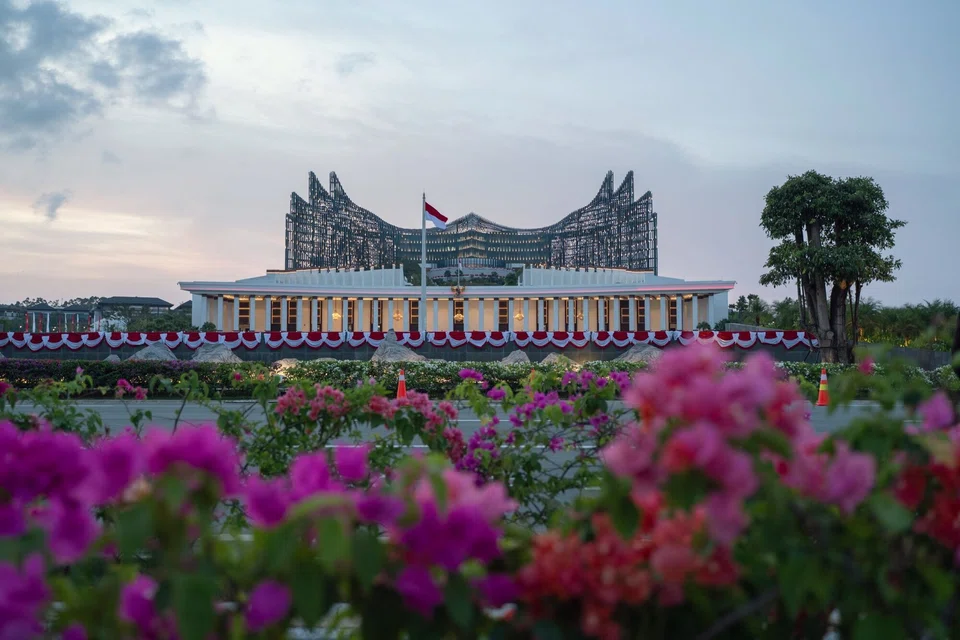
[JAKARTA] Indonesia’s new capital Nusantara is facing a new test as President Prabowo Subianto scales back its reliance on public funding, raising the question of whether private investors will provide enough capital to turn the fledgling city into a functioning urban centre.
Nusantara was not included among the eight national priority programmes in Prabowo’s proposed 2027 Budget unveiled last week, with future development expected to rely more heavily on private investment.
The project will receive just 6.7 trillion rupiah (US$375 million) from the 2027 proposed state Budget, roughly about 0.2 per cent of the government’s total planned spending of 4,097 trillion rupiah.
Nusantara Capital Authority said that the US$32 billion development is being funded through four schemes: the state Budget, public-private partnerships, private investment and grants.
Of the project’s total investment needs, the government will finance about 20 per cent, with the remainder expected to come through creative financing schemes, including direct investment.
With basic infrastructure now in place, a number of domestic and foreign investors have begun exploring opportunities in the new capital, Nusantara Capital Authority said in response to queries from The Business Times.
As at June, the agency said it has secured 134 trillion rupiah in commitments through public-private partnerships and 74.5 trillion rupiah in direct investment, as the government seeks to broaden private-sector participation in the capital’s development.
The investments include projects involving local developers as well as foreign investors from China, Singapore, South Korea, Malaysia, Russia and the United Arab Emirates.
The government has introduced a range of incentives to attract investors to Nusantara, including tax holidays and tax deductions of up to 30 years for investments of at least 10 billion rupiah.
Private investors gamble
Spanning about 252,660 hectares, Nusantara is roughly four times the size of Jakarta and more than three times Singapore. Yet its population remains small relative to its vast footprint.
Indonesia’s statistics agency recorded 147,430 residents across the designated Nusantara area in the first half of this year, highlighting the challenge of developing infrastructure and attracting a larger population to a city still in its early stages.
For now, much of the economic activity in the new capital remains linked directly or indirectly to government construction.
The city has housing, government offices and some services, but it does not yet have the dense commercial activity associated with an established capital.
Analysts said this could test investors’ appetite for taking on a greater role in financing the capital, given that Nusantara is still at an early stage of development.
“That creates a chicken-and-egg problem for private investors,” said Achmad Nur Hidayat, an economist and public policy lecturer at UPN Veteran Jakarta.
“Businesses need customers and workers, while residents need jobs, schools, healthcare, shops, restaurants and other services before they are willing to relocate permanently. That is precisely why attracting private investment will be crucial to Nusantara’s development.” He said Prabowo’s decision not to make the project a national priority should not be seen as a threat to the new capital’s future, but rather as a shift in public spending towards more pressing needs as the government faces fiscal constraints.
“If Nusantara is indeed attractive, now is the time for the government to prove it by attracting more private investment,” he added.
Willson Kalip, country director at property consultancy Knight Frank Indonesia, said the new capital’s long-term success will depend on the government’s ability to manage population growth and build a vibrant urban ecosystem.
He said without a critical mass of residents and a compelling reason for people to relocate permanently, the city’s extensive infrastructure risks lacking economic significance.
Kalip compared Nusantara’s development with major Australian cities, where new growth centres can take decades to mature.
“Nusantara could take 30 years or more to become a fully functioning city. This is a long-term investment and development game.”
Private investors are also being asked to enter the new capital at a time when construction costs are rising, potentially squeezing returns on projects that are already facing uncertain demand.
Contractors working in Nusantara have reported sharp increases in fuel and other construction materials following the escalation of geopolitical tensions in the Middle East.
Sony Alisa, an official overseeing construction in the new capital, told BT contractors had raised concerns about rising input costs, and the Nusantara Capital Authority is working to resolve these issues internally.
Data from the Indonesian Contractors Association showed oil prices rose 37.4 per cent between Feb 28 and Jul 1, pushing industrial diesel prices up 41.5 per cent. Over the same period, reinforced steel prices increased 27.8 per cent, while asphalt prices rose 23.9 per cent.

Indonesia is moving its capital from sinking Jakarta to Nusantara, a new city under construction in Borneo.
But the ambitious project has faced logistical and funding challenges since it was announced by then-president Joko Widodo, who is also known as Jokowi, in 2019, delaying the original 2024 inauguration target.
The project, whose construction began in September 2023 after pandemic-related delays, has since undergone several changes under Prabowo, from its funding and development timeline to its role in the government’s broader priorities.
Prabowo’s administration has retained the target of making Nusantara Indonesia’s political capital by 2028, while moving away from his predecessor’s plan to establish the city as the country’s full national capital.
The new capital’s exclusion from the national priority list marks a shift from Jokowi’s approach, under which the project was a flagship initiative backed by at least 40 trillion rupiah in public spending on basic infrastructure, including roads, reservoirs and worker housing.
What has actually been built
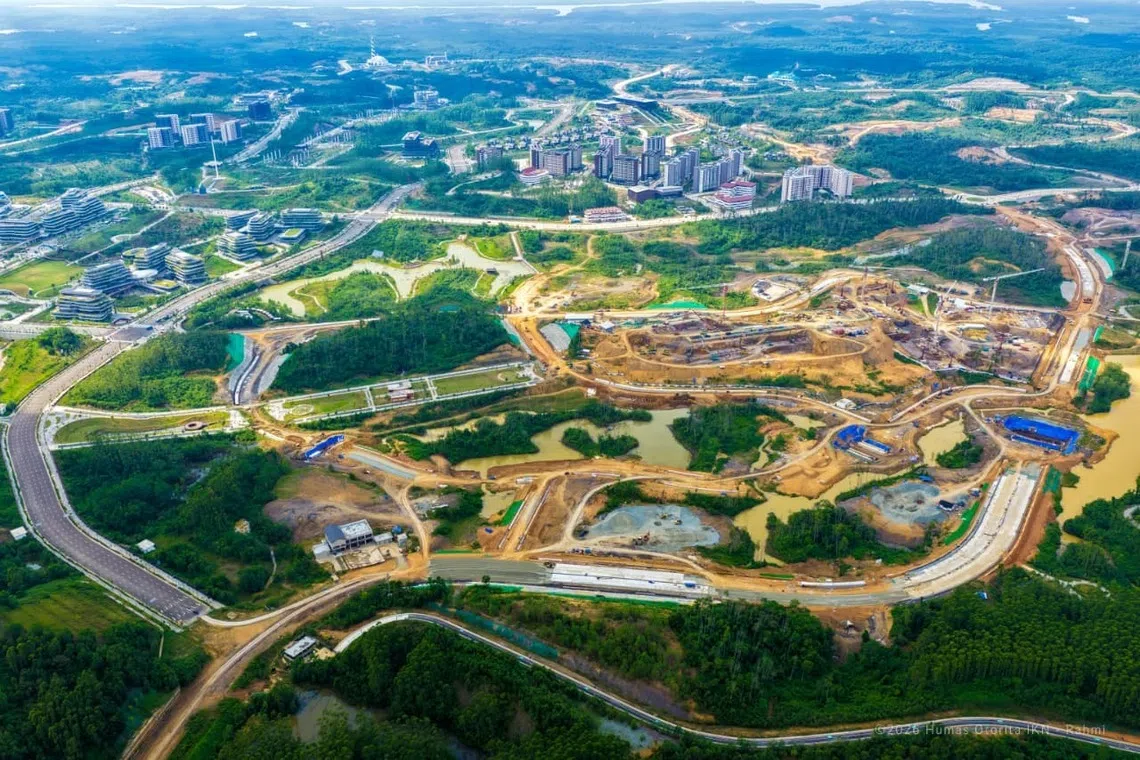
Set in the heart of Borneo’s lush jungle, Nusantara has moved beyond the planning stage, with roads, public infrastructure and government facilities taking shape across the city’s core area.
A 40 km toll road linking the new capital with Balikpapan, East Kalimantan’s main city, has also been completed, although its use remains limited.

The authority said construction is continuing on offices for the judiciary and legislature, which form key parts of the government district, as well as an office for Vice-President Gibran Rakabuming Raka, who is expected to begin working from Nusantara by the end of this year.
Construction of the main government buildings remains at an early stage, with most projects less than 13 per cent complete.
The judicial complex, which will house the Constitutional Court, Supreme Court and Judicial Commission, as well as the legislative complex being built under five packages are due for completion in December 2027.
The government plans to relocate thousands of civil servants as Nusantara becomes the political capital.
TRENDING NOW
Prima to move out of historic Keppel Road flour mill building in 2028

Temasek-related Azalea, SeaTown, Seviora Capital to merge in 2027
Family offices see more tailored products, leverage ‘collective firepower’ for direct deal access

Singapore room rates soar, but hotels seeing mixed demand from F1 race and events

