


Kopi Kenangan is profitable now, but its CEO thinks his pitfall was ‘too much funding’ at the start
The coffee chain is starting – but not rushing – its global roll-out early to future-proof the business

The strategies and stories that shape today’s leaders.
[SINGAPORE] Kopi Kenangan, one of Indonesia’s largest and fastest-growing coffee chains, clocked a milestone recently: its first full-year profit, for the year ended Dec 31, 2025.
This is a significant milestone for any startup, but an even more remarkable one for the chain, given its net loss of 452.2 billion rupiah (S$34.25 million) just three years earlier, in 2022.
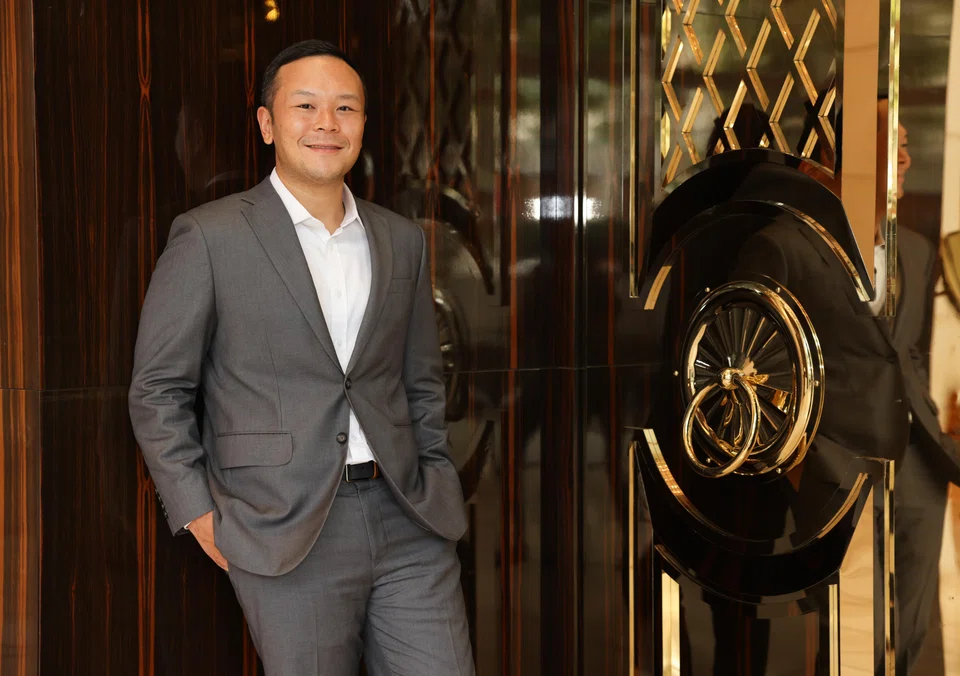
In an interview with The Business Times, co-founder and chief executive officer Edward Tirtanata reflected that finding “discipline” was key in helping Kopi Kenangan achieve profitability.
“The biggest problem in South-east Asia startups is that founders are over-resourced, not under-resourced,” he said. “When you raise that triple-digit (figure), you start to take on projects that are, say, the fifth, sixth, seventh priority.”
Kopi Kenangan, better known as Kenangan Coffee outside Indonesia, hit unicorn status at the end of 2021. A year before that, the startup raised US$109 million in a Series B funding round led by Sequoia Capital, with other backers including Alpha JWC Ventures, B Capital, Horizons Ventures, Chinese Internet firm Kunlun and Belgium’s Sofina and Verlinvest.
It raised US$96 million in the first closing of a Series C funding round led by Hong Kong-based Tybourne Capital Management in 2021, which lifted its valuation above US$1 billion.
Other backers in the Series A round included Serena Ventures – founded by Serena Williams – and Arrive Ventures by ROC Nation.
Kopi Kenangan then went on an aggressive expansion spree, launching Cerita Roti, which focuses on classic Indonesian bread; fried chicken chain Chigo; and Flip Burger, one of Indonesia’s pioneer burger chains.
In 2022, the group’s net loss deepened 70 per cent year on year to 452.2 billion rupiah.
“After 2022, I realised we had taken on too many things,” said Tirtanata.
“When you combine a lot of fresh capital with pressure to grow during a pandemic, the ‘easy’ logical step is to just add more verticals. In hindsight, those were costly lessons in terms of focus and capital. We realised those distractions were pulling us away from our core.”
The 37-year-old said the group managed to turn a profit in 2025 after refocusing its attention on its top three initiatives, as opposed to juggling 10 initiatives in a year.
Unaudited financial results for 2025 seen by BT showed Kopi Kenangan’s net profit came in at US$17 million, with revenue rising 45 per cent year-on-year to reach US$184 million.
The group attributed its 2025 performance to a growth in its technology platform, which helped drive a 159 per cent surge in new customer acquisitions. It gained 4.5 million new customers through its digital ecosystem; monthly digital transacting users rose 116 per cent to reach 1.5 million as at December 2025.
The strong customer growth means Kopi Kenangan now has sufficient scale to support investments in its technology platform, which it relies on heavily for customer acquisitions, said Tirtanata.
For 2026, the group is expecting net income to rise 67 per cent to reach US$29 million, driven by continued store openings and customer acquisition.
One new store a day
While Kopi Kenangan is now a group with interests in food and fast-moving consumer goods, the brand is still arguably best known for its cafes and coffee.
The group began as a coffee stall founded by Tirtanata and his high-school friend James Prananto in 2017, to bridge the gap between the more pricey coffees served by international chains and the cheaper instant coffee offered in Indonesia.
Before starting the coffee business, Tirtanata had started a tea company, Lewis & Carroll Tea, in 2015.
His burgeoning interest in coffee began as a teenager. Tirtanata only began drinking coffee in his freshman year but soon became accustomed to drinking three to four cups of coffee every day.
“You know, rainy day or sunshine, you still need coffee,” he said.
Kopi Kenangan evolved into a multi-brand group around 2020 before expanding overseas in 2022.
As at the end of 2025, it has 1,324 stores in six countries: Indonesia, Singapore, Malaysia, the Philippines, Australia and India. Its home market, Indonesia, remains the group’s core market and growth driver with 1,137 stores.
Tirtanata said the group averages one store opening a day and is looking at new markets such as Taiwan and the Middle East this year.
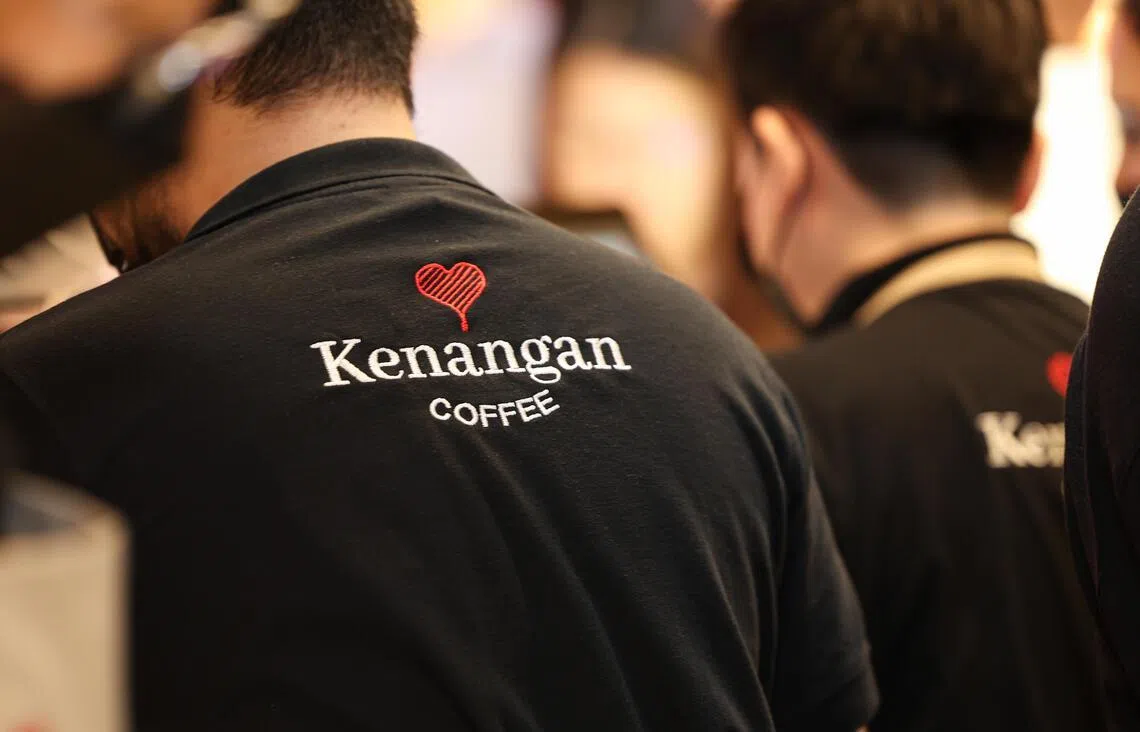
Kopi Kenangan sells only Indonesian coffee; Tirtanata said the group’s goal is to “sell Indonesian coffee not as a commodity, but as a brand globally”. Indonesia is one of the world’s top coffee producers, ranking either fourth or fifth by various estimates.
Therefore, while the group still sees more growth and expansion potential in Indonesia, its nascent overseas foray is part of a longer-term goal of selling Indonesian coffee as a premium brand to overseas markets.
Singaporeans love their coffee ‘gao’
Another key reason for going overseas slowly but early is to future-proof the business, Tirtanata said.
“It takes years for you to get the engine rolling right in every country,” he added. “For example, in Malaysia, we were unprofitable on an Ebitda (earnings before interest, taxes, depreciation and amortisation) level in 2022. We were only able to open 10 to 30 stores a year.”
Malaysia is Kopi Kenangan’s first and largest overseas market, with 158 stores as at the end of 2025.
Ebitda for the Malaysia business improved from a loss in 2023 to RM5 million (S$1.6 million) in 2024, further strengthening to RM17 million last year. The group said net losses continue to narrow; it expects the Malaysia business to turn net-profit-positive this year.
“I think any company that tries to open 200 stores in its first year is bound for a lot of failures and cash burn,” Tirtanata said.
Kopi Kenangan started with one store in Indonesia in 2017 and expanded to 26 stores the following year. It then grew to 223 stores in 2019.
“It’s gradual, that’s why we are starting this journey early,” Tirtanata said.
He sees the group’s overseas expansion plan as a seed-planting exercise. The goal is for store expansion and growth in each overseas market to proceed at a steady pace, gearing up for an increased expansion in five or 10 years, when growth in Indonesia may start to plateau from a period of sustained store openings.
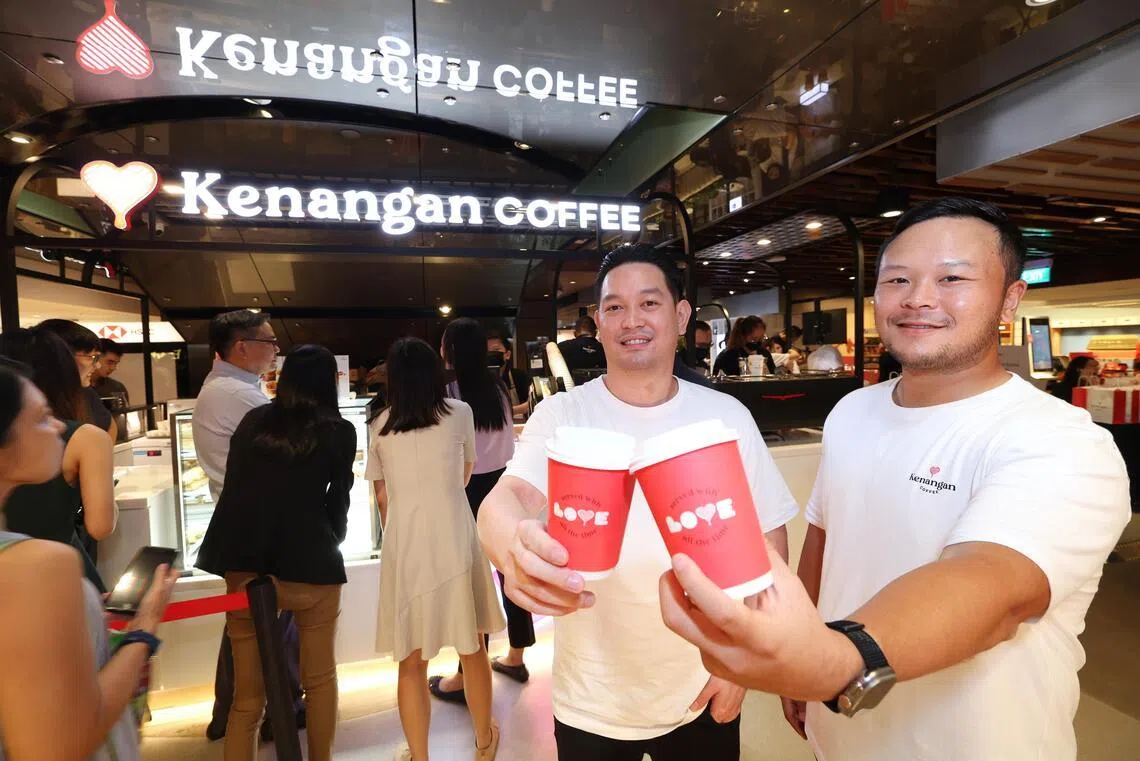
“It’s just bound to happen,” he added. “If you have 1,000 stores, you need to open 500 to go to 50 per cent. But if you have 10,000, then you need 5,000 to go to 50 per cent. When we reach that point, I don’t think growth can come from a single country.”
Kopi Kenangan adopts a localisation strategy in each market it enters, tweaking its products to suit local tastes.
Tirtanata said that the business also adjusts its customer experience to the local market.
For example, he has noticed over the past two years that consumers in Malaysia and Indonesia prefer placing orders through an app. In the Philippines, consumers prefer ordering with a cashier instead.
In Singapore, meanwhile, the preference is for self-ordering kiosks.
“Eighty per cent of our revenue (in Singapore) comes from there, not from the cashier or from the app,” he revealed.
Another thing he has learnt about Singapore: “Singaporeans love their coffee ‘gao’, so our regular coffee in Singapore has two shots of arabica.” “Gao”, Hokkien for “thick”, is a local slang used to order stronger drinks.
Offence is the best defence
Kopi Kenangan expects net revenue for Indonesia to rise 36 per cent to 3.2 trillion rupiah in 2026, with net profit increasing 40 per cent to 529 billion rupiah.
The positive outlook for Indonesia comes against a backdrop of some consumer uncertainty. While consumer confidence rebounded in the last few months of 2025, it was shaky in the months following US President Donald Trump’s “Liberation Day” tariff announcements on Apr 2, data from Bank Indonesia showed.
“The best way to come out of macro uncertainty is sometimes to play offence rather than defence,” Tirtanata said. “In 2025, we invested heavily in customer acquisition, and that’s why we’re able to achieve that 15 per cent in same-store sales growth.
“If you acquire enough users and retain them, then obviously you will be able to grow despite the macro challenges.”
Kopi Kenangan could open around 330 stores in Indonesia this year, with another 75 in Malaysia and between 10 and 20 stores in each of the rest of its markets.
Tirtanata projects that Indonesia will still be the group’s dominant growth and profitability driver in the next five years.
He added that Kopi Kenangan is not intending to go public in 2026, and that he has no time or place in mind for a listing yet.
“I think a lot of people go public too early,” he said. “To us, it’s a once-in-a-lifetime kind of thing, so we might as well get it right rather than going out too early.”
Three questions with Kopi Kenangan’s CEO and co-founder Edward Tirtanata
Q: Was there a pivotal moment in your career or personal life that changed your approach to leadership?
I would say that actually getting too much funding early on was a pivotal moment.
Based on my interactions with founders in South-east Asia, especially late-stage founders such as myself, I realised that the biggest problem in South-east Asia is that startups are being over-resourced, not under-resourced.
Because when you raise that triple-digit (figure), you start to take on a lot of projects that are, say, the fifth, sixth or seventh, best priority on your list instead of focusing on that one, two, or three most important priorities.
Q: What is one piece of “unconventional wisdom” you swear by, but which most business schools would tell you is wrong?
A lot of business schools will tell you to be data-driven, to have a lot of data analytics in everything that you do.
I think that conventional wisdom is true when you are in an established company or corporation like Kenangan Coffee. But when you are just starting something new, there is not much data available.
When we launched our fast-moving consumer goods product, we spent too much money trying to find out which product we should launch. We did that because we thought we needed to have data.
One year later, we found out the research did not hold water.
At the end of the day, the best way to start a new venture or a new product is to talk to customers, to get a sense of what people like, right? And there’s the possibility that you won’t be able to gather enough data when you launch a new product. So that’s why you have to rely on creativity and guts too.
Q: When you feel burnout creeping in, what’s your non-business-related “panic button” activity or routine that reliably resets your focus?
I don’t have a reset button. Usually, I’m exhausted because there are a lot of problems, and the only way to (resolve it) is to just solve the problems. If you can solve the problems, then you’ll feel good, right? But if you don’t, then they will always be lingering.
If I have to pinpoint something that makes me feel slightly better, it would be sports. I like any sport, from basketball to golf to boxing. So I do quite a lot of activities in my spare time, especially in the morning, just to make me reset.
TRENDING NOW

DBS, OCBC, UOB rout lops billions off STI as inflation, rate concerns spook investors

Grab CEO’s wife Chloe Tong on life with Anthony Tan and finding her purpose
OCBC sheds S$8 billion in value as shares close nearly 6% down; analysts cautious on banks

Deal between tycoon friends sparks scrutiny of Philippine power sector

