Philippine equities start the year hot, but can they overcome scandal and slump?
The undervalued benchmark index could rebound from a five-year low to hit 7,100 this year, says analyst

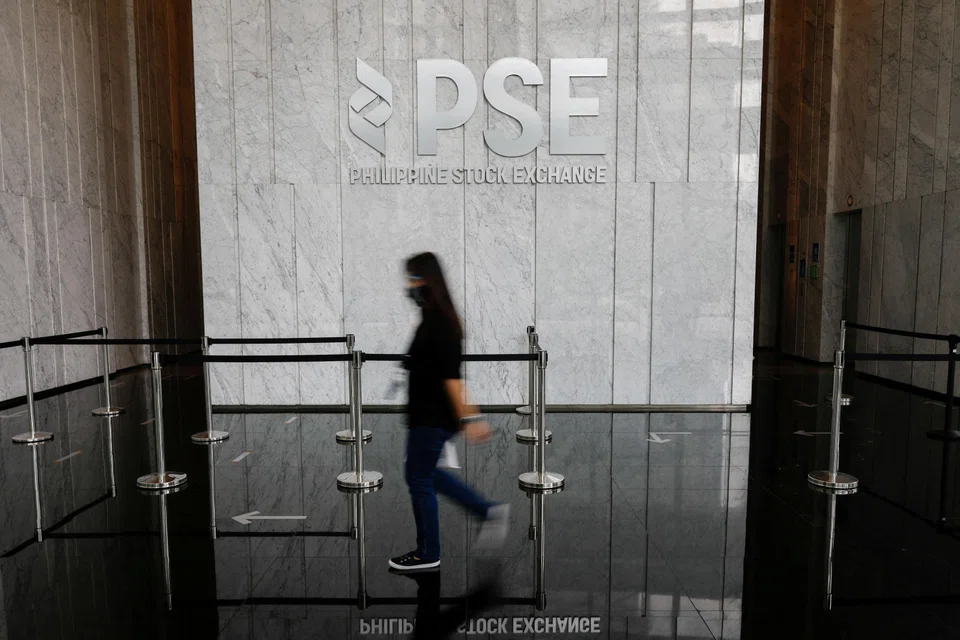
[SINGAPORE] Do not let its miserable outing in 2025 fool you; South-east Asia’s worst-performing equity market – Philippine stocks – is also the region’s cheapest, which may partly explain the rally in the benchmark index last week as it crossed the 6,500 mark.
Analysts attribute the Philippine Stock Exchange Composite Index’s (PSEi) upbeat start to the year, which they say could continue in the ensuing months, to two key factors – an undervalued market and robust corporate fundamentals.
The key index is up 8.3 per cent this year in US dollar terms, suggesting it may have reached an inflexion point. On Feb 11, the PSEi hit 6,543.35 points – a level last seen more than half a year earlier in July 2025. It closed at 6,407.15 on Thursday.
Since November, the index’s 15.9 per cent recovery is beginning to signal some optimism for foreign investors, who were net buyers in January with average inflows of US$97.4 million – after spending the majority of 2025 as net sellers.
Japhet Tantiangco, research manager at brokerage firm Philstocks, is expecting the index to climb to 7,100 points this year – which the PSEi last reached in late 2024 – marking a comeback from the six-year low of 5,584.34 it plunged to in November last year.
Macquarie analysts Gilbert Lopez, Karisa Magpayo and Foo Zhiwei, however, project a more modest outlook of 6,890 for the PSEi, citing heightened political risk and weak growth prospects as drags on earnings.
However, early signs of these political risks easing would heighten upside risk for the index, they said in a December report.
“In our view, the silver lining for the existing growth forecasts could be potential to deliver positive surprises,” they said.
Earnings growth
Tantiangco said that earnings of index members could increase by an average of 15 per cent in the year, where strong corporate fundamentals and healthy demand are expected to drive growth.
Low interest rates and recovering household consumption would play a notable role in improved earnings for the year ahead, he said.
Banko Sentral ng Pilipinas (BSP) reduced its key rate by 25 basis points during its rate-setting meeting on Thursday (Feb 19), as headline inflation of 2 per cent returned within the central bank’s target – albeit at the highest pace in nearly a year.
Since beginning its easing cycle in August 2024, BSP has reduced its key rate by 225 basis points, reaching a three-year low of 4.25 per cent.
The lagged effect of the rate cuts could give property developers a boost, Tantiangco said, with real estate loans and residential property demand showing signs of growth. A low-interest-rate environment also bodes well for the banking sector, where rising demand for loans among businesses and households is expected to support earnings.
Meanwhile, lower borrowing costs could also provide tailwinds for the consumer sector, as household consumption re-accelerates – boosted further by recovering employment levels and stable remittances from overseas foreign workers.
Philstocks picked property giants Ayala Land and Megaworld, banking standouts BDO, Bank of the Philippine Islands and GT Capital, and consumer stock Universal Robina among fundamentally sound stocks trading at attractive levels.
Nickel mining stocks could also outperform as demand from steel and electric vehicle batteries rises, while Indonesia’s plan to cut nickel production would offer miners in the Philippines a boost. Philstocks picked Semirara Mining and Power Corporation as both a high-dividend and long-term value play.
“Historically cheap”
A woeful 2025 saw Philippine equities yield among the worst returns in the world, sliding 7.6 per cent in a year when most emerging markets delivered strong gains.
A storm of a high-profile corruption scandal, weak economic data and typhoon-induced destruction battered investor sentiment, sending the index to its lowest level since the pandemic-driven global stock rout in 2020.
Tantiangco said the country’s lack of exposure to the artificial intelligence (AI) sector had also caused it to fall behind in the global AI bull run. Additionally, a weak peso throughout 2025 had weighed on the PSEi’s performance as foreign investors exited the market.
But the brief rally to start the year is now the third-quickest start among Asean-6 markets, behind Thailand’s 15.6 per cent and Singapore’s 9.5.
“Seemingly, the local market has already priced in and is now moving on from the underperformance of the local economy in Q4,” said Tantiangco.
This could be due to its attractive valuation, with the PSEi’s components remaining deeply undervalued compared to regional peers.
Tan Altundag, investment manager for emerging equities at Pictet Asset Management, pointed out that Philippine equities were trading at levels he described as “historically cheap” – with valuations last seen during the 2008 global financial crisis.
At around 10.9 times earnings, this is below its 2021 to 2025 average of 14.4 times, and the regional average of around 16 times. Said Tantiangco of Philstocks: “There is still a lot of room for bargain hunting.”
But lingering concerns from a corruption scandal and a patchy economic recovery could spoil the party.
Views among analysts appear mixed on whether the country’s economy can stage a convincing recovery to sustain the market’s momentum.
ANZ chief economist for South-east Asia and India Sanjay Mathur said in a Feb 10 report that governance concerns have rocked consumer and business sentiment, with consumer confidence in the fourth quarter falling to levels lower than during the pandemic.
“We are not certain at this stage whether growth in the Philippines will inflect for the better anytime soon,” he said.
Philstocks, on the other hand, projects the economy to recover to a 5 per cent growth rate, in line with the government’s expectations of a 5 to 6 per cent expansion in 2026 and further acceleration in 2027.
Nevertheless, foreign investors would still need to see deliberate government moves to restore political and economic confidence before they re-enter, said Altundag of Pictet Asset Management.
Kervin Sisayan, head of research at Maybank Philippines, said that early steps taken to restore confidence in the country’s governance are promising, where prosecution cases have been filed and Budget reforms are underway.
However, these initial steps and the market’s attractive valuations alone may not be sufficient to draw investor confidence back to its equities.
“Elevated political instability and policy uncertainty has elevated risk premia,” said Altundag. He added: “This has suppressed valuations and muted the positive impact of otherwise supportive macro tailwinds such as easing inflation, accommodative policy space and planned fiscal spending.”
Sisayan said: “We need a clear catalyst for re-rating (the Philippine market)”.
Will IPOs move the needle?
Just two initial public offerings (IPO) reached the Philippine Stock Exchange (PSE) in 2025, including the blockbuster 34.3 billion peso (S$745.3 million) listing of Maynilad Water Services, the largest since 2021.
The exchange ranked lowest among Asean-6 markets in the number of IPOs, while narrowly ranking above Thailand for the least amount of funds raised in the region last year.
PSE president Ramon Monzon told local media in January that the exchange was targeting up to 175 billion pesos in funds raised in 2026, around a 20 per cent increase from the 140 billion pesos raised in 2025. He estimated that four new market entrants would debut on the PSE this year.
In August 2025, casino operator Hann Holdings postponed its 11.8 billion peso IPO originally scheduled for September, citing poor market conditions, while fintech giant GCash delayed its Manila listing to the second half of 2026.
The e-wallet had said that the current 20 per cent minimum public float requirement was too high for its intended offering, prompting the country’s securities regulator to propose tweaks that would ease minimum free float levels for new listings.
But Pictet Asset Management’s Tantiangco said that these adjustments alone may not be sufficient to attract large firms to list on the struggling market.
Rather, companies are seeking a sustained recovery in confidence reflected in stronger trading turnover, and want clear evidence of investor appetite before proceeding with IPOs, he said.