Protests sweep Indonesia: Will unrest push Prabowo to reassess his economic agenda?
Months-long disenchantment over rising costs, graft allegations and policies have culminated in the most intense protests yet for his administration

[JAKARTA] Bubbling tensions over layoffs, rising costs, tax hikes, graft and political privilege have erupted into nationwide protests – potentially a wake-up call for President Prabowo Subianto to recalibrate and confront deepening inequalities.
By Saturday (Aug 30), the unrest had left five dead and government buildings in flames, underscoring a growing crisis of confidence in Prabowo’s leadership just 10 months into his term.
Referring to the protests as “the most intense demonstration” yet to test Prabowo’s administration, Dedi Dinarto, lead Indonesia analyst and senior associate at public policy advisory firm Global Counsel, remarked: “It’s a wake-up call for the administration to revisit its economic agenda and ensure resources are shared more fairly.”
He suggested that the administration reassess programmes such as the free school meals initiative and redirect funds towards more immediate support for the poor and middle class.
Since taking office, Prabowo has set a target for 8 per cent economic growth and pushed for budget cuts to finance his ambitious programmes, including a multibillion-dollar initiative to provide free meals for children.
Yet, in what many saw as a striking contradiction, the 2026 Budget raised lawmakers’ salaries – a breaking point for public resentment. Protests in Jakarta on Aug 25 erupted over their 50 million rupiah (S$3,858) monthly housing allowance, nearly 10 times the city’s minimum wage.
Prabowo announced on Sunday that parliament would revoke hefty allowances and impose a moratorium on lawmakers’ overseas trips, measures that had previously sparked public anger.
This is not the first protest under Prabowo; earlier unrest over military roles in civilian affairs and local election laws tested his presidency, but the current wave, fuelled by lawmakers’ privileges, may be the most intense yet.

Deja vu?
Analysts say the unrest goes beyond immediate economic pressures, pointing to a broader crisis of confidence in government institutions. They are also drawing uneasy comparisons with the 1998 protests that toppled Indonesia’s late authoritarian leader, Suharto.
“Policy direction isn’t clear,” said Siwage Dharma Negara, senior fellow of the Indonesia studies programme at Iseas-Yusof Ishak Institute in Singapore.
He noted that in 1998, even as the economy was battered by the Asian financial crisis, the government insisted conditions were stable, and pointed to falling poverty and unemployment – claims the public largely rejected.
“Today, the government presents optimistic data, yet the reality on the ground tells a very different story,” he said.
Indonesia’s economy grew 5.12 per cent in the second quarter, outpacing market expectations. But for many Indonesians, the upbeat numbers feel far removed from daily reality.
Rising layoffs, factory closures and sluggish consumer demand are raising questions about the official economic growth figures. Ministry of Manpower data indicates that 42,385 workers had been laid off by June 2025, a 32 per cent increase from the same period last year, underscoring the pressures facing Indonesia’s workforce.
The country’s manufacturing sector has also shown continued weakness. The S&P Global manufacturing index fell to 49.2 in July, marking the fourth consecutive month, signalling persistent challenges for industrial activity.

Protests spiral into chaos
By Thursday, protests had intensified as hundreds rallied at parliament and government offices against the lawmakers’ pay hike, demanding higher wages and lower taxes.
Tensions flared after a delivery rider was killed on Thursday night when a police armoured vehicle ran over him during clashes, sparking outrage that ignited nationwide demonstrations. The next day, thousands of protesters hurled stones and firecrackers at parliament and the police headquarters in Jakarta.
Indonesia’s stock market fell 1.5 per cent on Friday, while the rupiah weakened 0.8 per cent against the US dollar. On Sep 1, the Jakarta Composite Index was down 3.6 per cent, with the rupiah sliding more than 2 per cent.
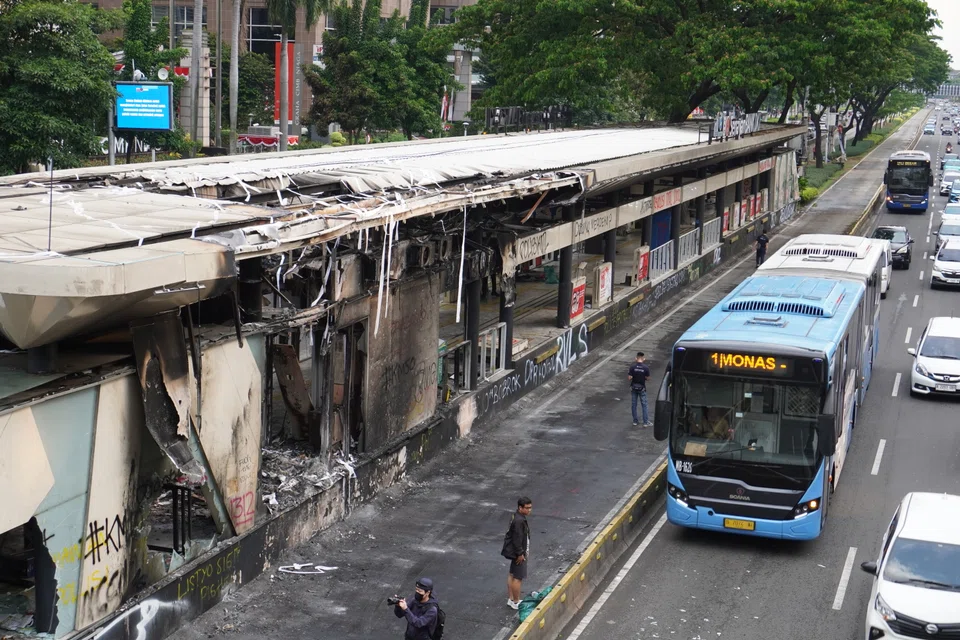
Looting of lawmakers’ homes in Jakarta and vandalism elsewhere forced the closure of malls, public transport and other services. As protests escalated nationwide, Prabowo cancelled a weekend trip to China at President Xi Jinping’s invitation for the Victory Day Parade in Beijing.
ByteDance’s TikTok said on Saturday that it had temporarily suspended livestreaming in Indonesia for several days amid escalating protests.
Smoke lingered over Jakarta’s inner-city toll road on Saturday after protesters torched seven toll gates near parliament overnight, forcing Transjakarta buses off the roads and shutting several Mass Rapid Transit stations. The unrest left the heart of the capital eerily silent over the weekend.
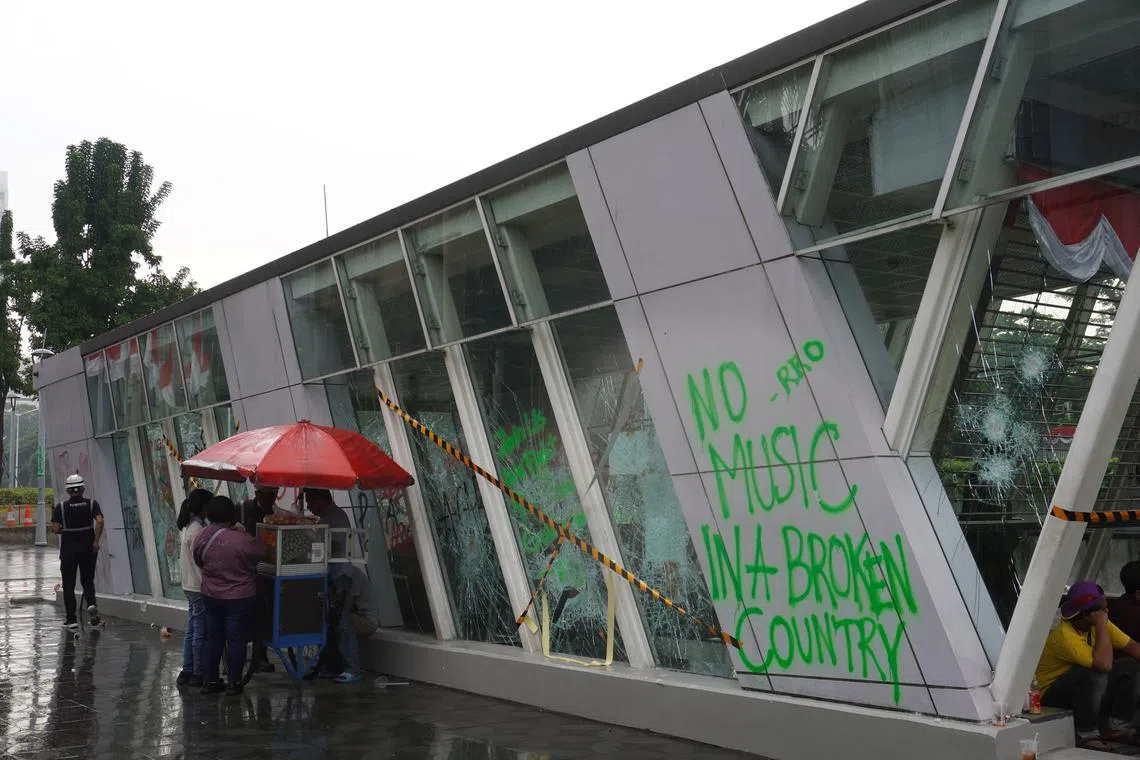
Protesters kept up attempts to storm parliament and the Jakarta mobile brigade police headquarters through Saturday night.
Reflecting wider business anxieties, the Jakarta chapter of the Indonesian Employers Association urged shops and companies to close from Friday evening, while the Singapore Embassy advised its citizens to avoid protest sites and large gatherings.
The disruption spread to Surabaya, where one of the city’s largest malls, Tunjungan Plaza, shut on Saturday, citing security risks after mass protests the night before.
Police and military pledged a decisive response, with Prabowo calling for “firm measures” to quell what he labelled “anarchic acts”, police chief Listyo Sigit Prabowo said.
Adding more fuel to fire
Outrage has also been stoked by steep property tax hikes under Prabowo’s Budget plan, which shifts costs to local governments. In Pati, Central Java, a 250 per cent increase in early August drew tens of thousands of villagers, farmers and laid-off workers into the streets.
The president’s administration took a further hit following the arrest of one of his deputy ministers by the country’s anti-graft agency on Aug 22.

Negara warned that prolonged instability could discourage labour-intensive industries, such as manufacturing and retail, which are crucial for job creation.
Disenchantment with the leadership has also fuelled suspicions of state fund misuse, with an Instagram post urging citizens to stop paying taxes drawing over 1.5 million likes and throwing Prabowo’s tax agenda into question.
The Indonesian Student Alliance and labour union group warned that protests could continue for several days, with demonstrators vowing to keep mobilising until their demands are addressed.
“If protests escalate and security becomes unpredictable, businesses may shut down or relocate,” said Negara. “This is his (Prabowo’s) defining moment. Can he restore faith in the rule of law?”