Renewables a key Asean growth engine for Surbana Jurong

Mindy Tan
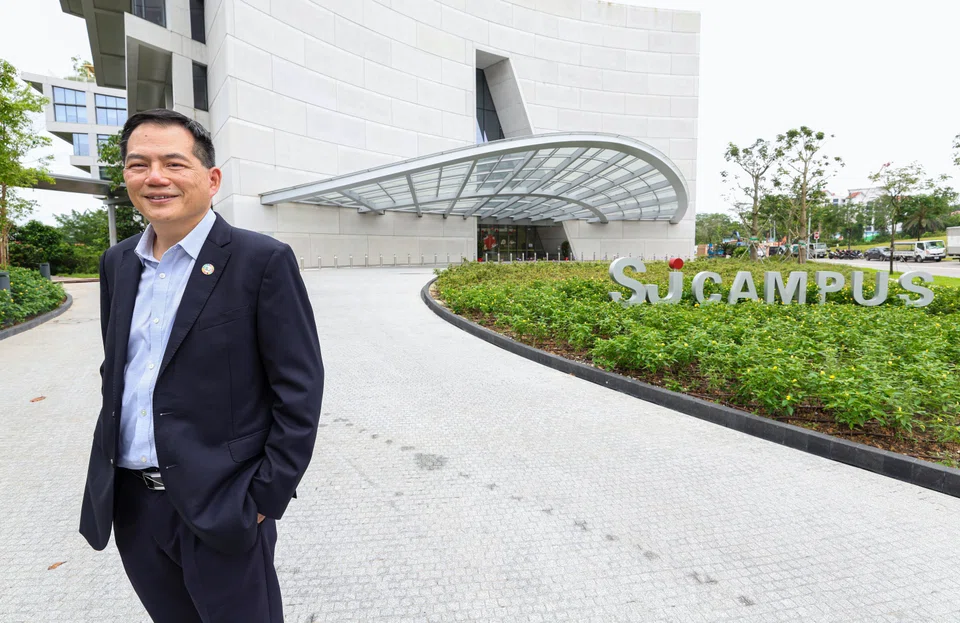
IN South-east Asia, the renewables sector is expected to be a key growth engine in the region, and Surbana Jurong (SJ) is doing all it can to ensure it is primed to tap on the many opportunities out there.
“Everybody is looking at five years down the line. If a company’s product came from a fossil fuel energy source, their product may not be exportable to say Europe or America in the future,” said Yeo Choon Chong, the Asean CEO of the Temasek-owned urban, infrastructure and managed services consulting firm.
“Companies need to have a plan. When we talk about energy transition, five years is not a long time,” the veteran engineer told The Business Times in a recent interview at Surbana Jurong Campus, its new headquarters at the Jurong Innovation District.
SJ has identified four strategic growth sectors – renewables, healthcare, transport and water – as part of SJ2.0, its strategic roadmap for its next phase of growth from 2022 to 2026.
According to Yeo, a large part of what is driving the dynamism today are more private companies that have moved from sceptical awareness of the need for more environmental, social and governance (ESG) initiatives – to being the ones pushing the envelope instead.
Green economy push
On its part, SJ has been working with governments around the world on their decarbonisation and energy-transition pathways, said Yeo, who joined the consultancy in 2016.
Citing one example, he shared how SJ was appointed by the Sarawak state government in Malaysia last year to advise on a comprehensive industrial transformation masterplan to better leverage the state’s natural resources.
State-owned Sarawak Energy owns three hydroelectric dams that are already in operation, with a fourth currently under construction and expected to be commissioned by 2027.
The renewable energy provider is also developing its first floating solar farm, and this project is on track to be commissioned by the end of this year.
“(Sarawak) wants to be one of the key states (in Malaysia) driving the green economy. And leveraging their capacity on the hydro and solar fronts, they can be a key player in this area,” said Yeo.
SJ is also the advisor for various projects in the UK, China, and the Philippines on similar decarbonisation and energy transition pathways for hard-to-abate heavy industries such as the petrochemicals and power sectors.
According to Yeo, more private firms are playing a more active role in this area and asking for decarbonisation-as-a-service, to help them reduce greenhouse gas emissions from their suppliers.
Last year, for instance, SJ entered into a partnership agreement with Singapore’s ready-mix concrete provider Pan-United Corporation. This deal studies the feasibility of using electric and hydrogen fuel cells to power Pan-United’s fleet of over 1,000 concrete mixer trucks and tipper trucks, which currently run on diesel.
SJ is also working with China National Offshore Oil Corp (CNOOC) to help the latter transition from a traditional petrochemical plant into one that can operate in the new economy, said Yeo.
The deliverables are to devise strategies for CNOOC’s natural gas resource and petrochemical development with the aim of achieving net-zero emissions by 2050, ahead of China’s national target of 2060.
“Everybody is positioning themselves for the future. But at the end of the day, it has to make economic sense,” said Yeo. “People are serious about the push today because they see that there is a financial reward; or they are focusing on the long-term survival of the company.”
Looking ahead, the consultancy sees embodied carbon initiatives and projects as a potential game-changer, said Yeo.
The awareness of embodied carbon – the greenhouse gas emissions associated with construction – is gaining traction in Scandinavian countries, the UK and parts of the US, he added.
“For example, the demolition of existing buildings is not allowed in London unless the building owner is able to justify that there are no other alternatives but to tear down and redevelop,” he said.
In Singapore, he noted that there are fewer instances of retrofitting over redevelopment.
KTP Consultants – a member company of Surbana Jurong – preserved a large part of the existing structures of Tekka Place and Mercure Bugis when these buildings were redeveloped, and readapted them to the new designs.
In the case of Tekka Place, KTP re-engineered the existing basement diaphragm wall so that it could support the new structures both under and above ground, resulting in significant savings of concrete and reinforcement steel.
Beyond savings in cost and carbon footprint, the construction period was also shortened by six months, said Yeo, who is concurrently the group managing director of KTP.
While these projects were driven by economic considerations – the footprint for the building would have been smaller if they had redeveloped the entire site – Yeo made the point that more “favourable regulatory incentives” would encourage developers to consider the adaptive re-use of existing assets.
For now, asset owners in Singapore are raising their game in their pursuit of energy and sustainability features, all in a bid to cap operational costs and woo future tenants, he added.
He cited the example of the Singtel Comcentre building near Orchard Road. Last June, Singtel announced that it was partnering real estate group Lendlease to redevelop the site.
The new Comcentre, which is expected to be ready in 2028, will incorporate best practices in sustainable and biophilic design, with the aim of minimising emissions.
“The brief given to us is that they want something future-ready,” said Yeo. “They are not doing the basics just for the sake of (being green). They want something that is better than anything that’s in the market.”