Thai pet-food makers still top dog for US, but tariff pain could bite in 2026
There are some 317 pet-food processors in Thailand, with 36 new companies registered in 2024
[BANGKOK] Leading Thai pet-food makers may still be top dog in their biggest market – the US – even as higher tariffs threaten to bite their margins, although some players expect the relief to be short-lived.
Despite a 19 per cent levy slapped on most Thai pet-food exports as of Aug 7 this year, sales to the US are exceeding expectations.
One of Thailand’s leading pet-food exporters, i-Tail Corp (ITC), reported a 6 per cent jump in sales in the third quarter of this year to 4.72 billion baht (S$192.2 million) from the previous year. Revenue from exports to the US rose 16 per cent over the same period, accounting for 55 per cent of the total.
The company, listed on the Stock Exchange of Thailand (SET) in December 2022, exports half of its products to the US.
ITC is one of the leading original equipment manufacturer suppliers to five top US pet-food brands.
Roy Chan, chief executive officer at ITC, said: “The US is a very important market for us... traditionally accounting for more than half of our exports, and this year exceeding that.”

Chan attributed his company’s ongoing resilience in the US market, in part, to its pipeline of new innovative products developed by its research and development teams (including a cattery with 51 feline testers) that were delivered to its customers in the first nine months of this year.
“At the same time, we have also voluntarily provided tariff support to our customers,” Chan told The Business Times. “The reason we did this was partly to support our customers, but also to protect our business.”
The “tariff support”, or slight price reductions to help importers cover the 19 per cent tariff bite, will be discontinued at the end of 2025.
“Going forward to 2026 and beyond, we have in principle agreed with our key customers that we will run cost-saving initiatives together to help them bring their total costs down instead of providing tariff support because we cannot support them permanently,” the CEO added.
The full blow of the tariffs will therefore be felt by US pet owners in 2026.
The US has traditionally been a market leader for pet food, given its high per capita income (US$85,373) and huge pet population of 144 million dogs and cats, a Kasikorn Research Center (KRC) study reported.
Fetching big exports
Thailand, a major producer/exporter of chicken meat and canned fish, has quickly evolved as the world’s second-largest exporter of pet foods, with exports expected to reach US$3.1 billion in 2025, up 15 per cent from 2024, said KRC.
Thailand is the leading pet-food exporter to the US.
The country’s foray into pet food was a natural evolution from its strong position as a key global producer/exporter of human food – frozen chicken, frozen shrimp and canned seafood.
Thai Union (TU), for instance, is the world’s top exporter of canned tuna (after purchasing the US’ Chicken of the Sea brand in 2000). TU owns 78 per cent of ITC, which it hived off as a separate stock on SET because of its rapid growth rate.
ITC faces plenty of local competition. Thailand’s pet-food market value in 2025 is expected to grow 12 per cent, driven by increased pet ownership (the kingdom has a pet population of an estimated 5.38 million, comprising 3.45 million dogs and 1.94 million cats), KRC said.
There are some 317 pet-food processors in Thailand, with 36 new companies registered in 2024.
Among the well-established producers, the US has traditionally been a favourite market.
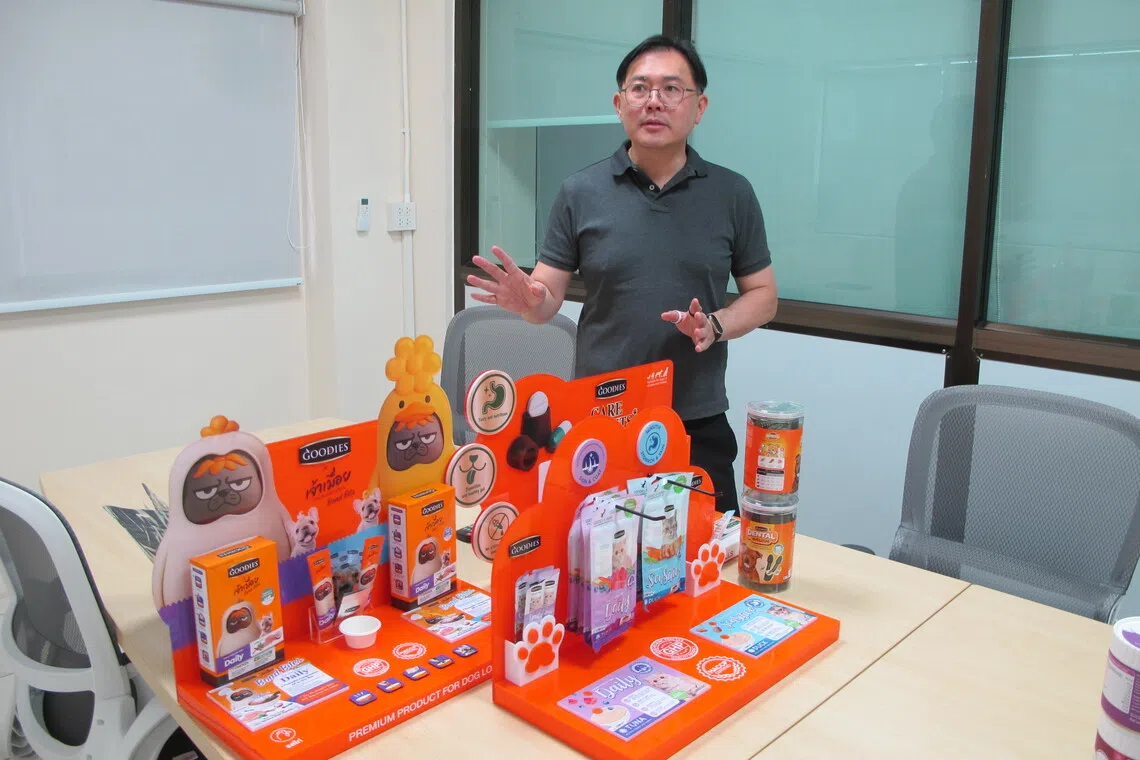
SIP Siam Inter Pacific, for example, has been exporting dog treats to the US market for more than three decades.
Prior to 2019, the US accounted for over 70 per cent of its exports. But the Covid-19 years, when demand for pet food and treats was high, but shipping was expensive, pushed the company to diversify its export markets.
Chatchai Lertviwatkul, operating director of SIP Siam Inter Pacific, said: “Nowadays the US is about 30 to 40 per cent of our market... we couldn’t put all our eggs in one basket.”
Despite the tariff, the US remained an important market for SIP in 2024, when the company’s revenue amounted to US$4.4 million. Total exports were up 1.5 per cent in the first half of 2025.
“We can still export to the US. I think it was because they ordered a lot in Q1 2025 and Q2 2025,” noted Chatchai.
“There was a slow period in Q3 2025, when everyone was waiting and seeing, like us, on the regulations and tariffs, but by the end of Q3 2025 they started to reorder again for Q4 2025, when their stock had almost run out.”
Tariff poser
But the future of the US market remains uncertain.
Chatchai said: “The only thing we need to wait and see is whether (President Donald) Trump will change the tariff rate in the future, especially with the Thai-Cambodia dispute.”
Last month, Thailand suspended a partially Trump-brokered peace accord with Cambodia, prompting the US Trade Representative to pause US-Thai trade talks about reciprocal tariffs until peace talks were resumed.
The stand-off has left exporters to the US uncertain about the future – especially as the border remains tense, with fighting breaking out again on Dec 7 to 8.
The tariff uncertainty takes the shine off what appears to have been a better-than-expected performance by many Thai export items in the US market, despite the tariffs.
For the first 10 months of 2025, Thailand’s exports to the US market grew 29.1 percent year on year, comprising 5.3 percentage points of total export growth at 13 per cent, KRC estimates indicated.
Burin Adulwattana, chief economist and managing director of KRC, said: “On many products we are doing better, because on comparative terms we are not too bad on the reciprocal tariff front.”
He added: “We are better off than India, China... so that helps to support our export growth.
“For example, (in) rubber tyres, we have gained market share because everyone is hit by the 25 per cent tariff, and we are a major producer of rubber, so that helps us.”
Thailand, and ITC in particular, have similar natural advantages in pet-food production.
Chan said that “seafood is part of the equation”, pointing to TU’s extensive tuna supply chains in Thailand. “We have an ecosystem in place, not just for manufacturing, but (also for) all the supporting businesses such as packaging, logistics. These sectors are well established in Thailand compared with neighbouring countries.”
Bualuang Securities has forecast ongoing growth for ITC, despite tariffs and the Thai baht appreciation – up 7 per cent this year.
“With 12 per cent earnings growth forecast in 2026, underpinned by new product-development scaling and new client wins, ITC offers both resilience and visible growth momentum,” it said.
ITC management is more modest. “Our expectation (for next year), in dollar terms, is between mid and high single-digit growth,” noted Chan. “That is for the total sales, not just the US.”