Thailand’s election is awash with giveaways, but real economic reform remains the hard sell
No political party is expected to win a majority, which means a coalition government is inevitable
[BANGKOK] Judging by the flurry of lottery-style gimmicks, cash handouts, subsidised transport and income supplements rolled out by Thai political parties ahead of this Sunday’s (Feb 8) general election, one might assume the economy is humming.
It isn’t.
Thailand’s gross domestic product is expected to grow just 1.5 to 1.7 per cent this year, the weakest pace in a decade outside the pandemic years and the slowest in South-east Asia, excluding Myanmar, according to central bank governor Vitai Ratanakorn. Growth is expected to come in at 2.2 per cent in 2025.
Besides structural challenges in the form of an ageing population, high household debt at around 87 per cent of GDP, and geopolitical uncertainties – from US tariffs to a changing world trade order – some of Thailand’s growth constraints are self-wrought.
“Political instability and frequent policy shifts, including the replacement of as many as six finance ministers within just five years, have made it extremely difficult to drive long-term policies, such as the regulatory guillotine process and efforts to address financial threats and cyber scams,” said Vitai, as quoted in a recent article by the Bangkok Post.
Thailand is increasingly looking over its shoulder at neighbouring Vietnam, whose economy expanded by 8 per cent last year, and is expected to keep the momentum this year, on the back of high foreign direct investments, growing exports and robust domestic consumption.
Vietnam has been under the same communist party since 1975, and has been consistently following a path of economic reform since 1978 while increasing its foreign trade agreements and carrying out an ongoing crackdown on state corruption at home.
“What makes Vietnam grow so fast?” asked Veerayooth Kanchoochat, one of three prime minister candidates for the People’s Party. “It is more about reform, so People’s Party is trying to push for reform-driven growth,” he told a recent gathering.
Of the 52 political parties that have registered to contest the polls, which will include a referendum on reforming the Constitution, the People’s Party has highlighted its economic reform agenda. It has dropped its previous focus on amending Thailand’s controversial lese-majeste law this time round.
The People’s Party is a reinvention of the Move Forward Party, which won the most seats in the 2023 election –151 out of 500 contested seats – on a platform of both political and economic reform, but whose charismatic leader Pita Limjaroenrat was blocked from assuming the premiership by the veto power of the then military-appointed Senate.

The Move Forward party was later disbanded in August 2024 by the Constitutional Court for its efforts to amend Thailand’s lese-majeste law that shields the reputations of the king, queen and heir apparent, and Pita and other executives were banned from politics for 10 years.
The current Senate no longer has the power to block the prime minister appointment, which is an improvement over the 2023 polls.
But 44 of the People’s Party’s current Members of Parliament face being barred from politics because of their past participation in calls to amend the lese-majeste law. These include prime minister candidates Natthaphong Ruengpanyawut and Sirikanya Tansakun.
Veerayooth, the other candidate, is not targeted in the case. An academic who taught at Tokyo’s National Graduate Institute for Policy Studies for 11 years, he is one of the key formulators of his party’s economic reform policy.
“Veerayooth is an expert in industrial policy,” said Pavida Pananond, professor of international business at Thammasat Business School.
She added: “The People’s Party stands out as having the economic policy that doesn’t only try to resolve the current problems that we have, but also tries to push Thailand into thinking about the next stage of development.”
Navigating Thailand’s complex political landscape
While opinion polls consistently place the People’s Party as a front runner in the Feb 8 election, voter popularity does not guarantee power in Thailand. The country’s reliance on coalition governments and the judiciary’s significant influence over political careers create a much more complex path to ruling.
No political party is expected to win a majority of the 500 contested seats, which means a coalition government of several parties is inevitable.
The other two parties expected to get the most votes comprise Bhumjaithai, led by current caretaker Prime Minister Anutin Charnvirakul, and Pheu Thai, led by academic Yodchanan Wongsawat, the nephew of Thaksin Shinawatara – the party’s de facto leader who is currently serving a one-year jail term.
Pheu Thai, known for its past election-winning populist policies, has promised to create nine millionaires a day (or 3,285 millionaires a year) through a lottery system that would require a budget of about 3.3 billion baht (S$132.5 million).
While a clever gimmick that taps people’s fondness for gambling, the millionaire lottery budget is considerably below the 500 billion baht cash handout scheme Pheu Thai campaigned under in the 2023 general election.
Even Pheu Thai seems aware that now is not the time for splurging. Thailand’s public debt is close to 65 per cent of GDP, and rising.
The country’s long-term outlook was downgraded from “stable” to “negative” in September last year by the rating agencies Fitch and Moody’s.
“The outlook change reflects increasing risks to Thailand’s public finance outlook from prolonged political uncertainty, combined with growth headwinds from slowing global demand, a delayed tourism recovery and household deleveraging,” said Fitch.
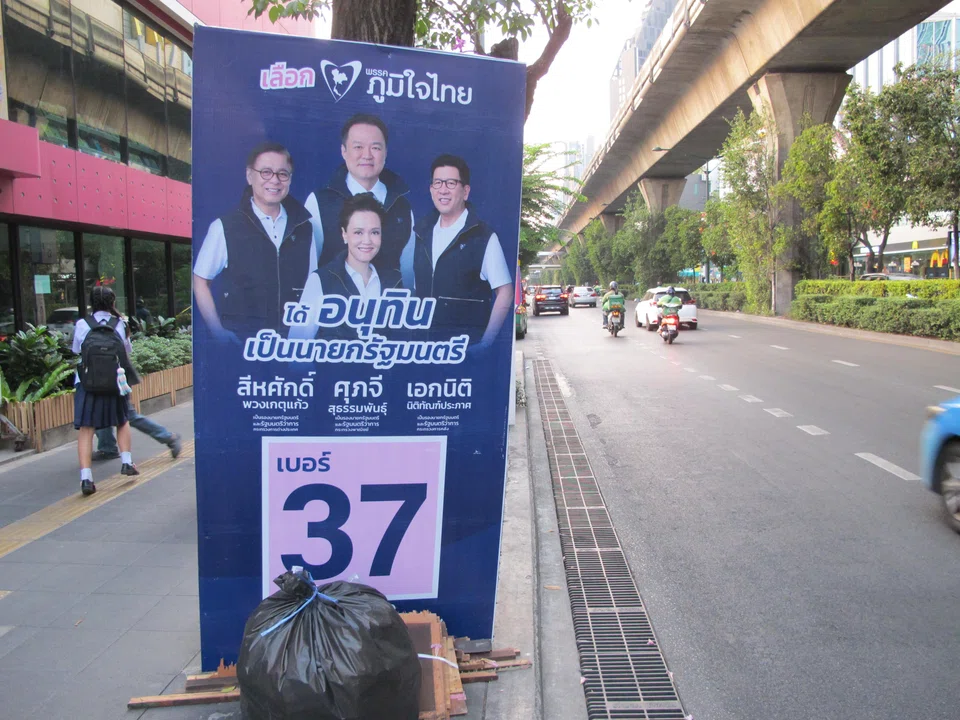
The Bhumjaithai Party has focused its campaign on the credentials of its “dream team” – three respected technocrats chosen to run the important finance, commerce and foreign ministries.
They are senior finance ministry official Ekniti Nitithanprapas; well-known businesswoman and former IBM CEO Suphajee Suthumpun; and senior former foreign ministry official Sihasak Phuangketkeow, respectively.
Given Thailand’s flagging economic performance, it is likely that whichever party wins will tackle the need for economic reform. The bigger question is, to what extent?
Picharn Sukparangsee, international lawyer at Bangkok Global Law, said: “If Bhumjaithai or Pheu Thai lead the next coalition, I don’t think they will push for total reform, but they may have piece-by-piece reform.”
He added: “The next government should focus on stopping illegal activities and improving the ease of doing business.”
Another player in the election outcome is the Democrat Party (Thailand’s oldest political party), which is now led by former prime minister Abhisit Vejjajiva, former finance minister Korn Chatikavanij and newcomer Karndee Leopairote, a digital economy expert.
The Democrats, running on a “clean government” and economic reform platform, are likely to come in fourth or fifth in the vote count, and could play an important role as an advocate of change in the next coalition.
“The first area that needs reform is the bureaucracy,” said Korn at a recent forum. “Technology and political will come into play here. We need to get rid of regulatory and legal obstacles to facilitate investment and growth.”