Vietnam’s stable economic policies a saving grace for investors amid leadership turmoil
Two presidents were ousted in just over a year in the South-east Asian nation, yet no major policy shifts are expected
Jamille Tran
[HO CHI MINH CITY] Foreign investors in Vietnam have weathered turbulent times in recent years amid its intense anti-graft drive and yet another leadership ouster less than a week ago, but investor sentiment towards the country is largely expected to remain resilient.
Analysts said that investor interest in one of South-east Asia’s fastest-growing economies will unlikely suffer a dent, as long as Vietnam’s key economic policies remain consistent, and do not shift with the leadership upheaval.
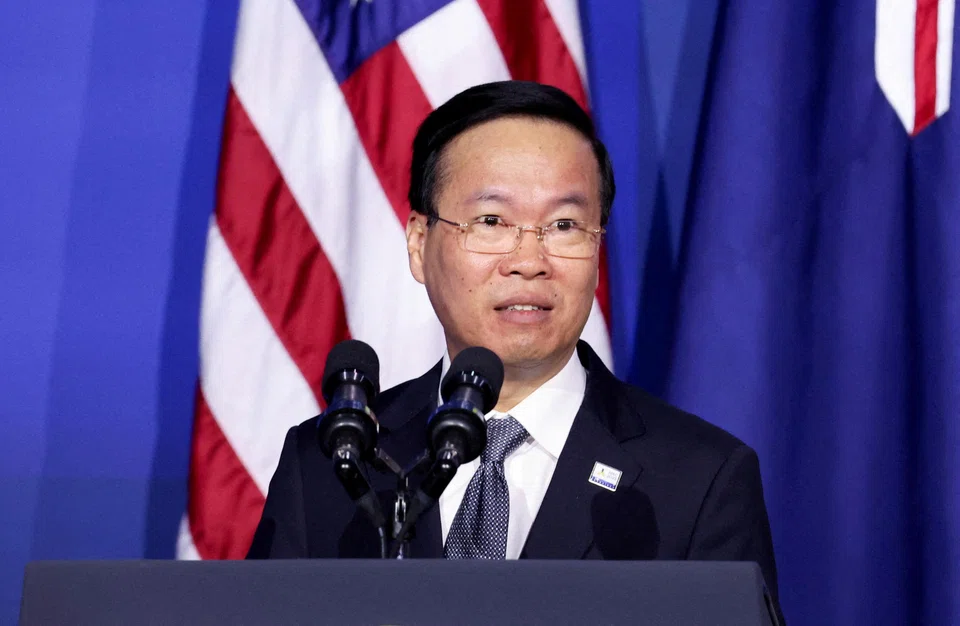
A blow struck Vietnam last week as Vo Van Thuong quit as state president after just a year in office.
“A lot of investors understand that the president’s role is not the most powerful position in Vietnam… (so) they are not expecting any significant policy shifts at all,” said Ismael Pili, head of institutional sales for the international market at Ho Chi Minh City Securities Corporation.
“No matter who is there, the policies will probably continue,” he said, adding however that it does create “unnecessary uncertainty and noise”.
The president is one of the “four pillars” of Vietnam’s collective political power, alongside the ruling Communist Party’s general secretary, prime minister and chairman of the National Assembly. However, the role is largely ceremonial and holds less political influence compared to the other three posts.
Thuong’s resignation marks the third leadership change in just over a year, following the departure of former president Nguyen Xuan Phuc in early 2023. Phuc stepped down from his role as president, taking responsibility for the misconduct of officials under his command when he was the prime minister.
In a statement on Mar 20, the Party Central Committee accused Thuong of “violating regulations on what party members cannot do”, and asserted that he had to “accept accountability as a leader in accordance with the party’s rules and the state’s laws”.
There was no elaboration on his deeds. This has fuelled speculation that it is related to the Communist Party’s “blazing furnace” anti-corruption agenda.
This latest event also comes as the party is set to determine the successor of its chief Nguyen Phu Trong, who is expected to step down at the next congress in 2026.
Since 2021, Vietnam has been embroiled in a sweeping anti-corruption crackdown that has ensnared top politicians. The crackdown implicated at least four Politburo members, two deputy prime ministers, two ministers, more than a dozen provincial leaders and hundreds of Communist Party members.
The implication of these events for Vietnam’s business community is whether political instability will hinder the legitimate processing of licences and approvals for businesses, as experienced in late 2022 and early 2023, when bureaucrats were apprehensive about getting in trouble.
“As the government knows well, we need the economy to keep going,” Seck Yee Chung, who leads the mergers and acquisitions practice in Vietnam for an international law firm, told The Business Times. “The longer it is prolonged, the greater it can erode investors’ confidence.”
On the other hand, Seck pointed out that the current developments reflect Vietnam’s commitment to address domestic affairs and enhance governance – “short-term pain for longer-term gain”.
“For the business community, we hope to see these investigations and issues managed as appropriately as possible through due process,” he said.
Vietnam has maintained a strong track record of foreign investment inflows in recent years.
Last year, registered foreign investment jumped 32 per cent to US$37 billion from a year earlier. Disbursement of foreign investment reached all-time highs in 2022 and 2023, at some US$22 billion and US$23 billion, respectively.
Vietnam’s one-party state is viewed to have effectively managed geopolitics and diplomatic relations. In the past year, the country has strengthened its ties with the US, Japan and Australia through comprehensive strategic partnerships. This means there are seven nations, including China, Russia, South Korea and India, at the top tier of the country’s diplomatic hierarchy.
“We are confident that the country’s business and investor-friendly economic policies will be consistently going forward, regardless of the individual holding a particular office,” noted Andy Ho, chief investment officer at VinaCapital, one of the largest multidiscipline investment management firms in Vietnam.
He added that worries tend to come from foreign investors who have “limited understanding of how Vietnam’s political system works”, though it is still critical to watch the political developments in the country in the next two years.
While state-related companies and large strategic investments may be more vulnerable to political uncertainties, analysts generally believe that Vietnam’s consensus-driven system will ensure that recent political events do not result in significant turbulence in the business environment.
Many investors are banking on Vietnam’s stable economic policies and strong fundamentals. The country boasts advantages such as a relatively low-cost and youthful workforce, a growing middle class, a robust manufacturing sector, enhanced infrastructure and extensive free trade access.
The Ho Chi Minh City Stock Exchange’s key VN Index hit a 17-month high last Friday (Mar 22), two days following the announcement of Thuong’s resignation.
The Vietnamese bourse has seen persistent net selling by foreign investors for 10 straight sessions up to Monday. Analysts attributed this partly to the US Federal Reserve’s intention to maintain higher rates for longer. Vietnam’s dong is also trading near its lowest level against the US dollar.
“What’s going to matter more (for investors) is the economy rather than politics,” said Pili. “Can the government improve the investment climate? If they can do that, we could probably offset all these political uncertainties that we are talking about.”