


Worker protests plunge Indonesian unicorn eFishery into turmoil amid fraud allegations, revenue scandal
The aquaculture startup faces intense scrutiny following accusations of inflating its September 2024 revenue by nearly US$600 million

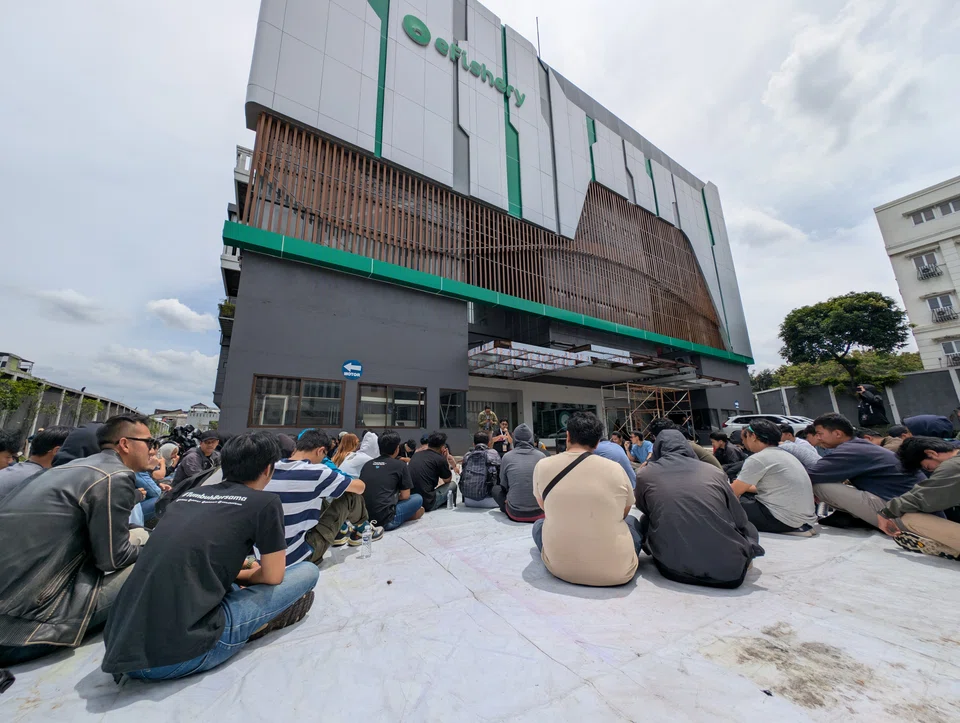
[JAKARTA] Employees of Indonesia’s aquaculture startup eFishery have pushed back against allegations of systematic fraud within the company, staging a protest on Thursday (Jan 23) to demand transparency and a thorough investigation.
More than 100 members of the workers’ union gathered in Bandung – where one of the country’s most prominent startups is headquartered – to urge management and investors to address the accusations and resolve the turmoil disrupting operations at the company.
The workers are also demanding that the company scrap its mass layoff plan and reconsider business lines that can be developed.
“This is based on the fact that eFishery still has cash and liquid assets exceeding one trillion rupiah (S$83.4 million), while its ongoing business exceeds three trillion rupiah,” the union said in a statement.
Risyad Azhari, a representative of eFishery’s workers’ union, told The Business Times that the employees held an open discussion, with the outcomes to be submitted to the company’s new chief executive officer and management team.
The company’s operations are believed to have been disrupted by ongoing employee protests, as workers voice concerns over the fate of their jobs and the potential risk of layoffs amid the ongoing financial and governance issues.
The protest comes amid intense scrutiny of eFishery, following accusations that it had inflated its September 2024 revenue by nearly US$600 million, Bloomberg reported.
Investigators also challenged the company’s claim of operating more than 400,000 fish feeders, suggesting the actual number was closer to 24,000, the report indicated.
The controversy first surfaced in December last year when DealStreetAsia reported that co-founders Gibran Huzaifah and Chrisna Aditya had been suspended over allegations of financial misconduct.
Following that, the company’s shareholders appointed Adhy Wibisono as chief executive officer to succeed Gibran.
However, Wibisono is said to have stepped down from his role, with shareholders appointing Albertus Indra Sasmitra as interim CEO and chief financial officer, said sources.
He serves as a director at Northstar Group, and was previously at GoTo and Trimegah Sekuritas Indonesia.
Patrick Walujo, co-founder and managing partner at Northstar, an early investor in eFishery, recently described the alleged fraud by the company’s founders as both systematic and embarrassing.
The CEO of GoTo, who is not part of the investigation team, revealed that findings from the audit team suggested that the fraud may have been ongoing since 2018. He was responding to queries on the scandal at a panel discussion at the recent DealStreetAsia: Indonesia PE-VC Summit 2025 in Jakarta.
The allegations of systematic fraud raised by investors through the investigation team have unsettled employees across the board.
Elsa Vinietta, eFishery’s product manager, said that allegations of systematic fraud within the company have caused long-term harm to employees and Indonesia’s tech community. “When it comes to financial matters, most teams are not even involved in transactions,” she wrote on her LinkedIn profile.
An employee who wished to remain anonymous said the allegations overlooked a crucial fact – that all the company’s products, including its Internet-of-Things solutions and artificial intelligence technologies, were fully developed and operational, not merely concepts.
This statement was made in response to rumours circulating on social media suggesting that eFishery was selling prototype products to farmers.
Founded in 2013, eFishery provides fish-feed services technology. It expanded into India in 2024. Recognised as a unicorn, the company reached a valuation of up to US$1.4 billion in 2023.
It secured US$90 million in its Series C funding round, co-led by Singapore’s Temasek, SoftBank Vision Fund 2 and Sequoia Capital India. Other investors in the round included Northstar, Wavemaker Partners, Argor Capital and SoftBank.
Better transparency
The alleged fraud case surrounding eFishery has sent shockwaves through Indonesia’s agritech startup ecosystem, adding to the turmoil in South-east Asia’s tech industry amid a funding slowdown.
This incident serves as a wake-up call, said industry observers and private equity executives, highlighting the importance of transparency and stronger governance from both startups and investors – even in a booming sector like agritech.
Roshan Raj Behera, a partner at Redseer Strategy Consultants, stressed that this stronger governance was needed across startups, not just those in agritech.
“We think investors will conduct more rigorous diligence for future investments, so they will need to update their processes around it. However, this will be broad-based and not limited to agritech investments,” he said.
He said that while the incident is regarded as company-specific, investors may focus more on other agritech business models, their monetisation potential and corporate governance. However, he believes this will not result in a blanket negative outlook for the agritech sector.
“There will be a whole range of responses from investors. Some might take a cautious approach, while others will see this as an attractive time to invest in promising startups,” he said.
A key executive at a Singapore-based private equity firm suggested that venture capitalists could learn from private equity and other investors by strengthening their focus on profitability. This shift would involve emphasising clear paths to profitability over revenue growth alone.
The executive noted that venture capitalists typically value early-stage companies based on revenue multiples, as profits are often non-existent at that stage.
“However, if someone is intent on committing fraud, it’s easier to inflate revenues than manipulate costs and profits. By focusing more on how early-stage companies can become profitable, investors may be prompted to ask questions that make revenue fraud less likely to succeed.”
South-east Asia’s tech sector faced significant challenges in 2024, with funding levels dropping sharply amid a sluggish global economy, a report by Tracxn indicated.
Startups in the region raised just US$2.8 billion across 420 funding rounds, a 59 per cent decline from US$7 billion in 2023 and an 80 per cent drop from US$14.2 billion in 2022.
Singapore maintained its position as the region’s funding leader, securing 67 per cent of the total, with startups raising US$1.9 billion. Jakarta was a distant second, securing only US$261 million.
TRENDING NOW

Looking beyond looming CEO succession, should UOB potentially pursue a transformative merger?
MAS holds monetary policy settings, pausing after two straight tightenings

Once staunchly pro-China, Malaysian Chinese businesses are now distancing themselves from Beijing

Stocks to watch: Kore US Reit, Parkway Life Reit, Raffles Education, Vin’s Holdings

