Asia’s AI robotics race: China leaps forward while South-east Asia finds its footing
High costs and labour trends slow the pace of robotic adoption in South-east Asia

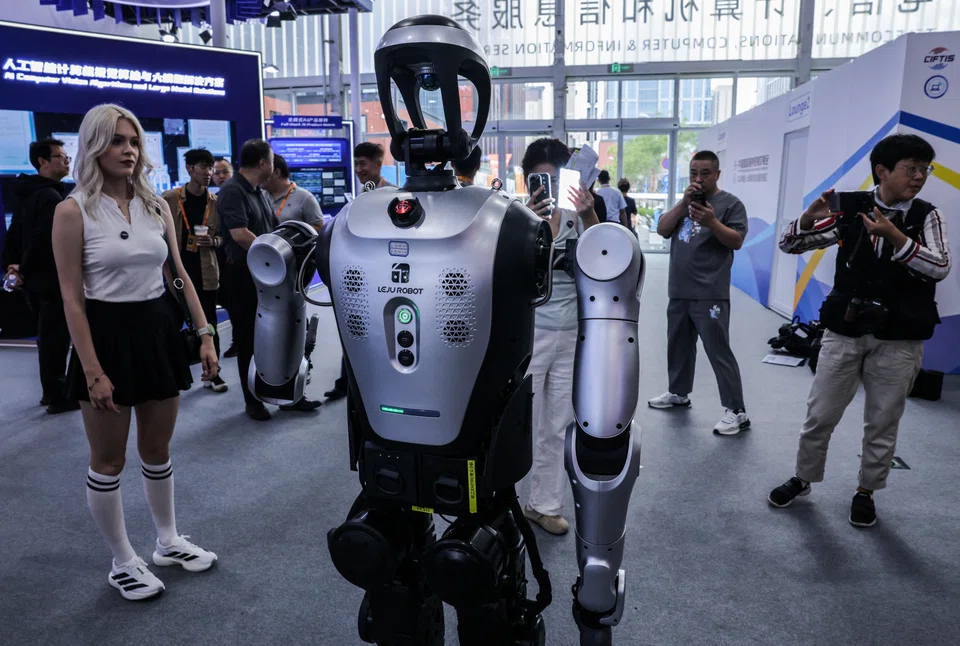
[SINGAPORE] Physical artificial intelligence (AI) is poised for its “ChatGPT moment” in 2026, according to Nvidia chief executive Jensen Huang.
Flanked by miniature robots straight out of a Star Wars film at the tech trade show Consumer Electronics Show in early January, Huang predicted that AI-powered robots with human-like locomotion and fine motor skills will emerge within the year.
The incorporation of artificial intelligence into physical machines – known as “embodied AI” – has fuelled investor interest, with many seeing it as the crucial next step in both robotics and AI innovation.
In particular, technological breakthroughs in China’s robotics sector have sparked hopes that AI could transform factory floors and retail spaces.
“Digital services have been the focus of much of the AI-driven transformation to date,” said Dr Jochen Wirtz, professor of marketing at the National University of Singapore Business School. “But physical services at restaurants, hotels, hospitals, and retail stores have remained stubbornly human.”
Yet, the gap between digital and physical services could soon narrow, he believes.
With the addition of AI through large language models, large behavioural models and agentic AI, robots can receive multi-modal inputs (visual or language cues) and translate them into immediate physical actions. Prof Wirtz projected that these systems could be widespread in just two to three years.
China takes the lead
Much of Asia’s robotics technology and adoption is being led by Chinese companies and manufacturers. Morgan Stanley estimates that 55 per cent of robots globally in 2024 were made in China.
The country’s nascent humanoid robot sector in particular has sparked considerable interest. These robots are designed to resemble human beings and are being developed to replace traditional labour.
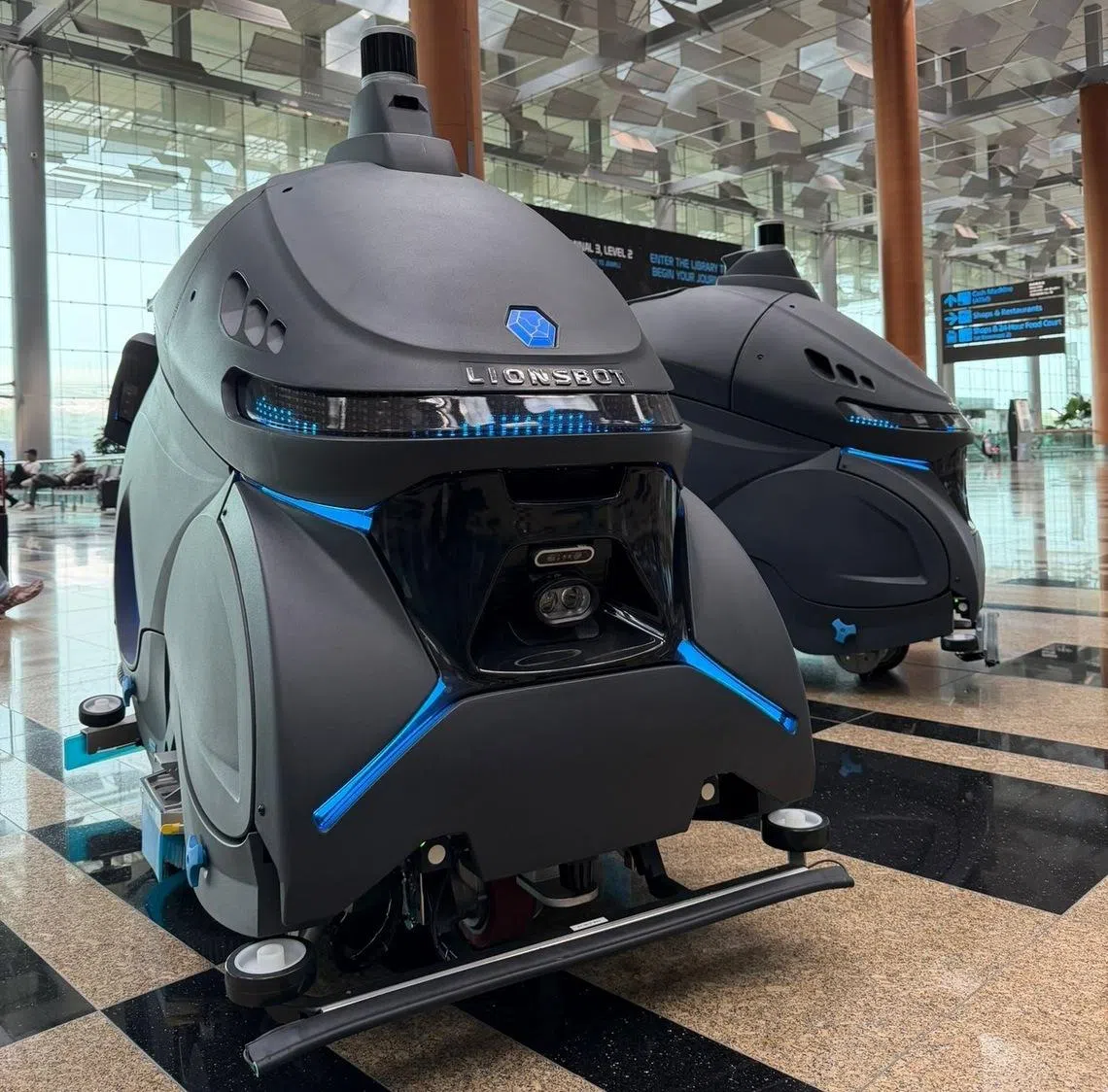
Raphael Yee, director of embodied AI at Lionsbot, which designs commercial cleaning robots, told The Business Times that the biggest advantage of a robot with an anthropomorphic design is its ability to use its hands and legs.
He noted that humanoids could navigate human infrastructure – climbing stairs, for example – thereby letting them access places that Lionsbot’s current fleet of wheel-based cleaning robots are unable to. Such robots, if trained using an AI model, would be able to do more and be broadly applied across any industry, he said.
Macquarie analyst Daisy Zhang projected in a November research note that commercial production of humanoid robots could begin as early as 2026, mostly in the US and China, with the pace to accelerate in the coming decade.
She expects that by 2034, such robots could outnumber industrial robots on the factory floor.
But concerns of a bubble have also mounted, with Chinese officials issuing a rare caution against excess investment.
“Frontier industries have long grappled with the challenge of balancing the speed of growth against the risk of bubbles – an issue now confronting the humanoid robot sector as well,” Li Chao, spokesperson for the National Development and Reform Commission, said at a briefing in Beijing in November.
Yee added that it will still take a significant amount of time for such robots to truly replace many human activities – especially the simple tasks.
“In robotics, we call it Moravec’s paradox – it’s much harder for robots to do the things that humans find easy, like picking things up gently or washing the dishes,” he said. “We’re just so different from the way they are built anatomically.”
South-east Asia’s robots
Despite the global excitement, South-east Asia’s adoption of embodied AI may be slower.
To be clear, robots have been used within the region’s manufacturing sectors for decades.
Vivekanand Patil, senior regional manager for robotics at Epson South-east Asia, noted that the multinational electronics manufacturer has incorporated the selective compliance assembly robot arm or Scara – a type of industrial robot which excels at fast, repetitive movements parallel to a work surface – and six-axis industrial robots in its manufacturing plants in the region.
Epson, which has regional operations in Singapore, Indonesia, Malaysia, the Philippines and Thailand, both produces industrial robots for clients and uses them in its own manufacturing.
“In South-east Asia, the most advanced adoption of robotics is in electronics manufacturing,” Patil said. “Vietnam and Thailand stand out as fast-growing automation hubs, particularly in electronics, automotives and logistics.”
He noted that AI is playing a larger role across robotics value chains in the region, such as in refining motion profiles to enable more human-like assembly skills. But it may take longer for the frontiers of humanoid robot technology or embodied AI to be breached in South-east Asia.
“For now, most companies in South-east Asia view humanoid robots as longer-term possibilities rather than near-term ones on the factory floor,” he pointed out.
“Manufacturers remain primarily focused on proven industrial and collaborative robots that are purpose-built for mainly specific industrial tasks,” added Patil. “In these markets, the emphasis is on scalable, easy-to-deploy systems that can support rapid expansion and upskilling of local workforces.”
Industry players noted that labour supply and costs are likely to remain a key determinant of robotics adoption in much of South-east Asia, as there will be a significant capital outlay for businesses to integrate robotic systems into their operations.
“Countries with labour shortage and high labour cost will lead the way,” said Prof Wirtz. This could include countries like Singapore, which frequently face difficulties in finding suitable manpower for businesses such as restaurants, hospitals and call centres.
Lionsbot’s Yee noted that the majority of the company’s fleet is used by European customers due to issues such as labour shortages and a lack of low-cost labour.
“In Europe, our customers tell us that it’s difficult to keep a consistent workforce, (as) people often leave after about two weeks,” he said. “Nobody wants to do the hard, dirty work.”
He added: “Europe and the US will be a lot faster than South-east Asia in the pace of adoption because there is more access to low-cost labour here.”
Even in high-risk sectors, robotics can struggle to gain traction against cheaper human labour in South-east Asia.
Danish-headquartered underwater services company C-Leanship uses remote-operated robotic systems to clean the hulls and propellers of ships. This is a task traditionally carried out by divers, who face significant risks posed by ocean currents and heavy ship structures.
However, the mechanised cleaning carries a premium price, making C-Leanship reluctant to build a large presence in South-east Asia, outside of Singapore, noted Syahrul Hatta, the company’s chief operating officer for Asia.
Another hurdle is loose oversight. Lax regional regulatory requirements mean that human divers remain the default low-cost option despite technological leaps in the industry – which includes players such as Singapore-based Neptune Robotics.
“We would like to be where they are focusing more on regulations for safety and environmental standards because it gives a good ecosystem for us to operate (in),” said Hatta. “Otherwise we’ll only be competing on price.”
For Epson’s Patil, the move towards widespread robotics use in South-east Asia is inevitable, as more multinational firms – including Chinese firms – relocate factories to the region.
But striking a balance between high-tech adoption and integrating humans into automated systems remains a delicate process; the goal is not to replace human workers with robots, he told BT.
“The aim is to create smarter, more collaborative systems that support operators, improve consistency and help manufacturers address labour and skills shortages sustainably.”
Decoding Asia newsletter: your guide to navigating Asia in a new global order. Sign up here to get Decoding Asia newsletter. Delivered to your inbox. Free.
Copyright SPH Media. All rights reserved.