


Is a trade deal between the US and Asia still on the cards or has the ship sailed?

Sharon See
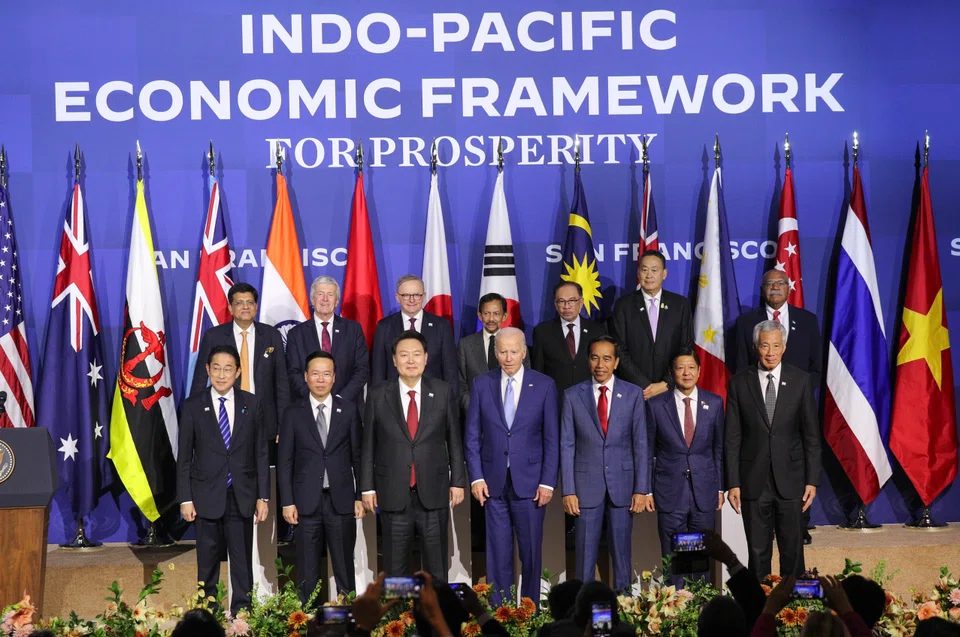
[SAN FRANCISCO] Last week, much of the business community heaved a small sigh of relief as they watched a meeting between US President Joe Biden and Chinese President Xi Jinping play out in San Francisco.
It was the first time that the two leaders were meeting since last year’s G20, in a year marked by pockets of tense relations, even if it’s clear neither side want a direct confrontation.
Instead, what went down at the historic Filoli estate struck a surprisingly genial and nostalgic tone, with initiatives that could bring US-China ties back to a path of stabilisation.
Cautious optimism is the mood, but watchers have stopped short of ascribing more cheer to the situation, given how painfully aware they are of deep differences between the two, whether ideologically or pragmatically, and the fragility of geopolitics these days.
Biden has no qualms about the US and China being in competition – even if Beijing may disagree with this framing – and nowhere was this clearer than US-led talks on the Indo-Pacific Economic Framework for Prosperity (IPEF).
The IPEF was launched in 2022 and currently includes 14 partners - Australia, Brunei Darussalam, Fiji, India, Indonesia, Japan, South Korea, Malaysia, New Zealand, Philippines, Singapore, Thailand, the US and Vietnam.
It was meant to be America’s answer to counter China’s growing influence in the region; and the Asia-Pacific Economic Cooperation (Apec) summit was where Biden was supposed to announce the conclusion to negotiations across all four pillars of cooperation – trade, supply chain, clean economy and fair economy.
But by early last week, it became clear that consensus on the trade pillar would prove elusive, owing to domestic pressures in the US.
Trade deals take a long time to negotiate, and unlike a traditional trade deal, the IPEF talks are not about expanding market access or lowering tariff barriers. But what members could not agree on were the higher labour or environmental standards that the US was pushing for.
On the part of the US, signing a trade deal so close to the upcoming presidential election in 2024 was always going to be a high-risk move, given suspicions that such deals are seen to disadvantage ordinary Americans and lead to job loss.
Former US president Donald Trump had seized on this prevailing sentiment in his campaign in 2016 and had withdrawn the US from the Trans-Pacific Partnership shortly after he won.
The Democratic Party simply cannot afford any more slip-ups, especially with Biden’s approval rating now on a sharp downward trend over his administration’s handling of the Israel-Hamas conflict.
This does suggest that hopes for a consensus on the trade pillar are likely to dim further into 2024, making the possibility of a deal increasingly fleeting by the next Apec summit in Peru. In the event that Biden secures a second term in office, it could still take years before an agreement is reached, given the complexity of trade negotiations.
Additionally, if finalising a deal among IPEF members, a small subset of the Apec grouping, is already difficult, then surely hopes of reaching any kind of agreement at all by February – at WTO’s 13th Ministerial Meeting in Abu Dhabi – are surely unrealistic.
Nonetheless, there is more to be optimistic about, given the record time, by all accounts, that negotiators have taken to make substantial progress on all other pillars.
Even without the trade pillar, the agreements addressing supply chain, the energy transition and anti-corruption will help the IPEF’s member countries address key challenges that they are facing and foster greater opportunities for future collaborations.
Decoding Asia newsletter: your guide to navigating Asia in a new global order. Sign up here to get Decoding Asia newsletter. Delivered to your inbox. Free.
Copyright SPH Media. All rights reserved.
TRENDING NOW

Companies still in search of AI use cases with worthwhile ROI, says Broadcom’s CEO

Malaysian king buys stake in Singapore-listed mining firm expanding into rare earths

Once staunchly pro-China, Malaysian Chinese businesses are now distancing themselves from Beijing

Singapore’s wealth management success should extend to everyday families

