

Prabowo’s oversized Cabinet aims to hit the ground running, but sparks gridlock fears
Indonesia’s bureaucracy, already frequently criticised for inefficiency, faces renewed concerns as businesses fear the expanded Cabinet could cause further delays

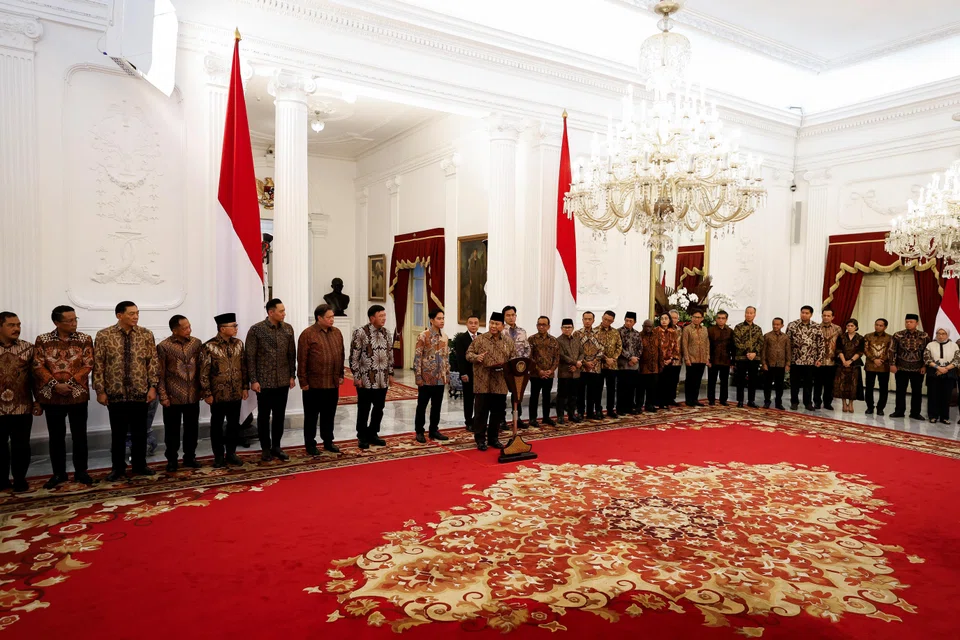
[JAKARTA] After being sworn in as Indonesia’s eighth president on Sunday (Oct 20), Prabowo Subianto swiftly unveiled his Cabinet, signalling a drive to hit the ground running. However, business leaders and investors have expressed concerns that the Cabinet’s size could lead to inefficiencies and slower policymaking.
On the other hand, Prabowo’s supporters argue that his top-down military leadership style will enhance policymaking efficiency within the expanded Cabinet, foster stronger collaboration with regional leaders, and promote his vision of an economic system characterised by “centralised decentralisation”.
On Monday, Prabowo inaugurated his Cabinet, named “Merah Putih” in honour of Indonesia’s national flag. With 53 ministers and 56 deputy ministers, it is the largest Cabinet in the country’s history.
This move was notably faster than that of his predecessor, Joko Widodo, who took a full week after his inauguration to form his Cabinet. Prabowo has also expanded the number of ministries to 48, up from Widodo’s 34.
With each minister now having a more specialised and limited scope of work, Prabowo’s Cabinet expansion has raised concerns about increasing sectoral interests among top government officials.
Shinta Kamdani, chairperson of the Indonesia Employer Association, warned that adding more government bodies could complicate the roles and responsibilities of each ministry.
She said clarity in officials’ roles is crucial for developing effective regulations, policies and business permits.
“The president needs to focus on improving bureaucratic efficiency, especially in business and investment licensing,” Kamdani told The Business Times.
She also stressed the importance of transparency and accountability in business processes – including policymaking – across all ministries by establishing a special office directly accountable to the president.
Siwage Dharma Negara, senior fellow and co-coordinator of the Indonesia Studies Programme at Iseas-Yusof Ishak Institute, noted that while having a large number of ministries and high-ranking officials can sometimes result in a “bloated” bureaucracy, it also brings the challenge of managing efficiency, and reducing the risks of corruption or misuse of power.
“Indonesia has never had a Cabinet this large before,” Negara told BT. He added: “Coordination among ministries and agencies during (former) president Widodo’s administration has been complex and problematic, often leaving investors frustrated.”
Indonesia’s 48 ministerial posts exceed those of the US, which, despite a population of around 346 million, operates with only 15 executive departments. In comparison, China, the world’s second most populous nation, manages its affairs with just 21 ministries.
Prabowo previously argued that a large administration is crucial for the smooth implementation of his ambitious programmes, such as providing free nutritious meals for 80 million children and pregnant women across Indonesia.
The 73-year-old politician established seven coordinating ministries to play a key role in the government structure, overseeing and harmonising the work of various ministries and agencies.
Among these is a newly created Coordinating Ministry for Infrastructure, specifically tasked with ensuring the successful implementation of the new capital development programme in Nusantara, Kalimantan.
Bill Sullivan, senior foreign counsel at Jakarta-based law firm Christian Teo and Partners, noted that an expanded Cabinet does not necessarily guarantee a well-run country or a more efficient government.
“Why can’t a more traditionally sized Cabinet accommodate President Prabowo’s programmes? I have yet to see a functional or logistical justification for an expanded Cabinet,” he said.
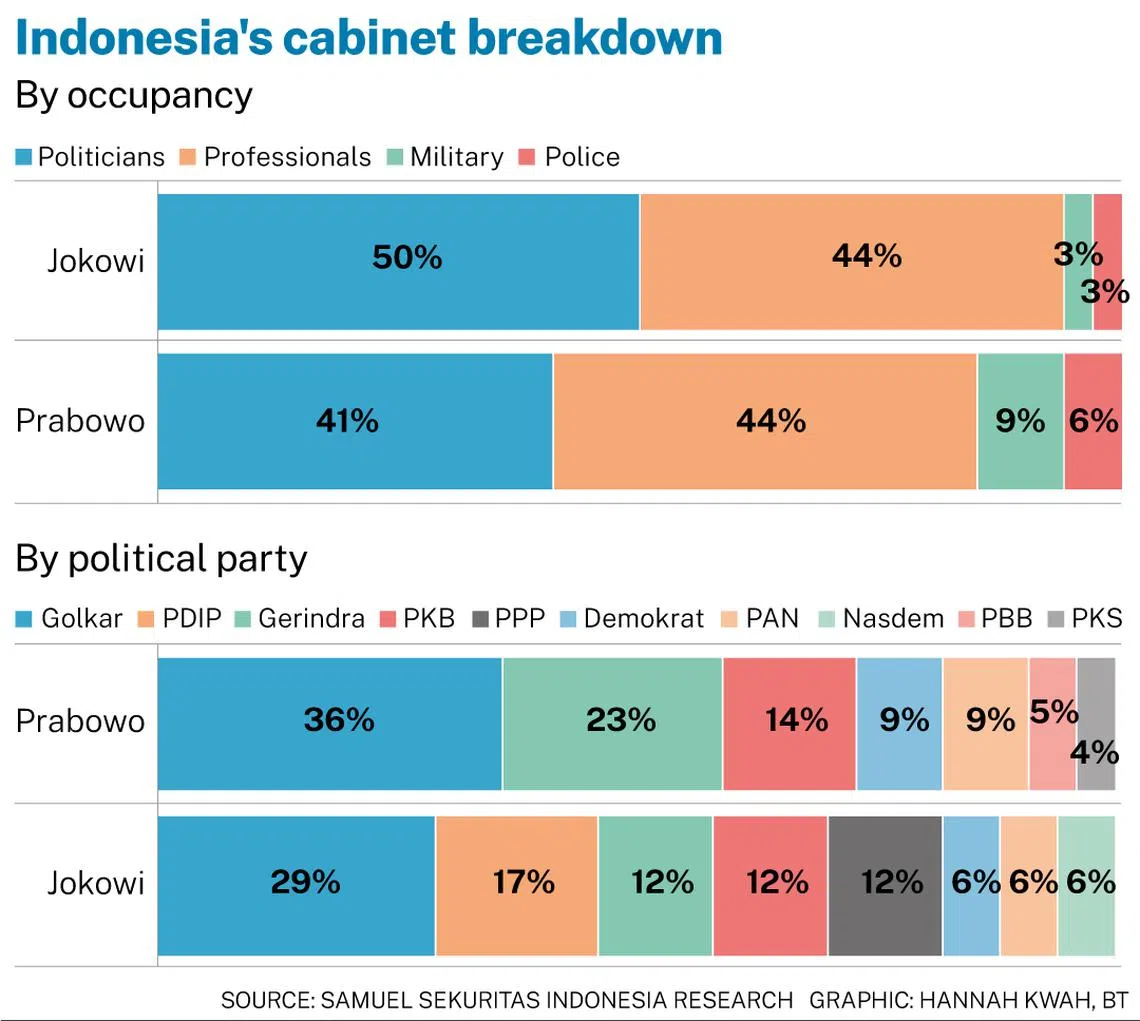
In the Merah Putih Cabinet, Prabowo has assembled a team predominantly composed of seasoned political figures, primarily drawn from his coalition of supporting political parties.
This strategic selection reflects his intent to solidify alliances and ensure stability within his administration.
Military touch in line-up
Adding a distinctive flair to his Cabinet, Prabowo, a former five-star general, has also chosen at least five ministers with military and police backgrounds, blending military discipline with political acumen, in a bid to navigate Indonesia’s complex landscape.
Putera Sambijantoro, head of equity research at Bahana Sekuritas, wrote in a note: “Prabowo’s strongman leadership style may be what a diverse country like Indonesia needs.”
Indonesia’s bureaucracy often faces criticism for its inefficiency in implementing effective policymaking.
While Indonesia has made strides under Widodo’s administration to simplify regulations and improve the ease of doing business – such as replacing complex licensing with simpler registration processes – it still faces challenges due to bureaucratic complexity and regulatory inconsistencies.
In the latest World Bank’s Ease of Doing Business index, Indonesia ranked 73rd out of 190 countries surveyed in 2023.
South-east Asia’s largest economy trails behind peer countries in the region, including in the ease of starting a business, enforcing contracts, trading across borders, and obtaining construction permits.
Analysts point to ongoing challenges with corruption and inefficiency, which continue to affect the government’s ability to fully respond to the needs of its citizens.
Investment climate concerns
Iseas’ Negara stated that foreign investors expect the newly appointed Cabinet ministers to demonstrate strong integrity and maintain a business-friendly vision.
“The key questions are whether their policies will be business-friendly, open to investment, or protectionist. Investors are concerned about ultra-nationalist policies, as these could negatively impact the investment climate,” he said.
The economic risks associated with Prabowo’s Cabinet expansion go beyond concerns of overlapping regulations that could affect foreign investors; they also include the potential for a heavier fiscal burden.
Observers noted that the addition of more ministries is likely to increase government spending over the next five years, potentially adding to the country’s fiscal burden as Prabowo embarks on his ambitious spending plans.
This year, the Center of Economic and Law Studies projected that Indonesia’s operational costs in the state budget could increase by two trillion rupiah (S$170 million), which would represent nearly a third of the country’s total expenditure.
This increase aims to cover the operational expenses of its 48 ministries, as well as salaries and benefits for around 4.2 million civil servants.
TRENDING NOW
Prima to move out of historic Keppel Road flour mill building in 2028

Temasek-related Azalea, SeaTown, Seviora Capital to merge in 2027
Family offices see more tailored products, leverage ‘collective firepower’ for direct deal access

Singapore room rates soar, but hotels seeing mixed demand from F1 race and events

