South Korea unveils US$747 billion energy transition plan through 2035
The country is targeting 100 gigawatts of renewable energy capacity by 2030
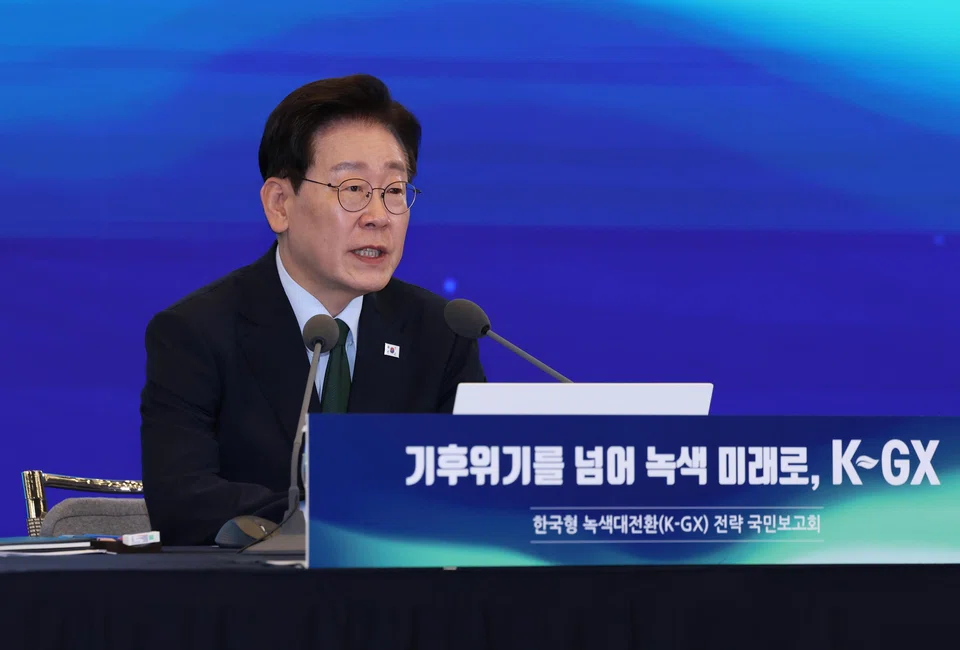
[SEOUL] South Korea‘s government on Wednesday (Oct 7) unveiled a 1,000 trillion won (US$747 billion) energy transition and decarbonisation strategy through 2035, aiming to expand renewable power, transform heavy industry and create new drivers of growth.
The K-GX, or Korea-Green Transformation, plan includes 200 trillion won in fiscal spending, more than 790 trillion won in climate finance, alongside a separate 220 trillion won private-sector investment, Finance Minister Lee Hyoung-il said in a presentation attended by senior officials and business leaders.
President Lee Jae-myung called for South Korea to use its innovative edge to position itself at the forefront of the global green economy.
“We must move away from the practice of chasing others and become architects and leaders of the green market ourselves,” Lee noted.
The government is targeting 100 gigawatts of renewable energy capacity by 2030 and plans support for industries including green steel, batteries, solar power, wind energy, hydrogen and small modular reactors (SMRs), according to a statement.
It also aims for electric and hydrogen-powered vehicles to account for more than 70 per cent of new vehicle sales by 2035 as part of a broader push to electrify transport and cut emissions.
The strategy seeks to accelerate decarbonisation in South Korea‘s five highest-emitting industries – steel, petrochemicals, refining, cement, and semiconductors and displays – while fostering 10 green industries including electric vehicles, power semiconductors and carbon capture technologies.
The government said that it aimed to lead the global green steel market by becoming the first country to mass-produce hydrogen-reduced steel, while also supporting next-generation industries such as advanced batteries and SMRs.
It also aims to commercialise tandem solar cells by 2028 and build domestic supply chains for key clean-energy technologies.

Climate Ministry officials said that the initiative was designed to address rising climate risks, energy security concerns and tightening global carbon regulations while turning carbon-neutrality efforts into a new source of economic growth.
Officials also added that projects receiving climate-finance support would be assessed for their greenhouse-gas reduction impact, while sector-specific decarbonisation roadmaps would be developed to help meet South Korea‘s 2035 emissions targets.
SK Group chairman Chey Tae-won, who heads the private-sector consultative body supporting the initiative, said that the K-GX strategy demonstrated the government’s commitment to share investment risks with the private sector that had been hesitant to make long-term carbon-neutrality investments amid uncertainty over technology, markets and policy. REUTERS
Decoding Asia newsletter: your guide to navigating Asia in a new global order. Sign up here to get Decoding Asia newsletter. Delivered to your inbox. Free.
Share with us your feedback on BT's products and services