Tales of a place formerly known as Aukang
My Father's Kampung weaves together personal and public histories, and uses each realm to enrich and reinforce the other

LOCAL history always strikes a heart-chord in a way that grand world history rarely can. Maybe it's because it feels closer to home. We feel more connected to things that we imagine happened in this place (wherever that is), and to people like us (whoever we are).
In that sense, there is no history more local - none that hits closer, literally, to home - than the family sort. There is something reliably poignant about tracing our genealogies, or racing to capture elderly family members' memories before mortality catches up with our work.
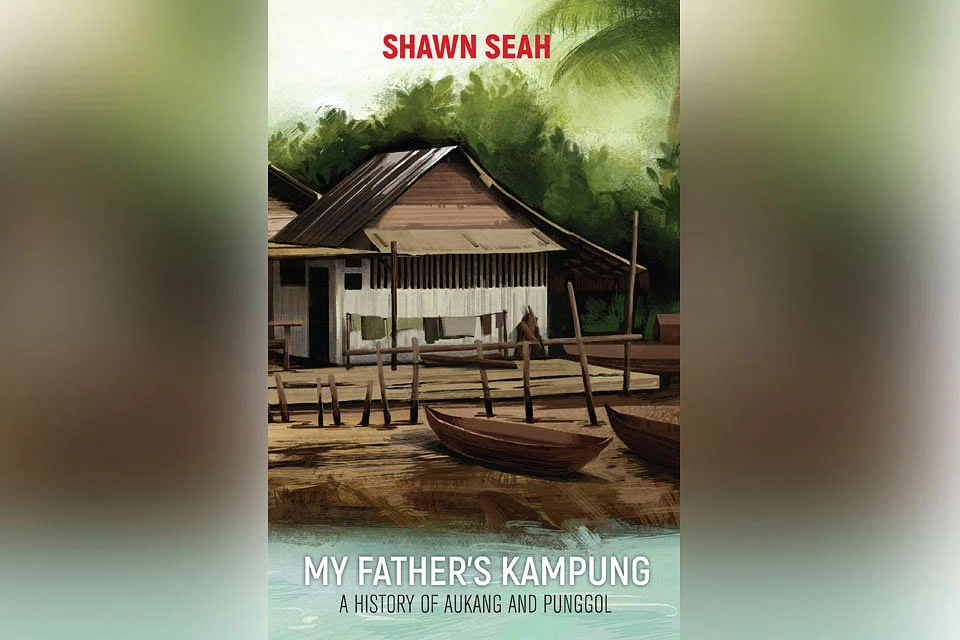
That is the quest Shawn Seah embarks on in My Father's Kampung: A History of Aukang and Punggol. Through historical records, interviews, and snippets of conversation, Seah pieces together what fragments he can find of his father's lived experience in Aukang from the 1940s to 1970s.
Along the way, he delves into the wider history of the region: its origins, its topographies, and its unique cultural characteristics as a predominantly Catholic Teochew enclave.
Many Singaporean readers, myself included, will empathise with Seah's quest. Like Seah, we are products of a generational rupture: between those who lived in kampungs and rattled off dialects, and those who grew up as urban children with public housing and skyscrapers for an inheritance.
Like Seah, our fathers' kampungs - and those of our mothers - no longer exist.
A forested settlement dating back to at least the mid-19th century, Aukang once spanned the northeast of Singapore, including areas now known to us as Hougang, Sengkang, Buangkok and Punggol. The region was earmarked for development in 1974, and made way soon after for modern towns and parks.
Seah taps historical records, like newspaper archives, to bring us the documented facts - like how early Aukang was inhabited by coolies who worked in gambier and pepper plantations, as well as fisherman and fish merchants who mongered their catch at Kangkar Fishing Village.
There are also cultural markers that still stand today, bearing common witness to the past - like the Japanese Cemetery Park in Hougang (a burial ground for Japanese civilians and war dead), and the Church of the Nativity of the Blessed Virgin Mary, founded in 1853 as a rural attap chapel and the former home of Montfort School.
But Seah also brings Aukang's more recent history to life with less public artefacts, like anecdotes and personal photographs from his father and various interviewees.
Through them, we gain a feel of the daily rhythms of life in Aukang during the mid-20th century kampung days: from outdoor toilets and badminton parties, to shooting birds from trees for food.
One Lee Boon Kee, for example, was born in 1943 and moved to Kangkar when he was 4 years old. He penned his reminiscences of his childhood years and shared them with Seah's father, his friend and former schoolmate. Seah reproduces these for us.
Lee remembers the night a fishing boat brought in a large crocodile that took 8 men to wrestle it to the auction shed; the haunted mansion in the neighbourhood, which no family ever stayed in for more than 2 months; and how as a boy, he would wade in mud for razor clams in the swampy ground behind his family home.
Such small, vivid details - like the lure of the "red luscious rambutan" in the haunted mansion's garden, or the sport of grabbing small prawns, fish and sea snakes from shallow pools - carry no weight in grand world history. But that is precisely what makes them scarce, and valuable. If not for efforts like Seah's, these human perspectives might be overlooked and lost to us entirely.
The book's greatest charm is this weaving together of public records and personal testimonies. By setting forth openly on a son's journey to understand his father's life and times, Seah opens a corridor between personal and public histories, and uses each realm to enrich and reinforce the other.
Perhaps there is no true difference between private and public stories in the end, insofar as we, as readers, find common frames of reference: echoes of stories told by our own fathers and mothers, and motifs of kampung life that we hold up even today as models of a simpler and more collective life.
It is quite apt that in Teochew, "Aukang" means "end of the river". One hopes, and is encouraged by this book, that a hearkening back to our upstream origins makes the water taste sweeter at the river's end.
My Father's Kampung: A History of Aukang and Punggol is available at S$29.96 including GST at Kinokuniya, Times, Epigram, Popular, and the World Scientific online bookshop.
Decoding Asia newsletter: your guide to navigating Asia in a new global order. Sign up here to get Decoding Asia newsletter. Delivered to your inbox. Free.
Copyright SPH Media. All rights reserved.