

Why social media may be really bad for you
Thanks to the digital onslaught and our smartphones, humans now have attention spans worse than that of a goldfish
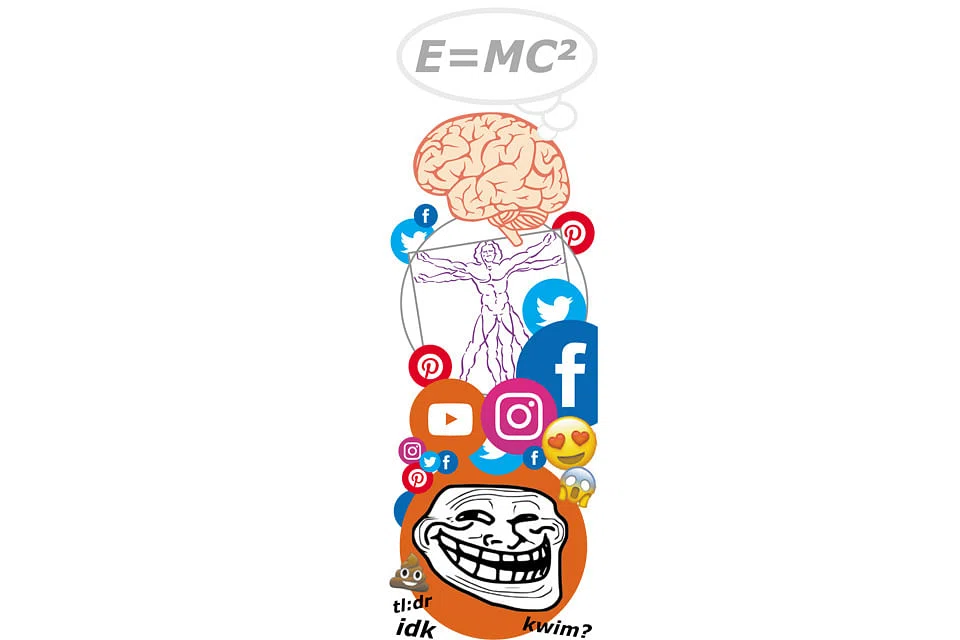
LAST Christmas, I sent a loving, warm-the-cockles-of-your-heart WhatsApp message to my niece in Germany on the birth of her first baby; another equally schmaltzy note over Facebook to a cousin in Toronto whom I had just re-connected with; and an effusive email missive to my Hatha Yoga guru in Thirukkadaiyur (in South India) to thank him for his guidance on meditation throughout 2018.
The replies - from my closest relatives, mind you - were minimalist to say the least - virtual stickers, augmented reality objects and the staple thumbs-up (in colour-appropriate mode, of course) over Twitter, WhatsApp and Snapchat. Save for the venerable guru who actually penned a physical letter and took the time to send it via Indian snail mail - sans emojis, thank heavens.
Increasingly, I've noticed over the last decade or so, that letters from my family abroad have dwindled to only the odd wedding invite or the mandatory festive card. Even social media messages have become truncated, pared-down perfunctory little jots - kwim for "Know what I mean?" or tl:dr for "Too long; didn't read" - the digital equivalent of grunts and burps.
You'd think that with all the infrastructure for communicating faster, longer and better at our disposal now, which we have never had before the year 2000 (about the time when the mobile revolution really began), people would be a much more articulate lot.
It's anything but. Microsoft Corp reported just a few years ago that, increasingly, we are all suffering from attention spans that are less than that of a goldfish. Its researchers in Canada surveyed 2,000 participants and studied the brain activity of 112 others using electroencephalograms (EEGs).
Microsoft parsed that data and reported in 2015 that since the year 2000, the average human attention span has dropped from 12 seconds to eight seconds.

On the positive side, the report says our ability to multitask has drastically improved in the mobile age, although heavy multi-screeners find it difficult to filter out irrelevant stimuli - they're more easily distracted by multiple streams of media. The report also said that normal multitaskers were more adept at scanning faster than before but not in the assimilation of in-depth reports or findings.
Microsoft said that the changes were a result of the brain's ability to adapt and change itself over time and a weaker attention span may be a side-effect of evolving to a mobile Internet.
And social media, not content to be kept at arm's length nestled only in the palm of our hands, is aiming to wrap itself around our other body parts: wearable tech is already on your wrist, wrapped around your head and torsos at the gym, and even over your eye (Intel's smart glasses called Vaunt, which use retinal projection to put a digital display in your eyeball).
While most would agree this is the way forward, what would you call it when most people can't even string a sentence together coherently? Almost two decades after the mobile Internet revolution in 2000, social media presents a slippery slope for those who yearn to pull themselves out of the morass of short-form to aspire to the critical thinking that comes with long-form writing (readily available via books, specialist magazines and newspapers or online sites containing in-depth analyses of the news and commentaries).
According to Assistant Professor Daniel He of the Department of Marketing at NUS Business School, passive media is to blame, such as YouTube, which addles one's brains with non-stop, bite-sized videos; as well as other forms of communication in the short-form format: WhatsApp, Snapchat, Twitter, Messenger and the majority of Facebook posts. With short-form, our critical thinking faculties are not engaged - and over time may not develop fully. "People tend to think more deeply when reading a book than when watching YouTube because they have more control over the rate of information processing," says Prof He. "Passive forms of media such as television or online videos impose a pace of storytelling onto the audience that does not always leave enough time for them to digest all the information. In order to keep up, people begin to think more superficially and rely more on shallow cues to inform them on what to think."
With less people reading long-form today, and looking to buy even more tech that forces them to multitask on multi-screens - does this inhibit creativity? For instance, when one reads a book, one is forced to create one's own movie of the book in the mind - meaning that other things are happening when you read: your creativity peaks, your imagination runs wild, and you are contemplating visually. Which does not happen when you're consuming a surfeit of visual "fast food" such as through YouTube and newsfeeds.
Says Prof He: "A classic psychology study in the 1980s demonstrated this very phenomenon. Student participants at the University of Toronto were asked to evaluate arguments in favour of switching the academic schedule to a trimester system. When these arguments were presented in written form, the participants thought more deeply about the issue by considering the merits of the argument.
"However, when the exact same arguments were presented in a video format, participants were no longer so analytical and instead rated the persuasiveness of the argument based on more peripheral cues such as the physical attractiveness of the spokesperson in the video. This study and many similar subsequent research suggest that passive entertainment like YouTube promotes more shallow, superficial thinking."
Already, children's screen time is being hotly debated on both sides of the Atlantic. The Royal College of Paediatrics and Child Health (RCPCH) earlier this month reported that it would not recommend any age-appropriate time limits as there is not enough evidence that screen time harms a child's health at any age.
In the US, the American Academy of Pediatrics recommends age-appropriate time limits. But medical experts have stepped in to warn that the lack of solid evidence does not mean that excessive screen time is not harmful. Problems arise when children are so absorbed with their digital devices that it displaces physical activity and face-to-face social interaction, and affects sleep and school performance.
To address the onslaught of social media, netizens today need to strike a balance. It's just as important to be engaged in well-written commentaries about the news in the daily newspapers, as it is to imbibe newsbytes on one's mobile phone.
One way to get weaned off a heavy diet of short-form media is to reduce distractions in order to free up mental resources, advises Prof He: "Compared to people in a neutral state, individuals who are mentally tired from multitasking are more likely to be persuaded by a large list of weak arguments because they are impressed by the length of the list, which has a lot of surface appeal, instead of the arguments themselves, which are actually weak and unpersuasive.
"One way to remedy this problem is to mitigate the number of distractions when browsing online, so that users will have enough bandwidth to think more deeply."
"Another way is to increase motivation. In order to examine an issue beyond its surface appeal, people need to be sufficiently motivated so that they will dedicate enough mental resources into thinking more deeply. Because social media is an environment that divides people's attention due to the overwhelming amount of information, it is not surprising that many people are drawn to more shallow and superficial ways of thinking," explains Prof He.
Also, sticking to a daily ritual of picking up the newspaper to read long-form regularly may be a prelude to bigger things: maybe a novella next, or a compilation of short stories. Or even a proper book. Anything will be an improvement from the current state of skimming, scanning and staccato acronyms.
Copyright SPH Media. All rights reserved.


