

Issue 199: S-E Asia’s exposed energy mix; CSE Global’s boardroom drama
This week in ESG: Region’s energy import bill could more than double by 2050, International Energy Agency says; CSE Global lead independent director resigns after dispute with chair

Energy transition
Putting a fire under South-east Asia’s energy transition
An exposed supply chain, sticky coal, cool spaces, nuclear dreams and a huge investment gap are some of the more interesting aspects of South-east Asia’s energy outlook.
A new report by the International Energy Agency (IEA) says South-east Asia will remain heavily exposed to global energy market disruptions unless it significantly steps up investments in reducing energy import dependence and improving energy efficiency.
Exposed supply
Before the US and Israel launched attacks in Iran in March, about 60 per cent of South-east Asia’s crude oil and about a third of its natural gas were imported from the Middle East, IEA says. Furthermore, 45 per cent of the region’s oil product supplies depended on Middle Eastern crude.
Without deeper changes, South-east Asia’s energy import bill could more than double to US$400 billion (S$513 billion) by 2050 from an estimated US$160 billion this year under current policies, IEA estimates.
Some policy responses to the Middle East conflict may help to manage its short-term impact, but actually hinder the structural changes needed to reduce long-term dependencies, IEA says. For example, fuel subsidies in the region are expected to “rise sharply” in 2026 from about US$40 billion before the conflict. However, these subsidies obscure market signals that would otherwise prompt behavioural shifts away from fossil fuels, and strain fiscal budgets that could otherwise be used to invest in energy transitions.
The region’s policy direction is broadly aligned with diversification away from fossil fuel energy – recent policy shifts have focussed on diversification and fuel switching – but the trajectory is not aggressive enough, IEA says. The most recently updated national climate targets submitted by South-east Asian countries will limit average annual growth of energy-related greenhouse gas emissions to 0.6 per cent through 2035, which is an improvement from the 2.5 per cent growth under earlier targets. But that is still far short of the 5.9 per cent annual reduction required to meet the countries’ net-zero goals.
If South-east Asia is able to apply stated policies backed by concrete implementation plans, it could reduce its energy import bill by about 40 per cent by 2050 versus current policies. The reduction could be an even larger 80 per cent if the region is able to hit its announced pledges.
The conclusion is that while South-east Asia is sending the right signals on building energy resilience, the region is not doing enough, especially when it comes to the lasting, long-term changes required to wean itself off of imported fossil fuels and high-carbon energy sources.
Sticky coal
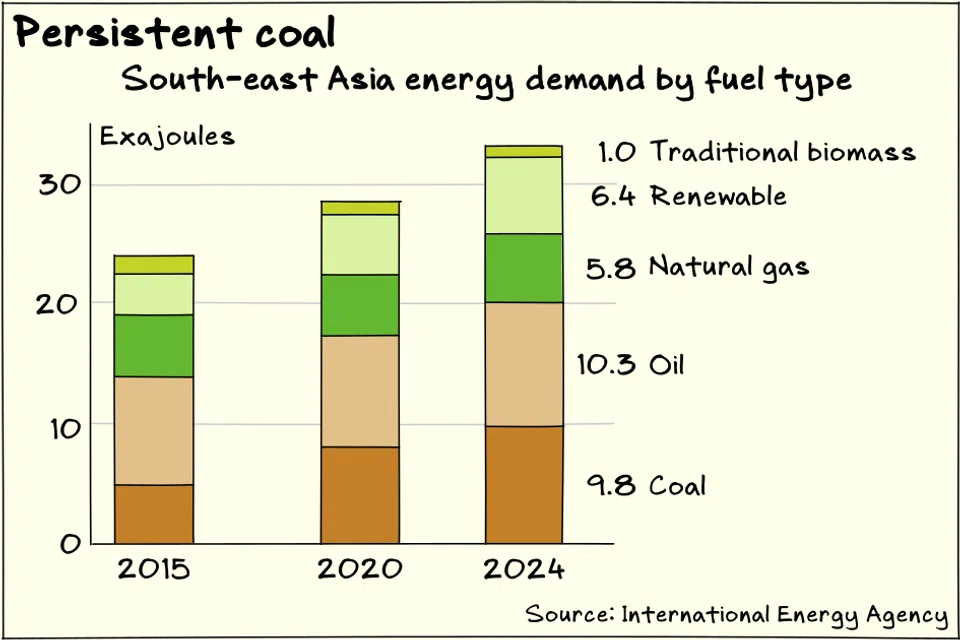
One consequence of the current focus on energy security is the entrenchment of coal in the region’s energy landscape.
With demand growing at an annual pace of about 8 per cent, coal is South-east Asia’s fastest growing energy source, IEA says. Coal’s share of the region’s energy mix has grown from about 20 per cent in 2015 to 30 per cent today.
Furthermore, emissions benefits from the increasing electrification of South-east Asia are dragged by the fact that coal has accounted for most of the additional electricity generation in the region. Coal-fired electricity generation has grown by more than 8 per cent per year on average between 2015 and 2024, raising coal’s share of regional generation to 47 per cent from 37 per cent over the same period.
Coal is cheap and abundant domestically – Indonesia is the world’s third-largest coal producer – which makes it difficult to replace, especially for industrial uses. IEA expects regional industrial coal demand to increase by 30 per cent by 2035 if stated policies are implemented, and by 40 per cent if current policies hold. Coal accounts for about a quarter of regional industrial energy demand today, and will decline only slightly to 20 per cent if stated policies are carried out while staying flat if current policies remain in place.
IEA says it has raised its forecast for coal-fired generation for the stated-policies scenario by about 10 per cent compared to 2024 estimates to reflect “higher-than-expected growth in captive coal generation in Indonesia and a more persistent pipeline of coal projects”. Captive coal refers to off-grid coal generation used to power specific industrial activities, such as a coal plant built for a nickel mine and smelter.
It is only after 2035 that coal begins to meaningfully yield ground to renewables, and that is assuming stated policies are followed through.
The implication of persistent coal is that South-east Asia will not hit its long-term emissions goals as a region without a more substantive shift towards cleaner energy.
Hot cooling
However, letting go of coal is made especially difficult because ballooning electricity usage means that generation capacity is a key priority in the region. Electricity demand in South-east Asia has grown at an average of 6 per cent per year since 2015, which is almost twice the global mean, IEA says.
One major source of electricity demand is the use of cooling appliances such as refrigerators and air conditioners. IEA finds that cooling demand in buildings is the fastest growing form of electricity consumption in the region, with the stock of residential air-conditioners expected to triple by 2035. Electricity used for space cooling has doubled since 2015 and now represents more than 10 per cent of regional electricity demand. Refrigerator and freezer ownership in the region has increased by 40 per cent since 2015.
Demand for cooling comes from two fronts. The first is growing wealth, which allows more households to buy air conditioners or refrigerators. The second is global warming, with its effect more pronounced in urban centres.
Demand mitigation is an essential aspect of addressing energy security and resilience. IEA notes that tightening standards on appliance efficiency and building designs are important steps to reduce cooling’s energy load.
Nuclear dreams
Given the challenges of meeting the region’s growing energy needs while diversifying away from fossil fuels, nuclear energy is increasingly being explored in South-east Asia.
Closing the cost gap between nuclear and conventional fossil fuel electricity is the key to making nuclear work, IEA says.
The average cost of electricity generation, excluding grids, is about US$70 per megawatt hour (MWh) in South-east Asia at the moment.
Nuclear energy’s levelised cost of electricity is just under US$100/MWh, based on construction costs of about US$4,000 per kilowatt (kW) and weighted average cost of capital of 8 per cent. Development costs need to fall to about US$2,700/kW or financing costs need to halve to lower nuclear’s levelised cost to US$70/MWh.
Small modular reactors, an emerging class of nuclear generation, could be cheaper and faster to build than traditional nuclear plants, but the technology is still nascent and actual development costs are still evolving.
Investment gap
South-east Asia needs to almost double energy investment in 10 years – to US$190 billion by 2035 from US$100 billion in 2025 – if it is to meet its long-term climate goals. However, current and stated policies are on a path to only US$130 billion of investments in the same time frame.
Low-emissions power might be easier to scale. IEA finds that while national oil companies tend to receive substantial public funding, clean energy is better able to attract private capital.
The region should also continue to develop transition finance and carbon markets to improve the availability of capital, IEA says.
Corporate governance
The bright side to CSE Global clash
The silver lining in the emerging boardroom row at Singapore-listed CSE Global is that an independent director is taking a stand against the controlling shareholder, and that the market regulator has taken an interest.
Singapore Exchange Regulation (SGX Regco) and CSE shareholders should seek to ensure that independent directors at the company are not hindered in performing their duties.
On Jun 2, veteran auditor Tan Chian Khong resigned as lead independent director at CSE, which builds integrated technology systems for industrial customers. In the disclosure form for announcing his resignation, Tan cited “difference of views with regard to working with controlling shareholders” as an unresolved difference in opinion on material matters.
In response to a query by SGX Regco, CSE provided more details about Tan’s departure.
Tan alleges that CSE non-independent and non-executive chairman Eugene Lai had asked him to resign even though Tan’s term ends in 2028. Tan further alleges that Lai wanted Tan to step down as chair of CSE’s nominating committee. Tan said that he and Lai appeared to hold “increasingly divergent views” on strategic matters.
In response to Tan’s allegations, Lai said he had not asked Tan to resign, but had privately shared his view that CSE needed to refresh its board and have a lead independent director with strong merger and acquisition (M&A) experience. Lai said that he left it to Tan to decide “what to do in the best interests of the company”. Lai is the board nominee of CSE controlling shareholder Heliconia Capital Management.
CSE is currently in the midst of a strategic review undertaken by Jefferies.
CSE shareholders can be grateful for two outcomes. The first is that SGX Regco got the company to disclose more details. As Singapore’s stockmarket regulation shifts further towards a “buyers beware” approach, greater transparency on potentially material matters is essential to enabling sound decisions in the market.
The second positive outcome is the fact that Tan chose to raise his concerns, because there is now an opportunity to scrutinise the company’s corporate governance. While harmonious boards are generally good to have, too little conflict should raise concerns that boards might not be diverse enough or that disagreements are being hushed over. The fact is that the market for directors disincentivises speaking out in public, because a reputation for being difficult can close the door to other directorships.
The market should therefore be comfortable with a healthy level of conflict, especially when the tension occurs in a sincere pursuit of the best interests of the company.
Regardless of which side is more true, shareholders should seek assurance from CSE that its independent directors are allowed to carry out their duties without inappropriate influence from Heliconia.
Shareholders should also ensure that CSE’s board has a structured approach to determining and acquiring the diverse skills and experience required to properly lead the company. It is worth challenging the wisdom of seeking to replace the only auditor on the board with an M&A expert when the seven-member board (while Tan was still included) already has three M&A experts: Lai, through his work at Heliconia; non-executive independent director Ng Shin Ein, through her work as a corporate lawyer advising clients on joint ventures, M&A and fundraising; and non-executive independent director Kenneth Tang, another corporate lawyer whose main areas of practice include M&A and corporate finance.
This is especially relevant given that CSE could soon be involved in corporate action following the strategic review. Shareholders need to be confident that the board’s independent members are looking out for the company’s best interests and not just its largest shareholder, and that the board has the right balance of expertise and perspectives to help it navigate that next phase.
Whether Tan or Lai is correct may ultimately have little economic impact for CSE shareholders, since Heliconia is the controlling shareholder. If Heliconia wants a new independent director instead of Tan, it is unlikely that Tan would have been re-elected after his current term is up.
However, the conflict highlights potential corporate governance risks that shareholders should address before CSE embarks on a more consequential journey.
Other ESG reads
- Singapore banks may need to address indirect exposure to captive coal in their financing policies
- MPACT prices S$200 million of green bonds at 2.53%
- China sets sights on heavy truck electrification in blow to diesel demand
- Green economy tops US$10 trillion as revenue growth accelerates
- Circular water economies will power South-east Asia’s growth story


