

Issue 201: WWF-Singapore CEO on coalitions; Corsia could be big business
This week in ESG: Market veteran Chew Sutat takes reins of nature non-profit; aviation’s carbon credits scheme could create US$1.6 billion of value for S-E Asia

Sustainable finance
WWF-Singapore’s Chew on building coalitions

As Chew Sutat takes on the task of leading the Singapore chapter of the World Wide Fund for Nature (WWF-Singapore), he tells The Business Times that scaling up support for nature and climate issues means framing challenges in ways that resonate with the motivations of different stakeholders.
Chew knows a little something about what matters to different stakeholders. After all, he has been many of those stakeholders at some point in a career that he likes to describe as having taken him “from profit, to people, to planet”.
Chew began as a banker in the 1990s, then rose to further prominence as one of the key captains at the Singapore Exchange (SGX) in the 2000s, running global sales and origination. At SGX, Chew was not only the face of the markets, espousing the benefits of listing a company on Singapore’s stock market; behind the scenes he also helmed SGX’s corporate and social responsibility functions and its flagship Bull Charge fundraising initiative.
Chew left SGX in 2021, and a year later took his passion for philanthropy to Community Chest, Singapore’s national charity. Under Chew’s chairmanship, Community Chest embraced national efforts to help charities better monitor and measure their impact under the Sustainable Philanthropy Framework.
Chew’s move to WWF-Singapore this month marks his entry into the “planet” phase of his career, where he will align his skills and experience with the non-profit’s focus on biodiversity and the environment. He acknowledges the immensity of the challenge before him and his organisation, but takes the approach that when faced with a huge problem, the only path forward is to try.
“Net-net, I’m more optimistic than I’m not. And I think it’s a good thing because the climate issue in particular is so vast,” he says.
He thinks it is natural to wonder if individual efforts are meaningful when many large companies and countries are still not doing enough. But he observes that progress is being made even if it is uneven. Multinational organisations still function, and many governments are still coming together to try to address environmental issues and to deliver on their climate commitments.
“It’s not a straight line,” Chew says. “You can take the view that because it’s not a straight line we kind of get depressed about it and we give up, but how is that being part of the solution?”
Chew’s challenge could well be getting as many stakeholders as possible to be part of the solution.
In 2023, a landmark “Green Economy” report by Bain, Temasek, GenZero and Amazon Web Services estimated that South-east Asia will need US$1.5 trillion of green investments in nature and climate to meet its 2030 climate goals, implying an annual need of more than S$200 billion per year.
The 2026 update of the report finds just US$40 billion of annual green capex in the South-east Asia 6 – Indonesia, Malaysia, the Philippines, Singapore, Thailand and Vietnam – from 2021 to 2025. The same update further estimates only about US$315 billion of green capex will be deployed between 2026 and 2030 under current market conditions in the South-east Asia 6 into the power and grid sectors and into electric vehicle value chains.
The numbers reflect a persistently large green investment gap in the region, a gap so large that scaling up financing necessarily requires the participation of many different segments of society. When Chew mentions WWF’s projects around Indonesia’s Tarakan Island, the Sulu-Sulawesi Blue Corridor between Indonesia, Malaysia and the Philippines, and in the Mekong Delta, it’s the whole-of-community aspect that he highlights.
“We don’t do this alone,” he says. “Each of these projects comes together with a coalition of the willing… For something like nature and climate, you really need coalitions of different people.”
Building coalitions requires addressing objectives that can be vastly different for each partner.
Chew says that profit-driven parties need to satisfy thresholds on materiality and returns.
“We know that for most listed companies’ boards in Singapore, they have to do an annual exercise on what are material risk factors for their business,” he says. “There’s everything you’ve got to think of in there, from cybersecurity all the way through to business continuity and so on. And increasingly nature-based solutions, or biodiversity and nature, are coming up as one of the things for boards to consider.”
While he acknowledges that some boards still deem their impact on the environment to be a low priority, those that are more progressive are potential partners.
“When we identify companies who have a commitment or have an interest to express, then we try to find the best way to partner them,” Chew says. “It’s no different from any other business. Understanding the customer’s need, and the interest and priority. With the pool of science-based resources that we have, and opportunities to actually deploy, hopefully we find a match.”
Innovation can help to improve the risk-return assessments for projects. For example, for projects seeking blended finance, WWF-Singapore is working with banks to explore ways to provide some level of insurance to de-risk projects for private investors.
WWF-Singapore’s Blue Carbon Support Programme also taps different types of technology and innovation, such as drone monitoring and mangrove planting methodologies, to improve confidence in outcomes, Chew says.
“There’s no lack of risk, but do we say because it’s risky, we don’t do it?” he says. “Just like in investing, some people have appetite for seed capital, some people have appetite for Series A, some people only come and buy the offtake in the carbon market. We don’t judge them based on what their mandate is, whether as an asset manager or as a corporate. We try to educate and encourage them to join others that can actually do this work together.”
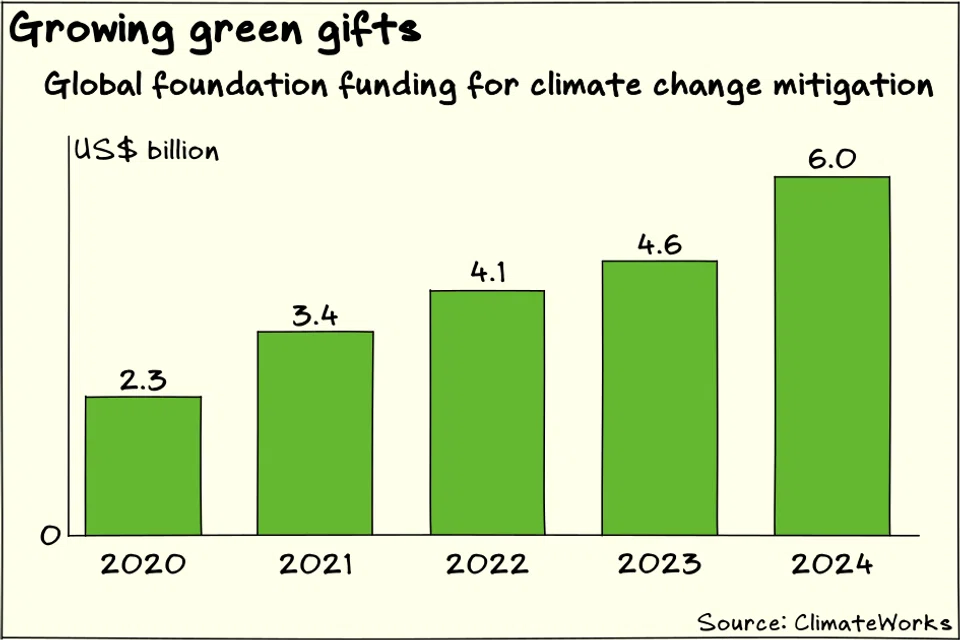
With philanthropic capital, one challenge is to raise allocations to nature and climate. Indeed, ClimateWorks data shows that while philanthropic giving to climate change mitigation grew about 30 per cent in 2024 to between US$11.7 billion and US$18.4 billion, the cause received just 2.1 per cent of all philanthropic giving, the first time it exceeded 2 per cent.
Chew’s approach is to recognise philanthropies’ differing priorities and find ways for them to participate in ways that meet their objectives. For example, philanthropies that are more interested in addressing social issues can be tapped to provide resources and improve livelihoods for rangers that are helping to keep poachers at bay.
“You could aggregate different levels of philanthropic capital to different areas of interest when you look at a landscape approach to things, rather than, just please come and help support this one animal or this one species,” he says. “I’m not saying that the animals and the species are not important, but when we let nature thrive on its own, a lot of things happen. So, that’s why we take a very holistic view. And with that, we can incorporate elements of different interests.”
Chew sees policy as an essential lever, but acknowledges that policymakers face tough decisions in trying to juggle environmental, social and economic outcomes. Still, the pursuit of a just transition requires society to address imbalances in those aspects.
“We know it’s all interconnected. And we know that collaboration is required from governments, business, finance, philanthropy and communities to all work together, because it’s a shared Earth that we have,” Chew says. “We can’t just ascribe this to someone else’s problem. Trying to be very precise about whose fault is it anyway neglects the opportunity to ask, if we come together, what do we achieve?”
Carbon markets
Aviation’s offsets a double-edged sword
The aviation industry’s voracious appetite for carbon offsets might be a lucrative opportunity for South-east Asia, but it also raises a quality risk as the carbon credits industry rushes to fill the gap.
A new report by aircraft maker Boeing, decarbonisation investment platform GenZero and carbon procurement platform Abatable finds that at least US$1.6 billion of economic value could be created for South-east Asia over the next decade due to the aviation sector’s carbon offsetting scheme. The opportunity could increase to US$8.5 billion if all carbon projects in the pipeline deliver as promised and meet required standards for the scheme.
The scheme, called the Carbon Offsetting and Reduction Scheme for International Aviation (Corsia), has two key phases. The first gives airlines – on a voluntary basis –until 2028 to offset 85 per cent of 2024-to-2026 emissions growth from 2019 levels. The second phase requires all airlines that are part of the International Civil Aviation Organization to offset emissions produced between 2027 and 2035.
At present, only four projects in South-east Asia are producing Corsia-eligible supply, with 2.6 million eligible carbon credits issued. An additional 54 projects are aligned with Corsia requirements, but have yet to receive letters of authorisation from their host countries to attain eligibility. These projects could add an additional 18.2 million credits for Corsia’s first phase, and a further 5 million to 26 million credits if they are extended to 2035.
But existing supply from the current four eligible projects represent only 7.1 per cent of global eligible supply, and 1.3 per cent of total demand. Even if all the pipeline projects are able to obtain eligibility, the amount of supply from the region would remain well short of what airlines require.
While the money may look enticing, the large disparity between supply and demand should raise concerns about quality controls. The larger the disparity, the greater the pressure on airlines and governments to increase supply, and this could weaken gatekeeping for Corsia-eligible credits. Integrity problems for carbon projects can take time to surface, making them challenging to detect and prevent in the early stages.
The truth is that decarbonising aviation is immensely difficult. The three prongs of the industry’s transition strategy are all struggling to produce meaningful progress. Carbon offsets are in short supply. Sustainable aviation fuel is in even shorter supply, with high prices rubbing salt into the wound. Technological advances are not advancing quickly enough.
Staying committed to the decarbonisation strategy and Corsia’s ratcheting requirements would be commendable and noble, but pragmatism could eventually force the aviation sector to adjust its ambitions to more achievable levels.
Other ESG reads
- Singapore’s second blended finance fund hits US$345 million with concessional capital from Temasek
- Koh Brothers Eco Engineering gets in-principle approval to move to SGX mainboard
- Energy is the chokepoint for AI’s next growth phase, says DBS CIO
- China, South Korea, Singapore lead Apac in global EV ranking
- Philippines leads the world in rush to solar as power prices soar
TRENDING NOW

S$8 billion wiped off OCBC value as shares slide 5.8% in heavy trade

Grab CEO’s wife Chloe Tong on life with Anthony Tan and finding her purpose

Brookfield denies accusation it cut Soilbuild out of Mapletree deal

8 public officers referred to police over property buys near unannounced MRT stations: Chan Chun Sing

