

Issue 205: GIC adjusts sustainability approach; AirTrunk data centre loan’s green credentials
This week in ESG: GIC tightens integration of sustainability and investment teams; AirTrunk obtains US$2.3 billion green loan for Johor data centre

Sustainable investing
GIC evolves sustainable strategy for new pressures
GIC is adapting its sustainability strategy alongside a broader adjustment to its investment approach as the Singapore sovereign wealth fund grapples with a more divided and uncertain world.
Closer integration of its sustainability and investment teams, a fragmented opportunity set in energy transition and stepped up management of physical climate risks are among the changes revealed by GIC in its latest annual and sustainability report.
GIC says that it is changing its investment framework in 2026 after more than a decade in response to what chief executive Lim Chow Kiat describes as a “more complex and dynamic world”.
“At GIC, we have long felt that the gravest risks are those that accumulate quietly before surfacing abruptly,” he writes in the report. “Today, across the global economy, constraints are tightening while outcomes are widening, creating a world of greater scarcity and complexity. These constraints do not exist in isolation. Geopolitical fragmentation, limited fiscal flexibility, and bottlenecks in technology and energy reinforce one another as their impacts play out unevenly across markets.”
The new investment framework introduces two key changes that strengthen the primacy of GIC’s mandate and give the firm more flexibility in how it executes that mandate.
The first is in the “Strategic Portfolio”, which reflects the Singapore government’s risk appetite and long-term return expectations. It’s the primary vehicle that ensures GIC can fulfil its fundamental mandate of preserving and enhancing the international purchasing power of the national reserves that it invests. Under the new framework, the Strategic Portfolio shifts away from a traditional asset class-centric organisation to allocations based on return characteristics – a bias towards function over form. For example, the growth-focused “equities” asset grouping can freely deploy between public and private equities without having to stay within allocation ranges for each of those asset classes.
The second key change is in the “GIC Portfolio”, which is where GIC aims to add value to the Strategic Portfolio through active strategies within risk limits. The new framework emphasises the portfolio’s objective to outperform the Strategic Portfolio.
Taken together, the changes are aimed at allowing GIC to respond more nimbly to what the firm perceives to be deep uncertainties and structural changes in the investment landscape where the old rules do not always apply.
Climate change happens to be one of the forces that GIC views as reshaping future growth and risk patterns, so its approach to sustainable investing is also evolving to further integrate sustainability within its investment functions. While GIC had focused sustainability teams within investment departments in its previous iteration, the firm says that the sustainability and investment teams will now work more closely together to better capture opportunities from climate change and sustainability trends.
Internalising sustainability in its investment functions could allow GIC to better address the sustainability risks and opportunities that lie ahead.
GIC outlines three important shifts in the sustainability investment landscape. The first is in sustainability sentiment and policies. Climate targets are less ambitious but more balanced against economic and social needs. Policies are more fragmented as governments adjust their climate pathways to local realities.
The second shift is that the energy transition is increasingly driven by energy security and resilience concerns, as opposed to purely environmental or economic reasons. GIC expects this to accelerate interest in cleaner and more reliable energy systems, because “where climate ambitions have faced headwinds, focus on energy security and resilience have gained traction”.
Finally, the massive growth of the artificial intelligence sector is also fuelling the energy transition. GIC says “expanding renewable capacity remains the quickest way to add electricity supply, while modernising power grids is essential to integrate low-carbon sources and maintain reliability”.
In previous years, GIC had identified three climate-related “opportunity sets” – decarbonisation solutions, energy transition and adaptation and resilience. Those remain investment priorities, but the latest report contains an important tweak to elevate the importance of local circumstances.
“The previous regime of broadly converging policy tailwinds is now giving way to a more fragmented landscape,” GIC states. “Sustainability-related strategies now require closer alignment with local policy conditions and market fundamentals.”
In essence, GIC sees opportunities, but they are uneven.
Climate fragmentation also means that the physical risks of climate change will probably increase. GIC has therefore made managing physical risks for its investments a strategic priority. Critically, GIC is clear that these physical risks are not distant dangers.
“The global transition towards a net-zero economy will not happen fast enough to avoid significant physical changes in the climate and environment,” the firm states. “This creates real, near-term physical risks for the companies and assets we invest in. We seek to understand and underwrite these appropriately.”
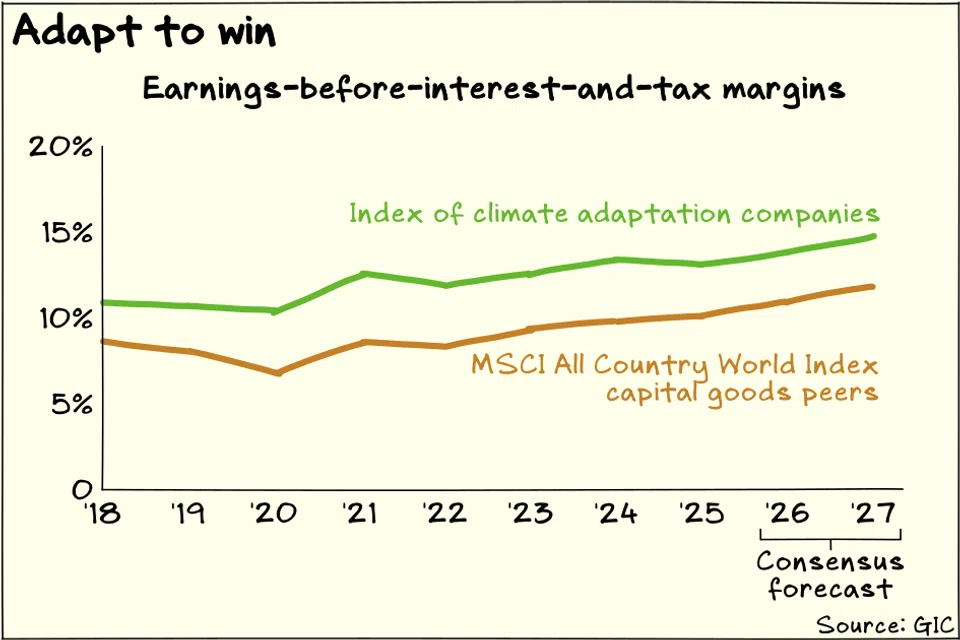
Highlighting the threat of damages and higher insurance costs, says that for assets with high physical risk exposure, the firm will assess risk management actions and possible divestment opportunities. The firm also takes strategic positions in proven adaptation and resilience solution providers with attractive valuations, and will support companies in implementing adaptation strategies where appropriate.
GIC, which does not report portfolio emissions, is also looking at how it can better measure the decarbonisation progress of its portfolio. It says it is working on creating its own metrics, including ways to reflect the emissions intensity of its portfolio complemented by a transition metric, exposure to growth potential from the climate transition, and exposure to climate risks.
Those metrics, when ready, would be welcome. Through its annual reports and occasional papers, GIC has a commendable history of sharing valuable insights into how it views and addresses sustainability issues as a long-term investor. However, the firm has yet to disclose metrics that can be used to understand its portfolio’s progress on its sustainability impact and exposure to sustainability-related risks, especially when it comes to climate impact, risks and opportunities. Without those metrics, it is difficult to understand how well GIC is translating its strategy into practice.
Sustainable finance
The discomfort in data centre green loans
One of the less intuitive aspects of green finance is that environmental benefit is relative. A project could be eligible for green funding even if it has a high carbon footprint – if the footprint is substantially smaller than a less efficient alternative.
Green funding for data centres regularly sparks debate about what should be considered green.
AirTrunk is the latest to obtain green financing, with a US$2.3 billion green loan for a Johor hyperscale development. The deal earned its green label because of its energy and water efficiency. The centre has a targeted design power usage effectiveness (PUE) of 1.37, which means that for every unit of energy used for computing an additional 0.37 is spent on the facility for purposes like cooling. The global average PUE for data centres is about 1.5 to 1.6.
The centre will also use “advanced water-efficient cooling technology”, although AirTrunk has not announced the level of water efficiency it will achieve.
A lot of criticism about green financing for data centres stems from the fact that these data centres can produce large amounts of greenhouse emissions even if they are efficient. How can a loan finance the generation of so much emissions and still be considered green?
The short answer is: Because it is significantly more efficient.
The long answer adds: Also, the benefits of the development are deemed to be worth the absolute emissions, and while achieving net-zero emissions through mechanisms such as renewable energy certificates is possible in some cases, it is not feasible in many cases.
Nevertheless, there are valid criticisms about the eligibility thresholds for data centres, relating to whether these thresholds are stringent enough and comprehensive enough.
One problem is that eligibility thresholds vary depending on jurisdiction. For example, the PUE threshold for a data centre in Singapore is 1.35, which means that AirTrunk’s project would not be eligible for green financing if it was built in Singapore. While these differences reasonably reflect local circumstances, they raise concerns about data centre development seeking jurisdictions of least resistance.
Another concern is that eligibility criteria might not be comprehensive enough. For instance, eligibility criteria are usually narrowly defined and do not generally consider the carbon intensity of the power supply, water usage and community impact in totality.
Perhaps a more fundamental problem with data centres lies with the fact that usage itself is highly inefficient. Even with a PUE of 1.5, most of a data centre’s energy consumption is for the computing carried out in the IT equipment. Data centres are multiplying so rapidly and using so much electricity because there is so much data storage and computing taking place, and most of that activity is probably useless. Do we really need that much data? Does every tech company need to build its own large language model? Do we need to say “please” and “thank you” with ChatGPT?
There are perfectly legitimate use cases for data centres, and taking away green financing might prevent those use cases from benefitting from the technology on a more sustainable footing. Reducing wasteful usage might be a more impactful way to lower data centres’ carbon footprint.
Other ESG reads
- Sembcorp to purchase 20% stake in clean power unit of Singapore refiner Aster
- OCBC, Asset World Corp ink pact with US$200 million sustainability-linked loan
- Brookfield bets on AI inference, clean power in India while tackling curtailment risks
- Acra proposes sustainability disclosure standards for Singapore
- Next step in sustainability reporting: Make these disclosures useful
TRENDING NOW

S$8 billion wiped off OCBC value as shares slide 5.8% in heavy trade

Grab CEO’s wife Chloe Tong on life with Anthony Tan and finding her purpose

Brookfield denies accusation it cut Soilbuild out of Mapletree deal

8 public officers referred to police over property buys near unannounced MRT stations: Chan Chun Sing

