

All you need to know about Singapore T-bills

Tay Peck Gek

SINGAPORE Treasury bills (T-bills) have received explosive investor interest lately, with individual investors making more than 92,000 bids – some for over S$1 million – in the Nov 10 auction.
Investors were likely to have been attracted after an earlier auction on Oct 27 closed with a decades-high cut-off yield of 4.19 per cent.
The last time yields were at the 4 per cent level was in 1989, after peaking at 4.73 per cent in 1988, according to data from the Monetary Authority of Singapore (MAS) website dating back to 1987.
Many investors are unfamiliar with the government-guaranteed zero-coupon fixed income product, though.
Below is a guide to T-bills and answers to some of the most frequently asked questions – including the million-dollar question of what is the appropriate competitive bid.
What are T-bills?
T-bills are short-term government bonds issued at a discount to their face value. Investors receive the face value at maturity, which is either six months or one year.
T-bills are issued in multiples of S$1,000 through auction, and the cut-off yield – determined solely by the competitive bids, from the lowest to highest yields – is not known to investors at the time of application.
Apart from making competitive bids, investors can apply for T-bills with non-competitive bids.
For a non-competitive bid, the investor specifies only the amount to invest and accepts the cut-off yield. Investors who would want to invest only if the yield is above a certain level should submit competitive bids and specify the yield, up to two decimal places.
As a reference for the competitive bid to submit, investors may want to check out T-bill statistics such as recent T-bill auctions and the daily closing yields published on the MAS website.
Up to 40 per cent of the issuance size will be allotted to non-competitive bids first, with the balance going to competitive bids.
If the total value of non-competitive bids exceeds the 40 per cent ceiling, allocations to non-competitive bidders will be made on a pro-rated basis in multiples of S$1,000.
Allocations to applications with a competitive bid at the cut-off yield will be pro-rated and adjusted on a random basis to ensure that allotments are in denominations of S$1,000.
Those with a bid below the cut-off yield would be fully allotted at the cut-off yield, whereas those above would walk away empty-handed.
Wong Di Ming, Bondsupermart’s research analyst for global fixed income, points out that competitive bidders usually have alternatives in which to park their funds should they not get allotments at the yield desired; and they are in tune with market conditions.
Illustration of bidding and allocations
If the above explanation is confusing, perhaps an illustration will help.
Assume a total issuance size of S$20. The bids are received as follows:
| Bid | Total application value for each bid level | Allotment (S$) |
| Non-competitive | S$5 | S$5 |
| Competitive; Yield at 1% | S$5 | S$5 |
| Competitive; Yield at 2% | S$4 | S$4 |
| Competitive; Yield at 3% | S$4 | S$4 |
| Competitive; Yield at 4% | S$3 | S$2 |
| Competitive; Yield at 5% | S$3 | 0 |
The total application value is thus S$24.
Bids are allotted up to the maximum of the issuance size of S$20. This means the bid at 4 per cent is only partially allotted, and the cut-off yield is 4 per cent per annum. The bid at 5 per cent receives no allotment.
The proportion of non-competitive applications allotted is 100 per cent.
*Note: This illustration assumes that the allotment limits for the applicants are not breached.
What is the cut-off yield?
At a cut-off yield of 4 per cent per annum, a successful applicant with a bid of S$1,000 in a six-month T-bill will get a refund of S$19.95 after the auction result is out and receive S$1,000 on maturity.
The amount to be refunded is calculated as 100 minus the cut-off price, which is usually given in the auction outcome, then multiplied by 10 for a S$1,000 investment, as one lot is S$100 invested.
In the auctions this year up to Nov 10, all non-competitive bids were fully allotted as the total application value of these bids was within the 40 per cent threshold.
But in the Nov 10 auction, 49.68 per cent of the non-competitive applications were fulfilled and 64 per cent of competitive bids were allotted at the cut-off yield.
Total applications amounted to some S$14.2 billion.
The total allotment to individual investors amounted to slightly more than S$2.1 billion or about 47 per cent of the S$4.5 billion issuance size for the Nov 10 auction, which had a cut-off yield of 4 per cent. Says an MAS spokesperson: “Application sizes from individuals ranged from S$1,000 to over S$1 million.”
More than 92,000 applications were received from individual investors, and the record-high number of applications meant auction results were delayed for over five hours.
The average number of bids received across the three T-bill auctions in January, in comparison, was a little over 200. At the time, yields were below 1 per cent.
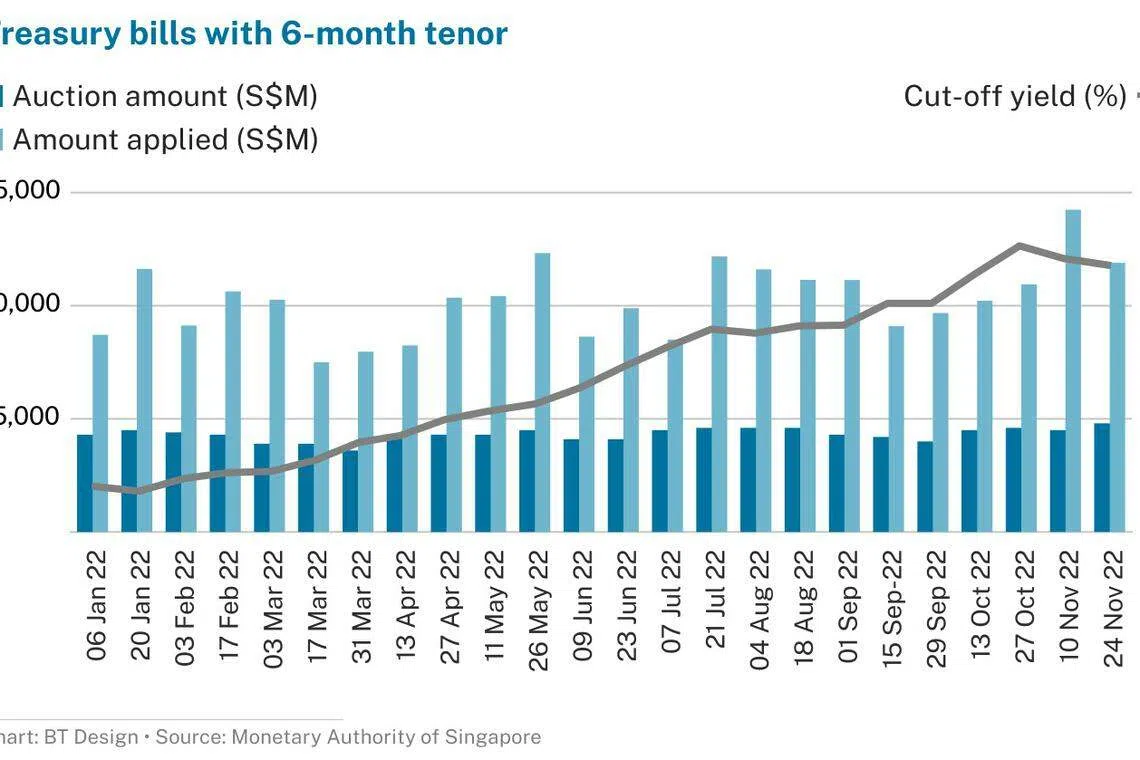
Benny Chan, managing director of group channels and digitalisation at UOB, says customer interest in T-bills picked up significantly in the third quarter of 2022, with subscription amounts estimated about eight times what they were the previous quarter.
Notably, non-competitive applications were not fully allotted on Nov 10 – the first time this year – as the total value of such bids amounted to 80.5 per cent of the issuance size, breaching the 40 per cent limit. Non-competitive bids accounted for 25.4 per cent of the total application in value.
In the Nov 24 auction, the proportion of non-competitive bids fell to 20.5 per cent of total application in value as more put in competitive bids instead.
The lower proportion of non-competitive bids was expected by DBS senior rates strategist Eugene Leow, who pointed out that the shift towards competitive bids could pull down cut-off yields.
The yield for that auction dropped to 3.9 per cent. “This is in line with my expectations as retail demand stays robust,” Leow says.
He expects yields on T-bills to be auctioned in December to edge up to a tad above 4 per cent, close to the levels seen in October. He says: “We still have to contend with a 50 basis point hike in December; and December has seasonality that could lead to higher short-term rates.”
Strategies for investment
Some investors are taking advantage of the current high yields from T-bills to earn higher interest rates for their emergency funds, which need to be liquid.
Dividing a portion of such a fund into 13 parts, an investor could buy T-bills as they are issued, once every two weeks, over a period of six months. Doing so would allow one to receive the face value of a matured T-bill every two weeks.
This strategy could even be combined with the use of Singapore Savings Bonds (SSBs). Investors can place a portion of their emergency funds in SSBs for a higher yield. The funds invested in SSBs can be redeemed easily, but there is a one-month waiting period. Matured T-bills should cover any need for funds in the interim.
Lim Choon Siong, research analyst at wealth advisory group Providend, says six-month T-bills can be a very good instrument to store savings in the short term, especially when yields are now at attractive levels.
As T-bills mature, however, investors may not always be able to reinvest the money at a higher or equivalent yield.
Investors who wish to mitigate reinvestment risk and interest rate risk (prices fall when interest rates rise) can consider applying a bond ladder by holding Singapore Government Securities (SGS) with different maturities. The longer duration SGSs will benefit more from capital gains as interest rates fall. Funds from matured T-bills can then be reinvested in a bond with a higher interest rate, Lim says.
Bidding strategies
As non-competitive applications have not been fully allotted in recent auctions, investors might want to switch to competitive bids.
One way to ensure allotment is to put in a very low competitive bid at 0.01 per cent – the bid will thus be under the cut-off yield, and receive an allotment.
Such low bids, however, may affect the result of the auction and its yield.
Although most auctions have a safeguard mechanism that allows MAS to offset unexpected changes in investor demand, such as when the auction cut-off yield is more than 25 basis points below or above the market yield, this safeguard does not apply to T-bills.
Investor Richard Leow says: “The only benefit if you lowball is you’ll get all you want; but you drag down the returns and sabotage yourself. So, the question is how low is too low?”
Leow had submitted a competitive bid in the Nov 24 auction, but did not get any allotment. He had submitted non-competitive bids in earlier rounds, and received full allotments, but only a partial allotment on Nov 10.
One of his suggested references for competitive bids is the mortgage rate, which is also affected by interest rate movements. “Obviously, investors should not lowball anything lower than their mortgage. Otherwise, they should take the spare cash and do an early repayment of principal.”
Another rate to take into account is the fixed deposit rate, which has risen to around 4 per cent as banks compete for funds from yield-hungry investors.
Those who buy T-bills with money from their Central Provident Fund (CPF) accounts should also ensure a break-even point higher than the 2.5 per cent or 4 per cent interest rates for ordinary account (OA) and special account (SA) savings, respectively, because the CPF Board does not compute interest for the amount withdrawn during the month. Interest is only paid on that amount for the month after a refund is made.
If six-month T-bills are purchased in the first auction of the month, an investor has an opportunity cost of seven months of CPF interest – requiring a yield of 2.92 per cent for OA and 4.67 per cent for SA to break even.
If the bills are purchased at the end of the month, an investor has an opportunity cost of eight months of CPF interest – with the breakeven at 3.33 per cent for using OA and 5.33 per cent for SA.
This is on top of charges by banks for purchases made using OA savings.
Finally, ensure that funds returned to the CPF Investment Account at the bank upon a T-bill’s maturity are transferred back into CPF accounts promptly in order to earn the prevailing interest rate.
Click here for the mechanics of how to buy T-bills.
TRENDING NOW
S$8 billion wiped off OCBC value as shares slide 5.8% in heavy trade

Grab CEO’s wife Chloe Tong on life with Anthony Tan and finding her purpose

Brookfield denies accusation it cut Soilbuild out of Mapletree deal

8 public officers referred to police over property buys near unannounced MRT stations: Chan Chun Sing

